
Average ROI reaches 400%, do you know these three high-yield crypto IDO platforms?

In the cryptocurrency field, IDO (Initial DEX Offering) as a new form of fundraising is becoming a crucial link between project teams and the community. IDO is a token issuance method based on decentralized exchanges. Compared to ICOs (Initial Coin Offerings) and IEOs (Initial Exchange Offerings), its main feature is decentralization and instant liquidity. Project teams issue tokens directly on a DEX through smart contracts, allowing investors to participate without intermediaries, and the tokens become tradable immediately after the transaction. The crypto community has long been dissatisfied with "overvalued, high FDV, low circulation" VC coins, making IDO a popular choice for project teams to attract community support, which has also propelled the emergence of new IDO platforms like Echo, Legion, and Buidlpad. These platforms not only provide funding support to projects but also give ordinary users the opportunity to participate in early-stage investments.
Echo: Elite Recommendations and Community Alliances
Echo was founded by crypto influencer Cobie (@echodotxyz) in March 2024. Cobie, a former Growth Lead at Lido and host of the popular Web3 podcast UpOnly, has interviewed industry core figures like Vitalik Buterin, showcasing significant influence.
The core of Echo lies in the "Lead Investor Recommendation Mechanism": users can act as lead investors to create investment communities, share projects with members, and receive a cut. This model is similar to the crypto investor's "elite alliance," which tends to favor high-potential projects recognized by a select group. Echo's highlight is its community-driven model, where investment is managed through smart contracts to ensure lead investors do not access user funds and allow users to decide when to sell tokens. If lead investors succeed in their investment, they receive a percentage of the co-investors' profits, incentivizing the sharing of quality projects. While its elite orientation keeps its user base relatively niche, this screening mechanism ensures project quality, attracting investors who place a premium on trust. However, Echo's exclusivity also limits its scale and may pose challenges in meeting the needs of a broader retail audience.
Since its launch in April 2024, Echo has invested $100,000 into early-stage startups in less than five months, reaching over 40 investment communities. Notable investment cases include a $300,000 investment in Ethena and a rapid $10 million funding in MegaETH.
Ethena, the first project Echo participated in, allowed transaction participants to buy in at a price when the valuation was $300 million (the most recent private sale valued Ethena at $600 million), minus a 5% royalty fee to the Echo platform.
In the MegaETH funding case, the initial goal of $4.2 million was reached in 56 seconds, ultimately raising $10 million within 3 minutes. Shuyao Kong, co-founder of MegaLabs, stated that the funding round's structure involved a combination of equity and token warrants, similar to MegaLabs' $20 million seed round in June, with both rounds valuing the company at "several billion dollars."
According to Dune Analytics, as of now, a total of 7,739 individual investors have facilitated 244 transactions using Echo, raising over $100 million.

Legion: Reputation-Based Innovative Funding
Legion, incubated by Delphi Labs, is positioned as a reputation-based IDO platform. In August 2024, Legion concluded a $2 million seed funding round led by Cyber Fund.
Legion's major highlight is the introduction of the Legion Scores rating system, which evaluates users' value and capabilities through aggregating on-chain activities (such as trading activity, project involvement) and off-chain data (like social media influence, community contribution). Project teams can allocate investment quotas and discounts based on Legion Scores, aiming to reward truly contributing users rather than merely relying on capital size. Legion does not require users to perform traditional tasks (such as staking or social tasks) but instead relies on the rating system as the primary allocation criterion.
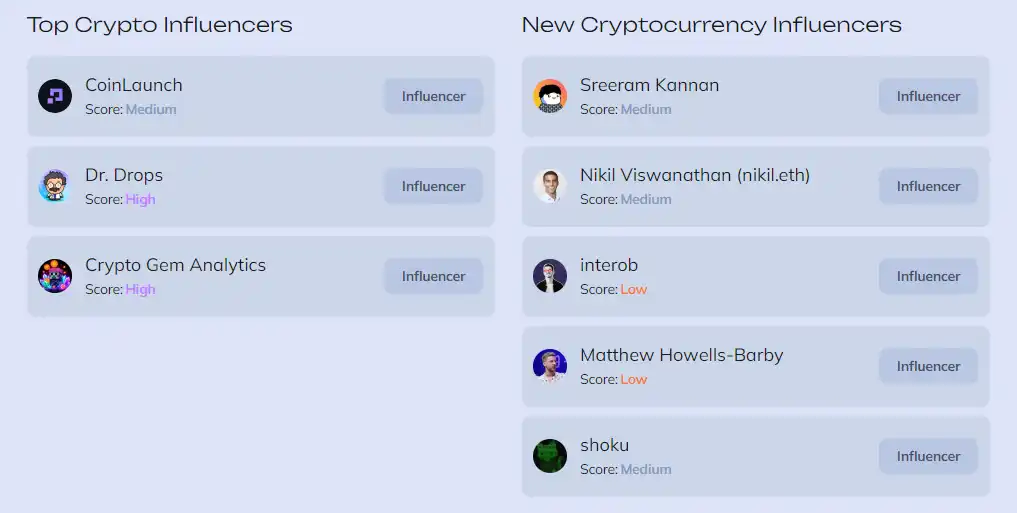
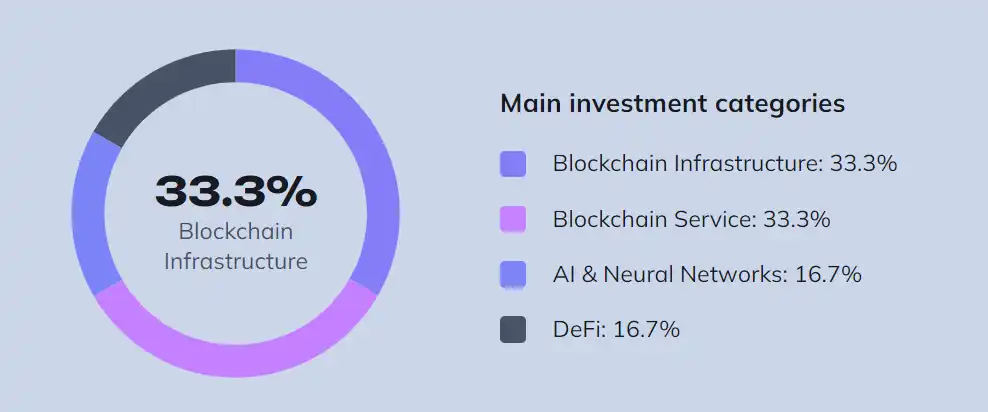
Legion has supported multiple projects in funding, totaling around $3.5 million, with approximately 1/3 of the supported projects being blockchain infrastructure, 1/3 blockchain services, 1/6 AI and neural networks, and the remaining 1/6 DeFi projects. According to CoinLaunch data, recent Legion projects include Fuel Network, Corn Crypto Network, Giza Crypto, Hyperlane, and eOracle, among others. Particularly noteworthy is the performance of Fuel Network, which, after launching on Bitget in December 2024, saw its price reach $0.08 at one point. This successful case significantly boosted Legion's recognition within the community.
Legion's innovation lies in its decentralized, compliant funding model. Its reputation system provides more opportunities for non-accredited investors, breaking the traditional VC-dominated funding landscape. Its vision is to address the shortcomings of the traditional ICO market, such as scams, bot participation, and regulatory pressure, allowing more non-accredited investors to participate in early-stage funding.
Buidlpad: Emphasizing Openness and Compliance
Buidlpad, founded by former Binance executive Erick Zhang, was officially launched in December 2024. Erick was responsible for Binance Research Institute and Launchpad, with a deep understanding of fundraising platform operations. Buidlpad emphasizes both openness and compliance, requiring users to undergo KYC verification and accepting stablecoin payments, thus reducing the barrier to entry. Its inaugural project Solayer (a re-staking protocol in the Solana ecosystem) concluded its public sale on January 18, 2025, aiming to raise $10.5 million but ultimately raised $57.3 million, surpassing expectations by 545.24%. The token LAYER was sold at $0.35, reaching a peak price of $1.2 post-listing, providing a return of over 3x.
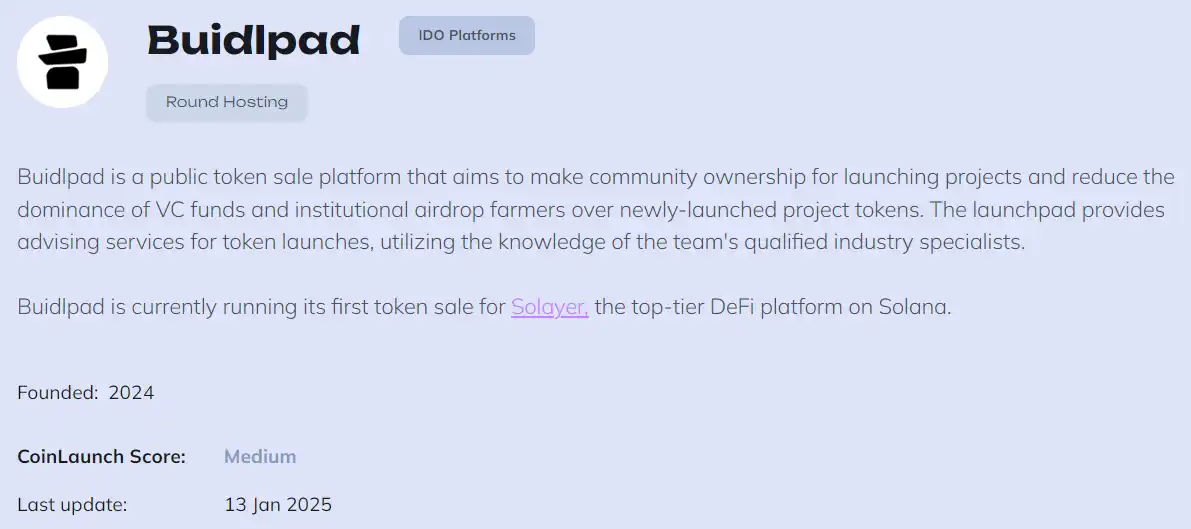
Solayer's successful funding demonstrates Buidlpad's attractiveness to the community, and its ecosystem has established partnerships with major DeFi players like Binance and Bybit. Compared to Echo's elite route and Legion's reputation-oriented approach, Buidlpad resembles a more traditional ICO platform targeting the masses, making it more suitable for projects looking to quickly attract a broad user base. By leveraging KYC and stablecoin payments, the platform ensures compliance and user-friendliness. While the KYC requirement may deter some decentralization purists, its compliance gives it an advantage in regulatory friendliness.
Echo, Legion, and Buidlpad represent different paths in the IDO space: Echo focuses on elite trust, Legion innovates with a reputation mechanism, and Buidlpad pursues open compliance. For investors, choosing a platform with a good reputation and thoroughly researching projects is crucial. For projects, partnering with these platforms requires balancing community interests and compliance requirements. Together, they are driving the decentralization wave of crypto funding, creating a win-win situation for both the community and projects. In the future, with the advancement of blockchain technology and the strengthening of community power, IDOs are poised to play a more significant role in the crypto ecosystem.
You may also like

SpaceX vs Tesla vs xAI: Which Elon Musk Trade Has the Biggest Upside in 2026?

OpenAI Reveals It Has Confidentially Submitted an S-1 to the SEC, Keeping the Door Open for a Future IPO
On June 9, according to an OpenAI announcement, the company recently confidentially submitted a draft S-1 registration statement to the U.S. Securities and Exchange Commission (SEC), beginning the preliminary compliance process for a potential initial public offering. OpenAI said it chose to disclose this proactively because it expected the news might leak; however, the company has not yet set a specific listing timeline, and related arrangements may still take some time.

Latest research from 13 top universities including Cornell University: The current state, challenges, and misconceptions of the fusion of Crypto and AI
Deconstructing Anthropic: The Best AI Company, Possibly Also a Type of Organizational Invention
Apollo and Blackstone Reportedly Back $35 Billion Anthropic Chip Financing as Deal Details Remain Unclear
On June 9, according to currently available news alerts, Apollo and Blackstone Group participated in a $35 billion financing for an Anthropic “chip project.” Based on the original wording of the report, the funding has already been raised, but public information remains limited. The financing structure, use of proceeds, project entity, and whether Apollo and Blackstone participated through equity, debt, or project financing have not yet been disclosed.

Humanity Protocol Security Incident Escalates: More Than $31 Million Stolen From Related Addresses as Attacker Continues Selling H for ETH
On June 9, according to monitoring by Onchain Lens, more than $31 million has been stolen from addresses linked to Humanity Protocol, and the attack is still ongoing, with the hacker continuously swapping H tokens for ETH. Project founder Terence Kwok later confirmed the security incident on X, saying the issue involved a private key leak.

Bloomberg: As Bitcoin Weakens, Stablecoins and RWA Continue to Drive Expansion in Crypto Businesses
In June, Bloomberg reported that despite Bitcoin falling below $60,000 last week, wiping out about $235 billion in market value within seven days, and dropping close to 50% from last year’s peak, some core businesses in the crypto industry are still expanding, mainly in stablecoins, real-world asset tokenization (RWA), payments, and infrastructure. The report also noted that overall altcoin activity has contracted significantly: altcoin market capitalization has fallen from a peak of about $431 billion in November 2021 to around $170 billion, and among the tens of millions of tokens issued in recent years, fewer than 1,700 still maintain meaningful trading activity.

Galaxy Deep Research Report: How Hyperliquid's HIP-4 Upgrade Changes the Landscape of Prediction Markets?
Binance Research: RWA Market Expected to Expand Nearly 6x from Early 2025, with Public Equities and Onchain Payments Heating Up Together
In June, Binance Research said in its monthly market report that the real-world asset (RWA) market is expected to grow by about 589% from the beginning of 2025. Bond- and money market fund-related RWA expanded by about $6.5 billion, up 83% year over year, while publicly traded equity RWAs grew by about 422%. The report also noted that monthly crypto debit card transaction volume exceeded $747 million in May, up 48.6% year to date.

Japan to Assess a Framework for Yen Stablecoins and Crypto ETFs as Asia’s Compliant Payments Narrative Heats Up
Recently, according to the original report, Japan is considering the launch of yen stablecoins and cryptocurrency ETFs. Public information remains limited at this stage, and there is still no complete policy text, regulatory draft, or clear implementation timeline, so this is better characterized as a “policy discussion” rather than formal implementation. The original wording also noted that advancing stablecoin regulation in Asia is driving XRP usage and supporting growth in the XRPL ecosystem. However, based on currently available public information, there is not enough evidence to directly establish a clear causal relationship between this round of discussion in Japan and XRP or XRPL.

ZachXBT: Humanity private key leak and abnormal surge in H token should be viewed separately
On June 9, according to related disclosures, on-chain investigator ZachXBT posted an update on Humanity’s roughly $31 million security incident, saying that after further analyzing fund flows, he currently tends to believe the project team was not involved in an “inside job” or a self-staged attack. According to him, the official explanation about the private key leak was broadly accurate, but before the token unlock, the price of H had been artificially pushed higher, and the hacker later took advantage of that market environment; therefore, the private key leak and the earlier abnormal price pumping should be regarded as two separate and independent events. This reframing has shifted the market’s understanding of the nature of the incident. Earlier discussion around Humanity had focused on whether the team directly participated in the attack or used the security incident to cover up internal operations. ZachXBT’s latest remarks shift the focus from “whether it was self-theft” to “whether there were pre-unlock market structure issues.” He also questioned whether the team may have.

Morning Report | OpenAI has submitted an S-1 registration statement draft to the U.S. SEC; Morpho completes $175 million financing

Morning Report | BitMine increased its holdings by 126,971 ETH last week; trader Eugene announced his exit from the crypto market

Wang Chuan: How can one not feel anxious after the neighbor Old Wang made thirty times profit by investing in storage stocks? (Seven) - A quarter-century cycle
Cryptocurrency CEXs are flocking to sell US stocks, and traditional brokerages are facing an "uninvited guest."
$75 billion in foreign capital has fled, and South Korean retail investors have absorbed it all using leverage

Japan’s Three Megabanks Plan Joint Stablecoin Issuance in Fiscal 2026
MUFG, SMBC, and Mizuho reportedly plan to jointly issue fiat-pegged stablecoins in fiscal 2026, signaling Japan’s growing push into bank-led digital payment infrastructure.

Humanity Discloses H Token Dual-Chain Attack Details, With Losses on Ethereum and BSC Exceeding $36 Million
Humanity said the H token attack across Ethereum and BSC caused more than $36 million in losses after leaked ProxyAdmin keys enabled malicious contract upgrades and token minting.
SpaceX vs Tesla vs xAI: Which Elon Musk Trade Has the Biggest Upside in 2026?
OpenAI Reveals It Has Confidentially Submitted an S-1 to the SEC, Keeping the Door Open for a Future IPO
On June 9, according to an OpenAI announcement, the company recently confidentially submitted a draft S-1 registration statement to the U.S. Securities and Exchange Commission (SEC), beginning the preliminary compliance process for a potential initial public offering. OpenAI said it chose to disclose this proactively because it expected the news might leak; however, the company has not yet set a specific listing timeline, and related arrangements may still take some time.
Latest research from 13 top universities including Cornell University: The current state, challenges, and misconceptions of the fusion of Crypto and AI
Deconstructing Anthropic: The Best AI Company, Possibly Also a Type of Organizational Invention
Apollo and Blackstone Reportedly Back $35 Billion Anthropic Chip Financing as Deal Details Remain Unclear
On June 9, according to currently available news alerts, Apollo and Blackstone Group participated in a $35 billion financing for an Anthropic “chip project.” Based on the original wording of the report, the funding has already been raised, but public information remains limited. The financing structure, use of proceeds, project entity, and whether Apollo and Blackstone participated through equity, debt, or project financing have not yet been disclosed.
Humanity Protocol Security Incident Escalates: More Than $31 Million Stolen From Related Addresses as Attacker Continues Selling H for ETH
On June 9, according to monitoring by Onchain Lens, more than $31 million has been stolen from addresses linked to Humanity Protocol, and the attack is still ongoing, with the hacker continuously swapping H tokens for ETH. Project founder Terence Kwok later confirmed the security incident on X, saying the issue involved a private key leak.


