
Don't panic, the market's true main line is still liquidity


Original Author: @RaoulGMI
Translation: Peggy, BlockBeats
Editor's Note: When the market is in panic, liquidity tightens, and asset rotation stagnates, a bullish view often seems out of place. This article presents a contrarian perspective: if global liquidity remains the key macro variable driving everything, then the restart of the debt refinancing cycle may trigger the next round of a "liquidity flood." This is a game of time and patience—a starting point for growth may emerge after the "pain."
The following is the original text:
The Market's Main Plot
I know almost no one wants to hear a bullish view right now.
The market is in panic, and everyone is blaming each other. But the road to Valhalla is not far.
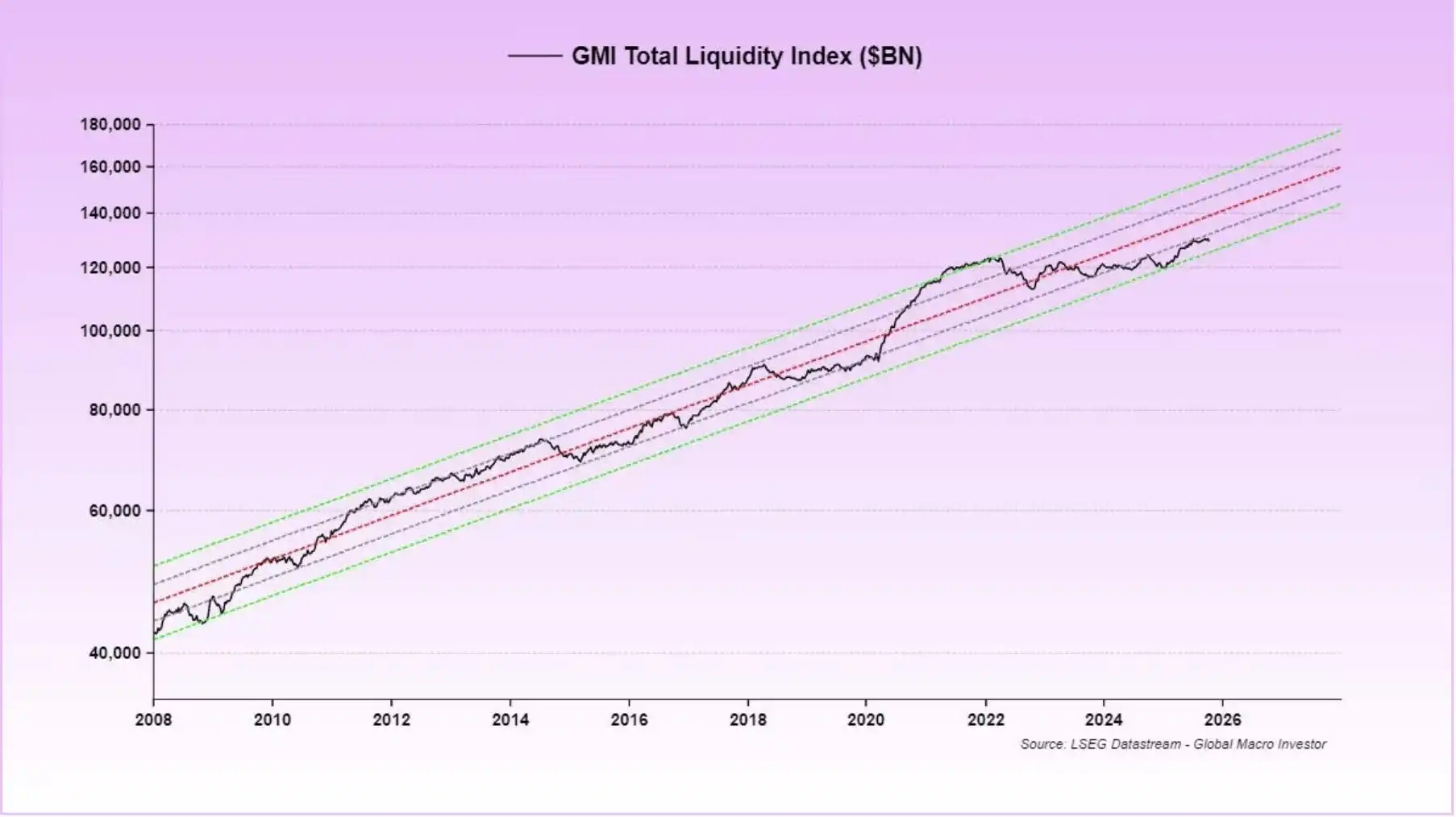
If global liquidity is the most decisive macro factor right now, then it is the only thing we should focus on.
Remember! The true main plot of the market now is the $100 trillion debt rollover. Everything else is a subplot. The game for the next 12 months revolves around this point.
Currently, due to the government shutdown, the Treasury General Account (TGA) is rapidly accumulating cash with nowhere to spend it, causing a sharp liquidity squeeze. This cannot be offset by reverse repos (as that portion of liquidity has already dried up), and quantitative tightening (QT) is further draining liquidity.
This has directly hit the market, especially the most liquidity-sensitive crypto assets.
The performance of traditional asset management institutions this year is generally lagging behind benchmarks, marking the worst performance in recent years. Now they have to passively "buy the dip," which paradoxically makes tech stocks more stable than crypto assets. Inflows from 401K funds have also provided some support.
However, if this liquidity dry-up persists longer, the stock market will also find it hard to escape a downturn.
However, once the government shutdown ends, the U.S. Treasury will disburse $250-350 billion within a few months, and quantitative tightening will stop, nominally expanding the balance sheet again.
With the return of liquidity, the dollar may weaken again.
The tariff negotiations will also come to an end, gradually reducing policy uncertainty.
At the same time, the continuous issuance of treasuries will inject more liquidity into the market through banks, money market funds, and even the stablecoin system.
Next, the interest rate will continue to be lowered. The economic slowdown caused by the shutdown will be used as a reason for the rate cut—but this does not mean an economic recession.
On the regulatory front, the SLR (Supplementary Leverage Ratio) adjustment will release more bank balance sheet space, supporting credit expansion.
The "CLARITY Act" is also expected to pass, providing a much-needed regulatory framework for banks, asset management firms, and businesses to adopt encrypted assets on a large scale.
Meanwhile, the "Big Beautiful Bill" will further boost the economy, setting the stage for strong growth leading up to the 2026 midterm elections.
The entire system is restructuring towards one goal: a robust economy and thriving market in 2026.
Meanwhile, China will continue to expand its balance sheet, Japan will work to support the yen and introduce fiscal stimulus.
With interest rates falling and tariff uncertainty dissipating, U.S. manufacturing activity (ISM index) will also rebound.
So, the key now is to weather this "Window of Pain."
At the other end of it is a "Liquidity Flood."
Always remember that old rule: Don't mess it up.
Be patient, endure the volatility.
Such pullbacks are not uncommon in a bull market, and their purpose is to test your conviction.
If you have the capacity, take advantage of the dip.
TD;DR (Too Delighted; Didn't Rejoice)
When this number (liquidity index) rises, all other numbers will rise with it.
You may also like

Morning Report | CoinEx becomes a key hub for Iran to evade sanctions, involving over $3.8 billion in funds; Kalshi seeks a new round of financing, with a valuation potentially rising to $40 billion

From the white-haired stock god to the billionaire fund mogul, the smart people shorting Nvidia are all getting rich using the same framework

Why do cryptocurrency projects always like to change their names?

Global Launch: As predictions become the most scarce asset in the AI era, Manadia is defining the next generation of the value internet

Who is footing the bill for the $64 billion accounting frenzy?
I never expected that the first application of AI x Crypto would be in security auditing

What is your view on Binance's competitive advantages?

ETH has entered a non-consensus phase, and the turning point is approaching!
The shift in the cloud of the air: from despising stablecoins a year ago to the high-profile entry of capital today
The survival dilemma of small and medium exchanges behind the withdrawal anomalies exposed by AscendEX

Why Is Bitcoin Falling Below $60K? 5 Key Market Drivers Explained
Bitcoin has dropped sharply amid ETF outflows, Strategy stock weakness, AI stock rallies, and changing Fed expectations. Explore the key forces driving BTC’s latest correction and what traders should watch next.

Bitcoin vs. Gold in 2026: Which Asset Performs Better in Different Markets?

Morning News | The draft amendment to the People's Bank of China Law aims to clarify the legal status of digital renminbi; South Korea will transfer about 40 unregistered virtual asset service providers to law enforcement agencies
The cryptocurrency industry has entered the "Show Me" era: merely relying on vision is no longer enough

Interpreting the Ethereum Foundation's new structure: Reaffirming self-sovereignty amid institutional trends
Former SpaceX engineer reconstructs the financial execution system using first principles
Standard Chartered Bank sings a 50x rhapsody again, aiming for AAVE to reach 3500 USD

Tidal Investment: We still have a positive outlook on the AI industry chain, but the reasons have changed
Morning Report | CoinEx becomes a key hub for Iran to evade sanctions, involving over $3.8 billion in funds; Kalshi seeks a new round of financing, with a valuation potentially rising to $40 billion
From the white-haired stock god to the billionaire fund mogul, the smart people shorting Nvidia are all getting rich using the same framework
Why do cryptocurrency projects always like to change their names?
Global Launch: As predictions become the most scarce asset in the AI era, Manadia is defining the next generation of the value internet
Who is footing the bill for the $64 billion accounting frenzy?
I never expected that the first application of AI x Crypto would be in security auditing


