
Farewell to "Air" Investments: Use These 6 Key Metrics to Identify a Winning Project

Original Article Title: How to Evaluate Crypto with DeFi Metrics
Original Article Author: Patrick Scott, Dynamo DeFi
Original Article Translation: Deep Tide TechFlow
In the past, cryptocurrency analysis has mostly revolved around charts, hype cycles, and narratives. However, as the industry matures, actual performance becomes more important than empty promises. You need a filter to help you distill truly valuable signals from the noise of information.
Fortunately, this filter already exists, and it is called Onchain Fundamentals.
Onchain Fundamentals provide DeFi (Decentralized Finance) with structural advantages over Traditional Finance (TradFi). This is not only one of the many reasons why "DeFi will win," but also a core concept that everyone looking to invest in this industry must understand.
Over the past four years, I have been immersed in DeFi data metrics research, initially as a researcher and later joining the DefiLlama team. This article summarizes some of the most useful analysis frameworks I have learned during this time, hoping to help you start using these tools.
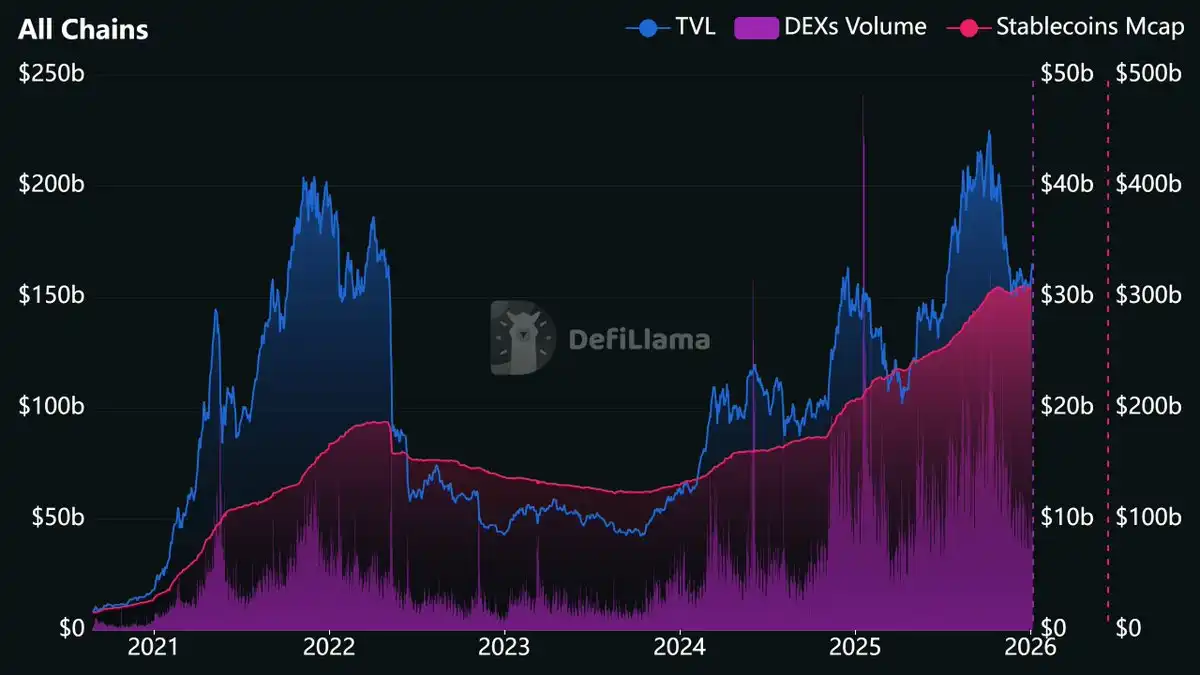
Source: https://defillama.com/?stablecoinsMcap=true&dexsVolume=true
Why Are DeFi Metrics Important?
Onchain data is not just a breakthrough in evaluating cryptocurrency assets but also a revolution in the entire financial data field.
Think about how traditional investors evaluate a company: they need to wait for quarterly earnings reports to be released. And now, there are even suggestions to change the frequency of financial report releases from quarterly to semi-annually.
In contrast, the financial data of DeFi protocols is available in real-time. Websites like DefiLlama update relevant data every day or even every hour. If you want to track revenue by the minute, you can even directly query blockchain data to do so (although overly granular data may not be meaningful, but you do have that option).
This is undoubtedly a revolutionary breakthrough in transparency. When you buy stock in a publicly traded company, you rely on financial data released by management after being audited by accountants, which often has delays of weeks or even months. But when you evaluate a DeFi protocol, you are reading transaction records happening in real-time on an immutable ledger.
Of course, not every crypto project has fundamental data worth tracking. For example, many "Memecoins" or "air projects" with just a whitepaper and a Telegram group may not benefit much from fundamental analysis (although other metrics like the number of holders may provide some reference).
However, for protocols that generate fees, accrue deposits, and distribute value to token holders, their operations leave behind data traces that can be tracked and analyzed, often preceding the formation of market narratives.
For example, Polymarket's liquidity has been growing for years, a trend that started well before prediction markets became a hot topic.
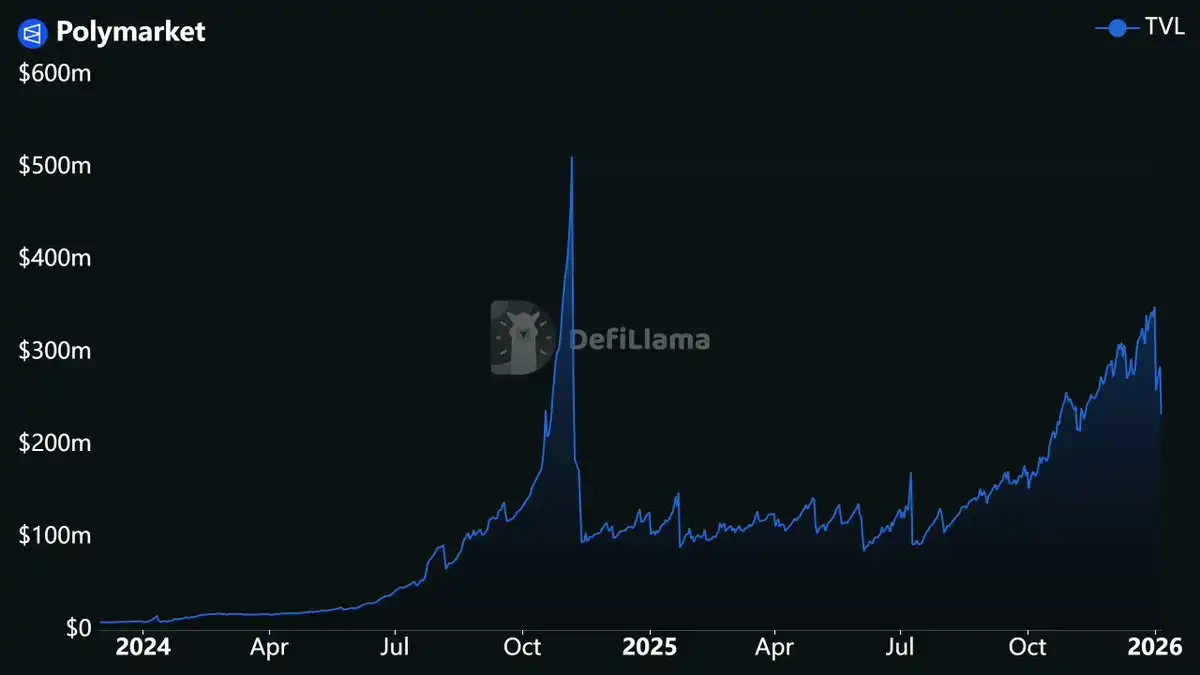
Source: https://defillama.com/protocol/polymarket
The price surge of HYPE token last summer was driven by its consistent high revenue performance.
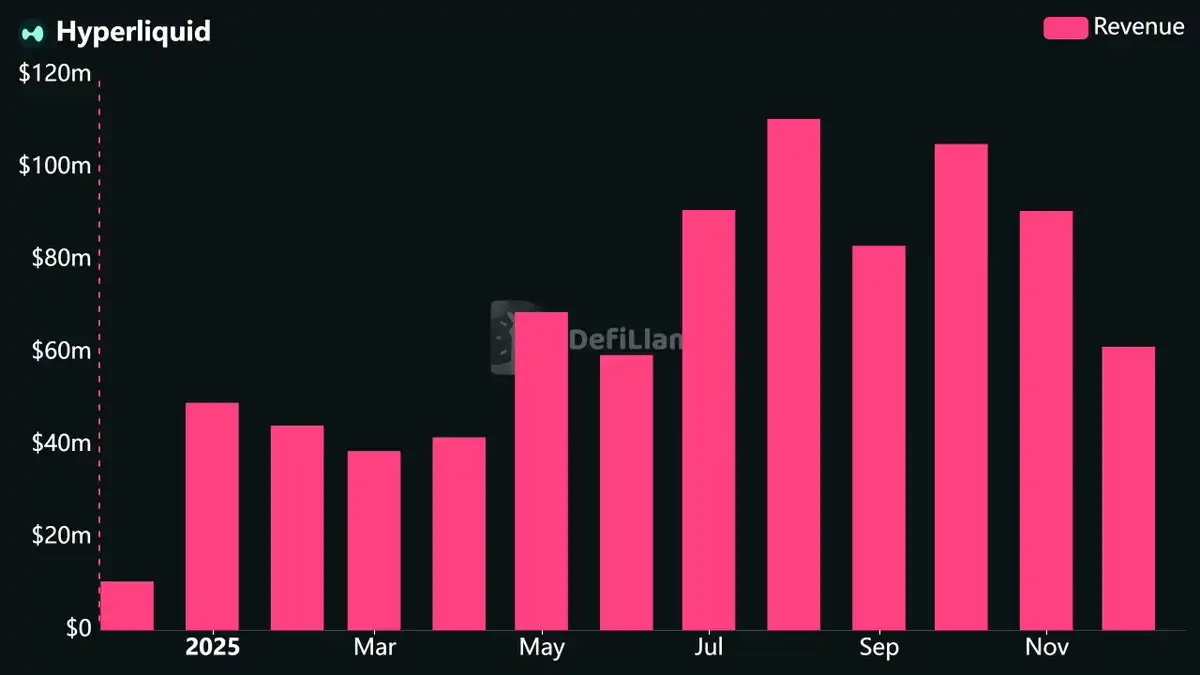
Source: https://defillama.com/protocol/hyperliquid?tvl=false&revenue=true&fees=false&groupBy=monthly
These metrics had already hinted at future trends; you just need to know where to look.
Core Metrics Deep Dive
Let's start with the core metrics you need to know for DeFi investing.
TVL (Total Value Locked)
TVL measures the total value of assets deposited in a protocol's smart contracts.
· For lending platforms, TVL includes collateral and supplied assets.
· For decentralized exchanges (DEXs), TVL refers to the deposits in liquidity pools.
· For blockchain networks, TVL is the total value locked across all protocols deployed on that network.
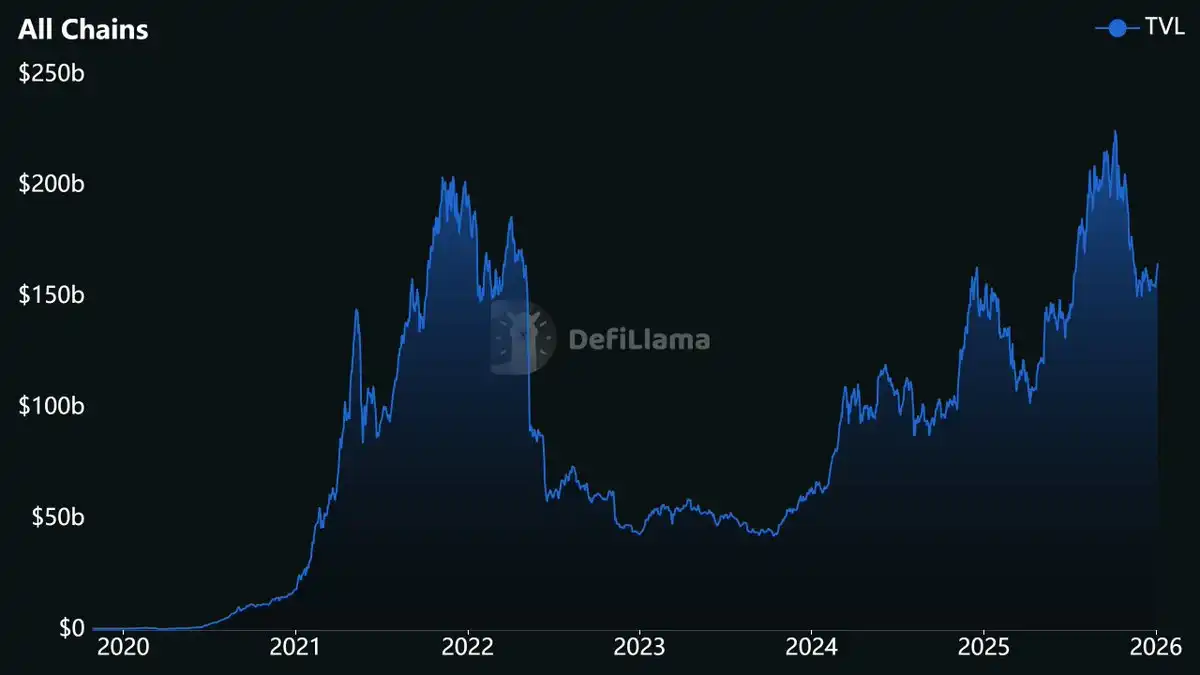
Source: https://defillama.com/
In traditional finance (TradFi), TVL is similar to Assets Under Management (AUM). Hedge funds report their AUM to show the total amount of client funds entrusted to them. Similarly, TVL reflects the total amount of funds deposited into a protocol, indicating the level of trust users have in the protocol's smart contract.
However, over the years, TVL has also faced significant criticism, some of which is valid.
· TVL Does Not Measure Activity Level. A protocol may have billions of dollars in deposits but generate very little yield.
· TVL Is Highly Correlated with Token Prices. If the price of ETH drops by 30%, the TVL of all protocols holding ETH will also drop proportionally, even if no actual withdrawals occur.
Since most DeFi deposits are in volatile tokens, TVL is easily impacted by price fluctuations. Therefore, savvy observers combine USD Inflows with TVL to differentiate price changes from actual deposit activity. USD Inflows are calculated by measuring the balance changes of each asset between two consecutive days (multiplied by the price) and aggregating them. For example, a protocol with 100% of its funds locked in ETH will see a 20% TVL decrease if ETH's price drops by 20%, but the USD Inflows will be $0.
Nevertheless, when TVL is presented in both dollar and token terms and used in conjunction with activity or productivity metrics, it remains valuable. TVL is still a crucial tool for measuring protocol trust and the overall DeFi scale. Just don't mistake it for a complete evaluation standard.
Fees, Revenue, and Holder Income
In DeFi, the definitions of these terms differ from traditional accounting, which can be confusing.
· Fees: From a user's perspective, fees refer to the costs you pay when using a protocol. For example, when you trade on a DEX, you need to pay a transaction fee. This fee may go entirely to liquidity providers or partially to the protocol. Fees represent the total amount users pay, regardless of the ultimate destination. In traditional finance, this is akin to Gross Revenue.
· Revenue: Revenue refers to the protocol's share of earnings. In other words, out of all the fees paid by users, how much did the protocol actually retain? This revenue may flow to the protocol's treasury, team, or token holders. Revenue does not include fees allocated to liquidity providers, which can be seen as the protocol's Gross Income.
· Holders Revenue: This is a more narrow definition, only tracking the portion of revenue that is distributed to token holders through buybacks, burn fees, or direct staking rewards. In traditional finance, this is similar to a combination of dividends and stock buybacks.
These distinctions are crucial in valuation. Some protocols may generate significant fees, but because almost all fees are allocated to liquidity providers, the final revenue is meager.
DefiLlama has now released comprehensive revenue reports for many protocols. These reports are based on on-chain data and automatically updated, breaking down revenue into different streams and redefining these metrics in standard accounting terms.
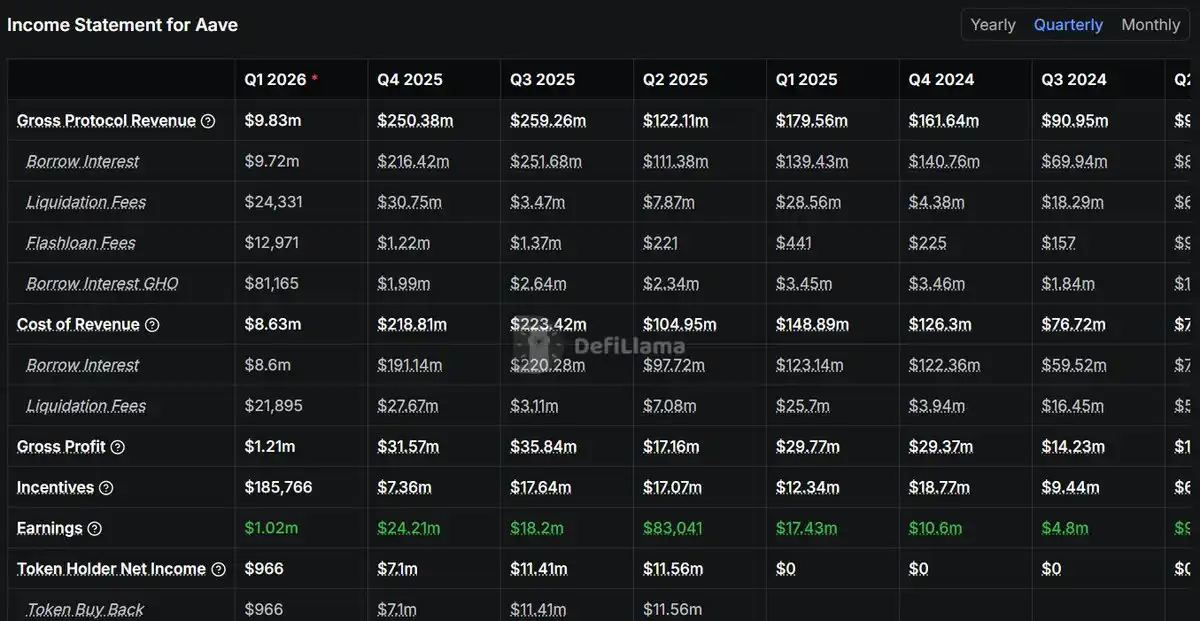
Source: https://defillama.com/protocol/aave
These revenue reports also come with flowcharts visualizing fund flows, showing funds flowing from users into the protocol and then distributed to various stakeholders throughout the process. If you want to delve deeper into the economic model of a specific project, this information is well worth exploring.
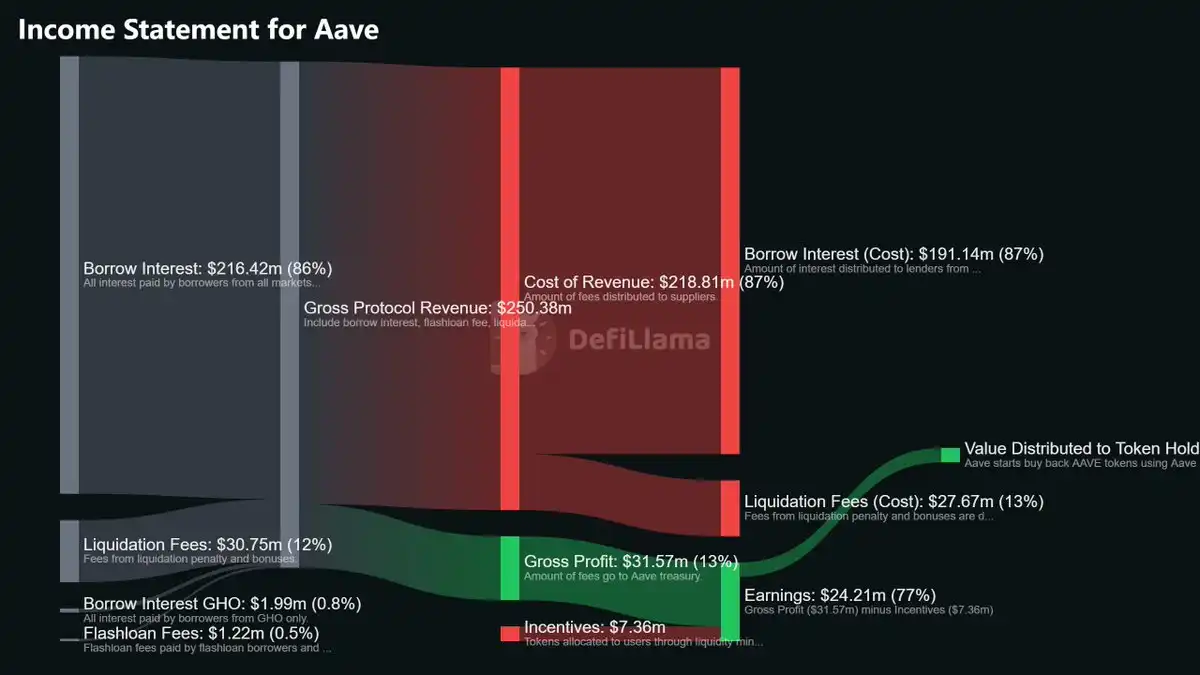
Source: https://defillama.com/protocol/aave
Volume
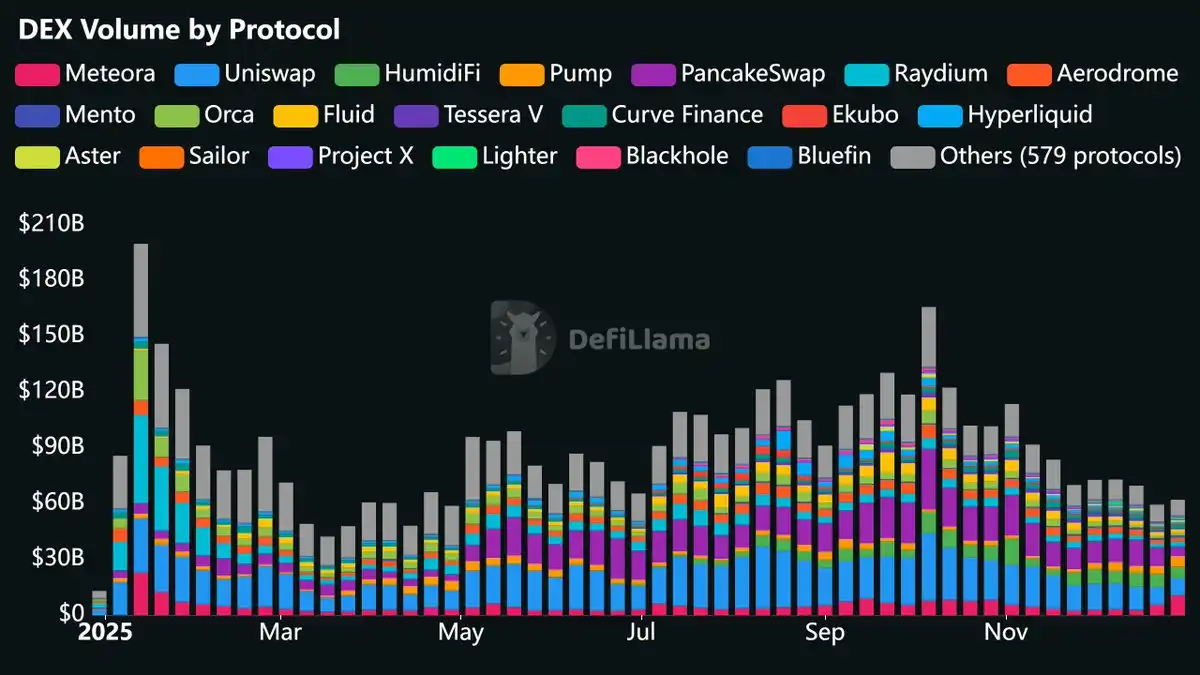
Volume is used to track the scale of trading activity.
· DEX Volume: Tracks all swaps on decentralized exchanges (DEX).
· Perp Volume: Totals the trading volume on all perpetual contract trading platforms.
Source: https://defillama.com/pro/97i44ip1zko4f8h
Trading volume is a key metric for measuring overall crypto market participation. When people actively use digital assets, they engage in transactions. Surges in trading volume are typically correlated with shifts in market interest, whether due to bullish enthusiasm or panic selling.
Compared to previous cycles, perpetual futures contract trading volume has seen significant growth. In 2021, the presence of perpetual futures trading platforms was still quite limited. Today, platforms like Hyperliquid, Aster, and Lighter see daily volumes in the billions of dollars. Due to the rapid expansion in this space, comparing to historical data provides limited insights. For instance, comparing current perpetual contract volumes to 2021 can only illustrate the sector's expansion rather than offer more valuable information.
Within a specific category, changes in market share trend are more important than absolute trading volume. For example, if a perpetual contract DEX's market share grows from 5% to 15%, it indicates an improved market position even if its absolute trading volume decreases. DefiLlama's custom dashboard library offers many market share charts worth exploring.
Open Interest
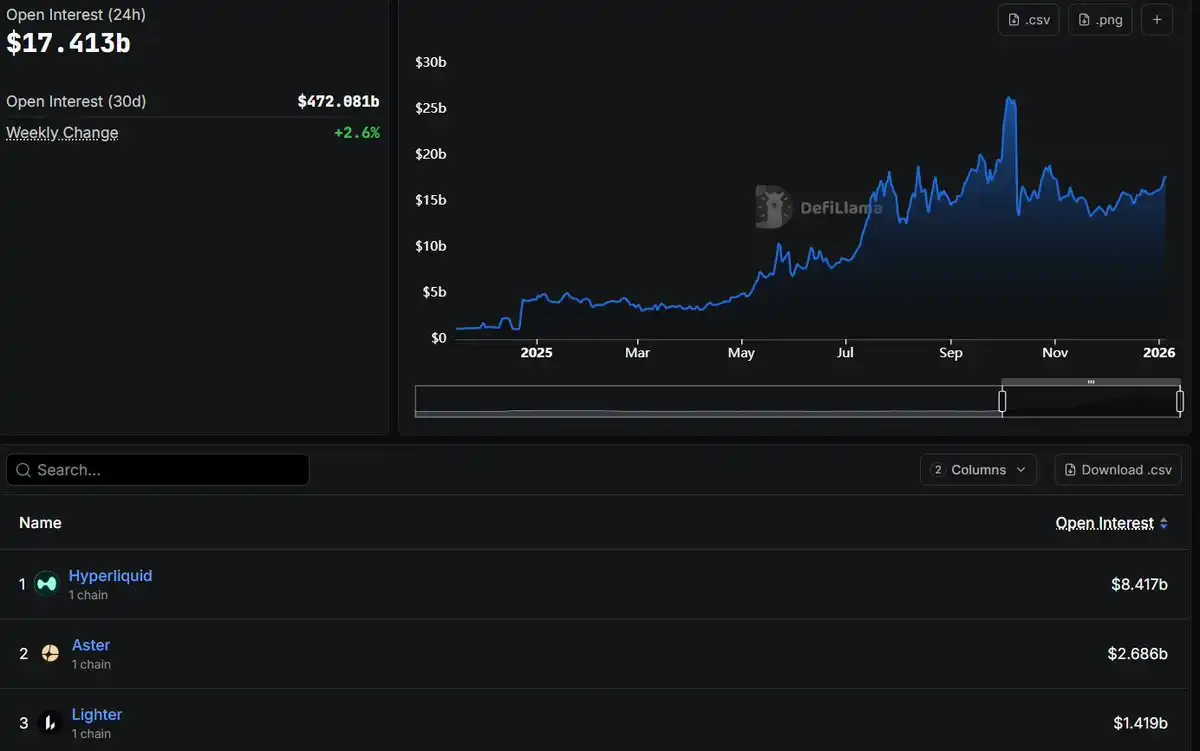
Open Interest refers to the total value of derivative contracts that are outstanding or have not been liquidated. For a perpetual contract DEX, Open Interest represents all positions that have not yet been closed or settled.
Source: https://defillama.com/open-interest
Open Interest is a critical metric for measuring liquidity on derivative platforms. It reflects the total capital deployed in active perpetual contract positions.
During market turbulence, this metric can experience rapid breakdowns. A large-scale liquidation event can wipe out Open Interest within hours. By tracking the recovery post such events, one can observe whether a platform can reattract liquidity or if funds have permanently moved to other platforms.
Stablecoin Market Cap
For a blockchain network, the stablecoin market cap refers to the total value of all stablecoins deployed on that network.

Source: https://defillama.com/stablecoins/chains
The stablecoin market cap is a key metric for measuring capital inflows. Unlike TVL, which is affected by token price fluctuations, stablecoins represent dollars (or dollar-equivalents) truly injected into the chain via cross-chain bridges. For example, when the stablecoin market cap on a chain grows from $30 billion to $80 billion, it means that $50 billion of real capital has flowed into that ecosystem.
Since October 2023, approximately $180 billion has flowed into the crypto market in the form of stablecoins. Some of it inevitably entered DeFi, driving TVL growth, increased trading volumes, and fee generation. Stablecoin liquidity resembles capital inflows in a country's economy, where an increase in stablecoin supply signifies new capital entering, while a decrease indicates capital outflows.
App Revenue & App Fees
App revenue and app fees are chain-level metrics that track the revenue and fees generated by all applications deployed on that chain, excluding stablecoins, liquidity staking protocols, and gas fees.
I see this as the blockchain's "GDP," showcasing the actual economic activity within that ecosystem.
Revenue is one of the hardest-to-fake data points as it requires users to genuinely spend funds. This makes it a high-signal indicator for assessing DeFi ecosystem activity levels.
It's important to note that you cannot value based on app revenue since valuing based on revenue unrelated to assets doesn't make sense. App revenue and app fees are better suited for diagnosing whether a chain is growing rather than evaluating its worth.
How to Effectively Interpret These Metrics?
Understanding individual metrics is the first step, but to effectively utilize them, you need an analysis framework. I prefer to use the following three-step analytical approach:
1. Prioritize Sustainable, Stable Growth.
2. Track Both Stock and Flow Metrics Simultaneously.
3. Consider the Impact of Token Unlocking and Incentive Mechanisms.
1. Prioritize Sustainable, Stable Growth
Protocols that experience a brief spike in revenue on their charts followed by a rapid collapse cannot demonstrate sustainable value creation. I have seen numerous protocols achieve a revenue peak in a week only to disappear a month later.
What truly matters is stable growth over a longer period. For example, if a protocol's monthly revenue gradually grows from $500,000 to $2 million over six months, it indicates sustainable growth. On the other hand, if a protocol's revenue suddenly spikes to $5 million in a week but then quickly drops to $300,000, it might just be a short-lived anomaly.
In the crypto industry, time moves much faster than in traditional markets. Here, sustaining growth for a month is roughly equivalent to a quarter in traditional markets. If a protocol's revenue continues to grow over six months, you can consider it akin to a company that has seen revenue growth for six consecutive quarters. This kind of performance is noteworthy.
2. Track Both Stock and Flow Metrics Simultaneously
· Stock Metrics: Such as TVL (Total Value Locked), Open Interest, Stablecoin Market Cap, Treasury Balance, etc., tell you how much capital is deposited in the protocol.
· Flow Metrics: Such as Fees, Revenue, Volume, etc., tell you the actual activity level in the protocol.
Both are equally important.
Activity levels are easier to manipulate. For example, a protocol can artificially inflate its transaction volume through incentives or wash trading, and these temporary spikes are not uncommon. Genuine liquidity, however, is hard to fake. To have users truly deposit funds and stay long term, a protocol needs to have real utility or offer attractive returns.
When evaluating any protocol, analyze at least one stock metric and one flow metric. For example:
· For a Perpetual Contract DEX, you can choose Open Interest and Volume.
· For a Lending Protocol, you can choose TVL and Fees.
· For blockchain, you can choose stablecoin market cap and application revenue.
If both of these metrics show growth, it indicates that the protocol is indeed expanding. If only the activity metric is growing while liquidity remains stagnant, further analysis is needed, as there may be manipulation. If only liquidity is increasing while activity remains stagnant, it may indicate that deposits are mainly coming from a few "whales."
3. Consider Token Unlocking and Incentives
Token unlocking creates selling pressure. A portion of the vested tokens released by the protocol weekly will always be sold. If there is no other source of demand to offset this sell-off, the token price will drop.
Before investing, please check the token's unlocking schedule. A protocol with a circulating supply already at 90% has little future dilution pressure. On the other hand, a protocol with only 20% circulating supply and facing a large unlocking in three months has a completely different investment risk.
Likewise, for high-revenue protocols, if the token incentives issued exceed the revenue earned from users, the high revenue data may not look as impressive. DefiLlama tracks this through the "Earnings" metric, which deducts the incentive cost from revenue. For example, a protocol may generate $10 million in revenue annually but issue $15 million in token rewards.
While incentive measures are an effective strategy for driving early protocol growth and are usually necessary in the early stages of a protocol's life cycle, they do create selling pressure that needs to be offset by other demand.
You may also like

ZachXBT: Humanity private key leak and abnormal surge in H token should be viewed separately
On June 9, according to related disclosures, on-chain investigator ZachXBT posted an update on Humanity’s roughly $31 million security incident, saying that after further analyzing fund flows, he currently tends to believe the project team was not involved in an “inside job” or a self-staged attack. According to him, the official explanation about the private key leak was broadly accurate, but before the token unlock, the price of H had been artificially pushed higher, and the hacker later took advantage of that market environment; therefore, the private key leak and the earlier abnormal price pumping should be regarded as two separate and independent events. This reframing has shifted the market’s understanding of the nature of the incident. Earlier discussion around Humanity had focused on whether the team directly participated in the attack or used the security incident to cover up internal operations. ZachXBT’s latest remarks shift the focus from “whether it was self-theft” to “whether there were pre-unlock market structure issues.” He also questioned whether the team may have.

Morning Report | OpenAI has submitted an S-1 registration statement draft to the U.S. SEC; Morpho completes $175 million financing

Morning Report | BitMine increased its holdings by 126,971 ETH last week; trader Eugene announced his exit from the crypto market

Wang Chuan: How can one not feel anxious after the neighbor Old Wang made thirty times profit by investing in storage stocks? (Seven) - A quarter-century cycle

Cryptocurrency CEXs are flocking to sell US stocks, and traditional brokerages are facing an "uninvited guest."

$75 billion in foreign capital has fled, and South Korean retail investors have absorbed it all using leverage

Japan’s Three Megabanks Plan Joint Stablecoin Issuance in Fiscal 2026
MUFG, SMBC, and Mizuho reportedly plan to jointly issue fiat-pegged stablecoins in fiscal 2026, signaling Japan’s growing push into bank-led digital payment infrastructure.

Humanity Discloses H Token Dual-Chain Attack Details, With Losses on Ethereum and BSC Exceeding $36 Million
Humanity said the H token attack across Ethereum and BSC caused more than $36 million in losses after leaked ProxyAdmin keys enabled malicious contract upgrades and token minting.
White House Discusses CLARITY Act With Law Enforcement Ahead of Senate Vote
The White House discussed the CLARITY Act with law enforcement ahead of a Senate vote, focusing on illicit finance risks and developer protections.

Bitcoin Trading Guide 2026: Strategies for Experienced Traders

What Is XAUT and PAXG? Why Tokenized Gold Is Booming in 2026

Will the SpaceX IPO Hurt Bitcoin? Here's What Traders Are Watching

Foreign selling in the South Korean stock market accelerates, with cumulative net sales reportedly reaching $75 billion this year
On June 9, The Kobeissi Letter, citing Goldman Sachs data, reported that global investors are selling South Korean stocks at an unusually rapid pace. In the latest trading session, foreign investors sold about $801 million worth of Kospi constituent stocks again; total foreign outflows last week reached about $10 billion, and the market has been in net foreign selling on nearly every trading day over the past month. According to the data cited in the report, foreign investors have sold about $75 billion worth of South Korean stocks so far this year. Meanwhile, South Korean retail and institutional investors together recorded roughly $69 billion in net buying over the same period, suggesting that the market’s main buying support has come from domestic capital rather than returning overseas funds. The information currently disclosed still mainly comes from The Kobeissi Letter’s retelling and Goldman Sachs data summaries, while public details on the statistical period and the specific definition of “selling” remain relatively limited.

Fortune Warns of Strategy’s Financing Structure Risks as Bitcoin Premium Narrows
Fortune warned that Strategy’s Bitcoin treasury model faces growing financing risks as MSTR’s net asset premium narrows and preferred stock dividend pressure increases.

Ferrari Challenge Le Mans: Carl Moon to Dominate in WEEX Livery

Sahara AI Responds to SAHARA’s Sharp Drop: No Contract or Product Security Issues Found, Internal Investigation Underway
Sahara AI responded to SAHARA’s 60% price drop, saying no token contract or product security issues have been found and an internal investigation is underway.

WEEX Deposit/Withdrawal Dynamic Island: Your Asset Status, Always in Sight
Scaling Crypto Derivatives: The Digital Asset Infrastructure Behind High-Volume Trading
In the fast-moving digital asset ecosystem, derivatives platforms face an extreme architectural test. High-leverage futures markets demand more than just standard security—they require absolute operational precision, zero-latency matching engines, and ironclad structural scalability, all while navigating intense market volatility.
As global platforms scale to meet these demands, the industry is shifting away from rigid, monolithic setups toward a more agile, "decoupled" infrastructure philosophy.
The Blueprint for High-Volume Copy TradingFor elite global exchanges like WEEX (founded in 2018), this architectural choice becomes critical when scaling high-volume retail features like social copy trading. When thousands of users automatically mirror the real-time strategies of elite traders simultaneously, it triggers sudden, monumental spikes in concurrent transactional volume.
To prevent execution latency or settlement bottlenecks during these peak volatility events, a platform's primary engine must remain entirely dedicated to risk management, copy-trade synchronization, and order matching.
The Architectural Rule: New-generation platforms must separate front-end user execution engines from heavy backend infrastructural overhead to eliminate operational friction.
By separating these layers, platforms can maintain complete sovereignty over their trading environments and user experiences while strategically aligning with institutional-grade infrastructure ecosystems. This strategic framework allows modern exchanges to leverage advanced Digital Asset Custody infrastructure such as Cobo’s behind the scenes, ensuring that backend wallet management scales elastically alongside trading spikes.
Capitalizing on Market Momentum and 400× LeverageIn a derivatives arena where platforms offer up to 400× leverage on perpetual contracts, capital efficiency and market agility are core business metrics. To capture market momentum, an exchange needs the ability to rapidly expand its asset offerings, supporting everything from legacy crypto assets to sudden, trending altcoins across a massive library of trading pairs.
Adopting a flexible, scalable Wallet-as-a-Service (WaaS) solution such as Cobo’s could completely rewrite the development timeline for high-growth exchanges. Instead of spending months of engineering capital building out custom backend wallet architectures for every new blockchain network, platforms can deploy localized infrastructure in days.
This agility allows platforms to instantly scale their listings to over a thousand trading pairs without compromising security or delaying time-to-market. It mirrors the exact operational advantages seen during high-velocity market events, similar to how advanced wallet infrastructure empowers platforms during sudden asset surges; allowing exchanges to pass that speed and liquidity directly to their global user base.
A Mature Foundation for GrowthThe synergy between trusted infrastructure ecosystems and global trading platforms represents the natural evolution of a maturing crypto market. As WEEX continues to scale its global spot and derivatives offerings for over 6 million users, adopting robust backend paradigms proves that platforms no longer have to compromise between cutting-edge trading velocity and uncompromised structural security.
ZachXBT: Humanity private key leak and abnormal surge in H token should be viewed separately
On June 9, according to related disclosures, on-chain investigator ZachXBT posted an update on Humanity’s roughly $31 million security incident, saying that after further analyzing fund flows, he currently tends to believe the project team was not involved in an “inside job” or a self-staged attack. According to him, the official explanation about the private key leak was broadly accurate, but before the token unlock, the price of H had been artificially pushed higher, and the hacker later took advantage of that market environment; therefore, the private key leak and the earlier abnormal price pumping should be regarded as two separate and independent events. This reframing has shifted the market’s understanding of the nature of the incident. Earlier discussion around Humanity had focused on whether the team directly participated in the attack or used the security incident to cover up internal operations. ZachXBT’s latest remarks shift the focus from “whether it was self-theft” to “whether there were pre-unlock market structure issues.” He also questioned whether the team may have.
Morning Report | OpenAI has submitted an S-1 registration statement draft to the U.S. SEC; Morpho completes $175 million financing
Morning Report | BitMine increased its holdings by 126,971 ETH last week; trader Eugene announced his exit from the crypto market
Wang Chuan: How can one not feel anxious after the neighbor Old Wang made thirty times profit by investing in storage stocks? (Seven) - A quarter-century cycle
Cryptocurrency CEXs are flocking to sell US stocks, and traditional brokerages are facing an "uninvited guest."
$75 billion in foreign capital has fled, and South Korean retail investors have absorbed it all using leverage


