
Frequent Regulatory Easing: Is the Cryptocurrency Spring Coming to the US Market?


Recently, there have been continuous signals of regulatory optimism for the cryptocurrency industry in the United States: in the early hours of February 26, the U.S. Securities and Exchange Commission (SEC) announced the termination of its three-year investigation into Uniswap Labs, without taking any enforcement action; market maker giants Wintermute and Citadel Securities began to enter the U.S. market; Tornado Cash founder Alexey Pertsev was granted permission by a Dutch court and was temporarily released... The new government has been constantly "reversing" the previous harsh accusations against the cryptocurrency industry, welcoming the influx of fresh blood, which has also sparked discussions on whether the cryptocurrency regulatory framework is shifting towards "loosening." How to regulate in a way that better fits decentralized institutions has always been an issue that financial regulators have not been able to properly address, leading to many long-standing controversial litigation cases.
Uniswap: SEC Investigation Terminated After Three Years
As early as 2021, the SEC began investigating Uniswap Labs, questioning whether it was operating as an unregistered securities exchange and whether its UNI token constituted an illegal securities issuance. On April 11, 2024, the SEC issued a warning to Uniswap Labs, which was issued in the form of a Wells Notice, planning to take enforcement action against the company. On May 22, Uniswap Labs responded for the first time in writing to the notice received from the SEC in April, stating that the Uniswap Protocol is a secure, low-cost, and transparent infrastructure, that its protocol does not meet the definition of an exchange, and that the UNI token does not meet the standard of an "investment contract." Uniswap Labs argued that the SEC should embrace open-source technology that improves outdated business and financial systems, rather than attempting to eliminate it through litigation. On July 10, Uniswap Labs Chief Legal Officer Katherine Minarik posted on social media, stating that Uniswap Labs urged the SEC not to continue advancing its proposed rulemaking process, which inappropriately expanded the definition of a "trading platform" to include DeFi and more.
Key points of Uniswap Labs' defense included:
The Uniswap protocol, website, and wallet do not meet the legal definition of a securities exchange or broker;
The UNI token is held by over 300,000 holders, its value is not dependent on Uniswap Labs' efforts, similar to Bitcoin and Ethereum, it is decentralized and should not be considered a security.
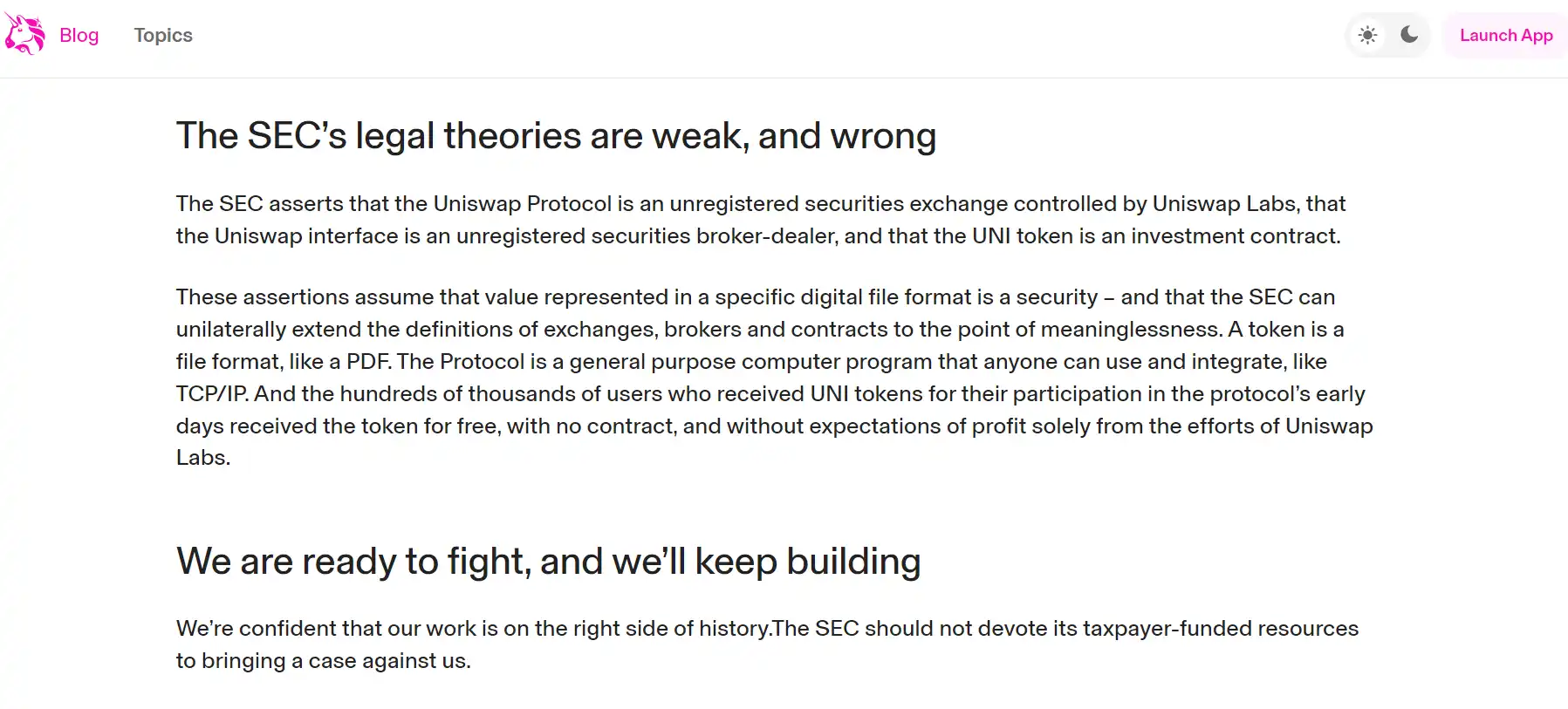
Image Source: Uniswap Blog
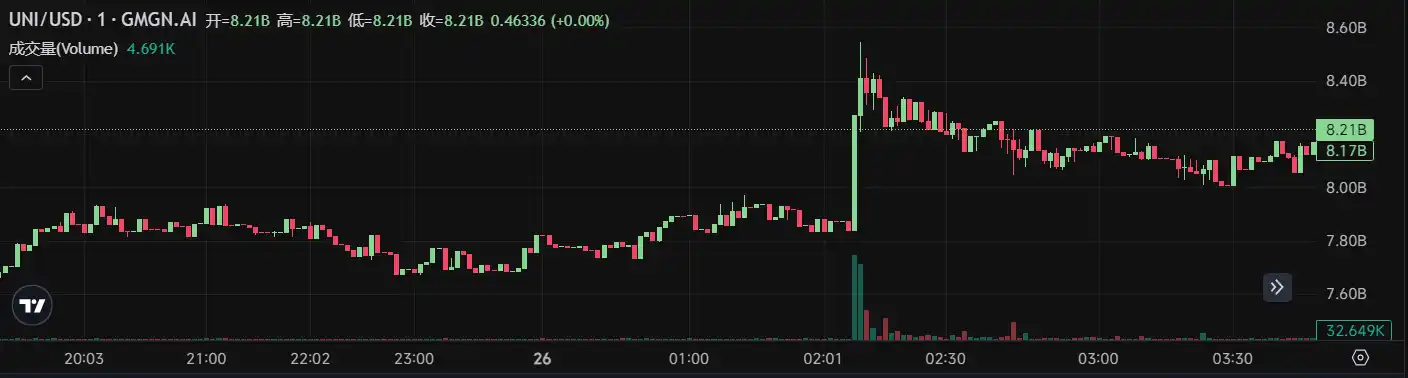
On February 26, 2025, after previously accusing Uniswap Labs of operating an unregistered securities exchange, broker-dealer, or clearing agency, and potentially issuing unregistered securities, the SEC finally concluded its investigation and dropped all charges. Uniswap founder Hayden Adams stated that the SEC's enforcement lacked a clear legal basis and, as a form of selective enforcement strategy, the SEC attempted to forcefully fit DeFi into an unsuitable regulatory framework while refusing to provide clear rules or compliance paths. This investigation lasted over 3 years, wasting significant time and millions of dollars. The UNI token also saw a brief spike of nearly 10%, indicating a strong market response.
This saga has finally come to an end, with Uniswap Labs calling it a "major DeFi victory," emphasizing, "This once again proves the fact we have always believed in—that the technology we have built stands on the right side of the law, and our work stands on the right side of history."
Uniswap's victory is not only a victory for decentralization but also a reminder that relevant authorities should establish appropriate regulatory policies. DeFi provides an alternative to traditional financial services through blockchain smart contracts, such as lending, trading, and asset management, aiming to eliminate centralized institutions' influence on the market. However, its decentralized nature complicates regulation, as existing legal frameworks primarily target centralized financial institutions. Regulators lack understanding and experience in regulating decentralized platforms. Although the SEC and other regulatory bodies attempt to apply Anti-Money Laundering (AML) and Know Your Customer (KYC) regulations to DeFi, enforcement is challenging.
Former SEC Chairman Gary Gensler once referred to DeFi as the "Wild West," emphasizing the need for stricter regulation. The Uniswap case demonstrates that existing securities laws may not fully apply to decentralized platforms, suggesting that future congressional legislation may be necessary to establish a specialized DeFi regulatory framework.
Tornado Cash Case Sees a Turning Point
Another typical case that was once severely sanctioned by US regulatory agencies, only to later achieve victory after a lengthy legal battle, is Tornado Cash.
Tornado Cash is an Ethereum-based privacy protocol that can obfuscate transaction origins, destinations, and counterparts, aiming to indiscriminately facilitate anonymous transactions without attempting to trace their origins. It was designed to protect user privacy but also drew regulatory attention due to its misuse in money laundering.
In August 2022, the U.S. Department of the Treasury's Office of Foreign Assets Control (OFAC) sanctioned Tornado Cash. In its statement, the Treasury Department stated that since its creation in 2019, Tornado Cash has been used to launder over $7 billion in cryptocurrency, including $455 million stolen by the North Korean government-backed hacker group Lazarus Group; additionally, Tornado Cash was also used to launder over $96 million of illicit funds from the Harmony Bridge hack on June 24, 2022, and at least $7.8 million from the Nomad hack on August 2, 2022.
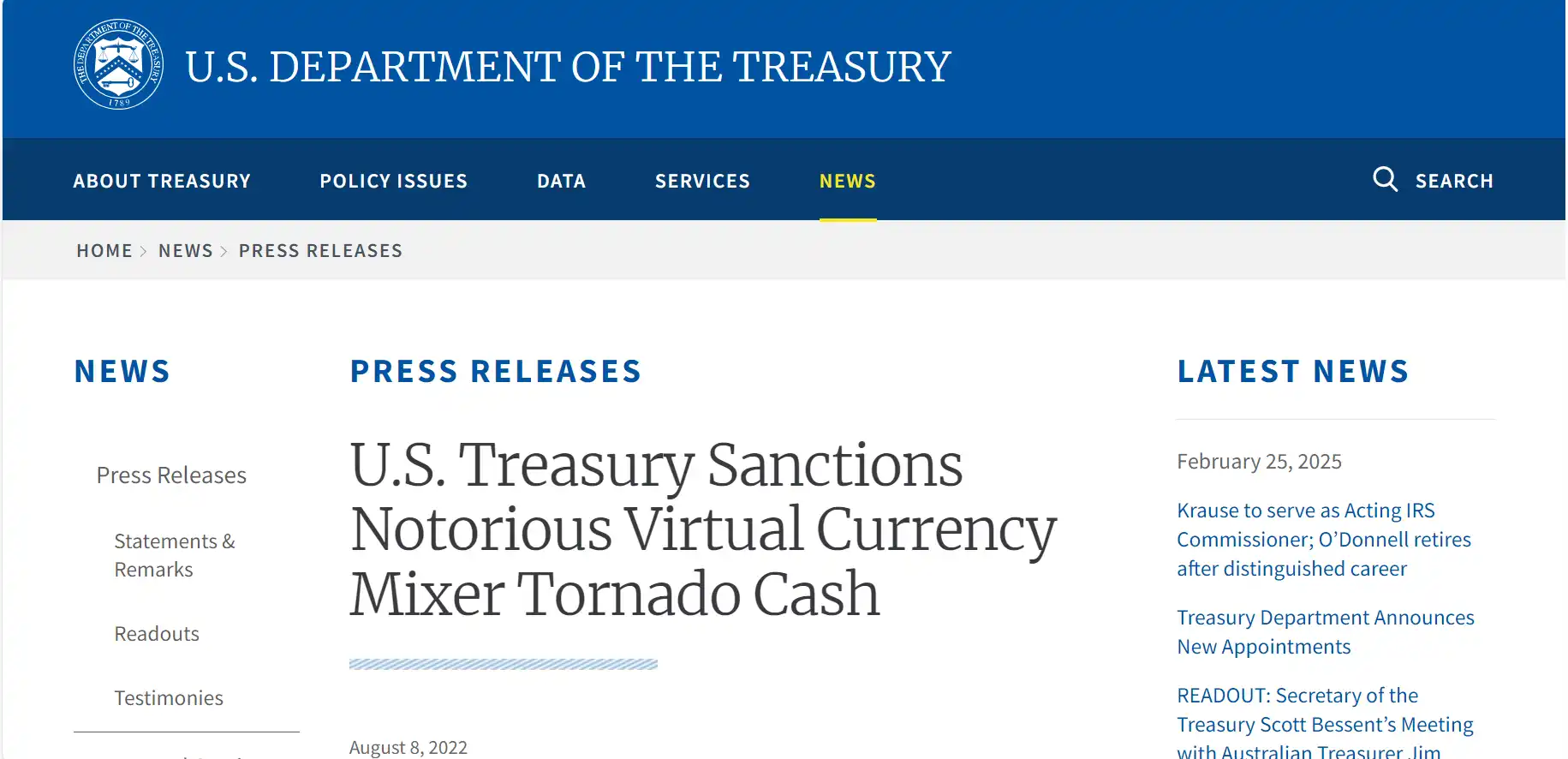
Image Source: US Treasury Official Website
The Treasury Department's sanctions primarily include prohibiting access, banning entities and individuals from interacting with it, preventing U.S. institutions or platforms from engaging in financial transactions with it, and freezing all assets owned or controlled by Tornado Cash within the United States.
Furthermore, in May 2024, a Dutch court found Tornado Cash founder Alexey Pertsev guilty of assisting in laundering $22 billion in cryptocurrency and sentenced him to 64 months in prison. The prosecution accused him of failing to prevent criminal organizations (such as the North Korean Lazarus Group) from using the protocol for money laundering, despite the defense highlighting the protocol's "decentralization" and "uncontrollability." However, the court believed that developers are still responsible for abusive behavior.
The Tornado Cash incident signifies an escalation in the ongoing struggle between "cryptographic protocols" and "regulation." This sanction against Tornado Cash is a direct regulatory attack on the protocol, as the Treasury Department believes that creating a privacy protocol available for criminals to use is a criminal act, not recognizing the protocol's "decentralization" and "uncontrollability."

Image Source: CoinDesk, Crowd rallying in support of protecting cryptographic technology and privacy
The shift occurred at the end of 2024. On November 28, 2024, the court ruled that the immutable smart contract of Tornado Cash is not considered property and cannot be sanctioned under current law, rendering the Treasury Department's previous sanctions on Tornado Cash illegal. As stated in a report to investors by 10X Research, "While this ruling does not condone money laundering, it sets a precedent allowing programmers to develop and release smart contract protocols without fees without fear of sanctions." Balaji Srinivasan, former CTO of Coinbase and a prominent cryptocurrency entrepreneur, tweeted, "Privacy won. Smart contracts won. Tornado Cash won. And OFAC lost." The Tornado Cash protocol token, TORN, also saw a rapid surge in price following the ruling, rising from a low of $3.7 to a high of $43 within an hour.
In January 2025, a Texas court once again supported the overturning of sanctions, stating that the U.S. Treasury Department's approval of interacting with Tornado Cash exceeded its authority, further confirming the invalidity of the sanctions.
Shedding the "illegal" shackles, over two months later, Alexey Pertsev also posted that a Dutch court had agreed to temporarily suspend his pre-trial detention under electronic monitoring conditions, and he would be temporarily released on February 7 at 10 a.m. Pertsev stated that this would give him the opportunity to continue his appeal, fight for justice, and thanked all supporters for their help.
Related Read: "Landmark Ruling: Sanctions on Tornado Cash Ruled Illegal, TORN Skyrockets Over 10x Before Falling Back"
Long-standing Market Maker Joins U.S. Market
At the Consensus Hong Kong 2025 conference a week ago, Wintermute CEO Evgeny Gaevoy, in an interview with Bloomberg, stated that the company's business expansion plan had changed. While the focus was previously primarily on the Asian market, it is now shifting emphasis to the U.S., expressing hopes for favorable cryptocurrency regulatory policies in the U.S.
On February 25, according to Bloomberg, Citadel Securities, a traditional financial industry giant with a market value of $650 billion, plans to enter the cryptocurrency market-making sector, marking a significant shift in its previous cautious stance on the cryptocurrency sector. The company is already planning to join the market-making roster of several exchanges, such as Coinbase Global, Binance, and Crypto.com, potentially initially establishing market-making teams outside the U.S.
Citadel Securities and Wintermute, one a veteran market maker in the traditional financial sector and the other a market-making giant with long-standing involvement in the crypto space. Their entry will undoubtedly directly increase liquidity in the U.S. crypto market. Especially with the entry of the traditional financial giant Citadel, it directly drives the crypto market from the "wild west" period towards maturity, promoting comprehensive enhancement of the market in liquidity, trading efficiency, and regulatory compliance dimensions. It also indicates that as U.S. regulatory laws evolve, institutional confidence in the crypto industry continues to grow, and the U.S. crypto market may be entering a new growth stage.
Related Read: "Regulation Continues to Loosen, Are U.S. Crypto Market Makers Coming Back?"
As Hayden Adams mentioned today, "It is great to see the new SEC leadership take a more constructive approach and look forward to working with Congress and regulatory agencies to develop rules that truly fit DeFi — encouraging innovation, enhancing transparency and financial market access, allowing this technology to thrive in the United States, rather than being forced overseas." With the continued release of regulatory positive signals, DeFi's best days may be ahead, and the U.S. may be on the brink of a crypto spring where all flowers bloom.
You may also like

Latest research from 13 top universities including Cornell University: The current state, challenges, and misconceptions of the fusion of Crypto and AI
Deconstructing Anthropic: The Best AI Company, Possibly Also a Type of Organizational Invention
Apollo and Blackstone Reportedly Back $35 Billion Anthropic Chip Financing as Deal Details Remain Unclear
On June 9, according to currently available news alerts, Apollo and Blackstone Group participated in a $35 billion financing for an Anthropic “chip project.” Based on the original wording of the report, the funding has already been raised, but public information remains limited. The financing structure, use of proceeds, project entity, and whether Apollo and Blackstone participated through equity, debt, or project financing have not yet been disclosed.

Humanity Protocol Security Incident Escalates: More Than $31 Million Stolen From Related Addresses as Attacker Continues Selling H for ETH
On June 9, according to monitoring by Onchain Lens, more than $31 million has been stolen from addresses linked to Humanity Protocol, and the attack is still ongoing, with the hacker continuously swapping H tokens for ETH. Project founder Terence Kwok later confirmed the security incident on X, saying the issue involved a private key leak.

Bloomberg: As Bitcoin Weakens, Stablecoins and RWA Continue to Drive Expansion in Crypto Businesses
In June, Bloomberg reported that despite Bitcoin falling below $60,000 last week, wiping out about $235 billion in market value within seven days, and dropping close to 50% from last year’s peak, some core businesses in the crypto industry are still expanding, mainly in stablecoins, real-world asset tokenization (RWA), payments, and infrastructure. The report also noted that overall altcoin activity has contracted significantly: altcoin market capitalization has fallen from a peak of about $431 billion in November 2021 to around $170 billion, and among the tens of millions of tokens issued in recent years, fewer than 1,700 still maintain meaningful trading activity.

Galaxy Deep Research Report: How Hyperliquid's HIP-4 Upgrade Changes the Landscape of Prediction Markets?
Binance Research: RWA Market Expected to Expand Nearly 6x from Early 2025, with Public Equities and Onchain Payments Heating Up Together
In June, Binance Research said in its monthly market report that the real-world asset (RWA) market is expected to grow by about 589% from the beginning of 2025. Bond- and money market fund-related RWA expanded by about $6.5 billion, up 83% year over year, while publicly traded equity RWAs grew by about 422%. The report also noted that monthly crypto debit card transaction volume exceeded $747 million in May, up 48.6% year to date.

Japan to Assess a Framework for Yen Stablecoins and Crypto ETFs as Asia’s Compliant Payments Narrative Heats Up
Recently, according to the original report, Japan is considering the launch of yen stablecoins and cryptocurrency ETFs. Public information remains limited at this stage, and there is still no complete policy text, regulatory draft, or clear implementation timeline, so this is better characterized as a “policy discussion” rather than formal implementation. The original wording also noted that advancing stablecoin regulation in Asia is driving XRP usage and supporting growth in the XRPL ecosystem. However, based on currently available public information, there is not enough evidence to directly establish a clear causal relationship between this round of discussion in Japan and XRP or XRPL.

ZachXBT: Humanity private key leak and abnormal surge in H token should be viewed separately
On June 9, according to related disclosures, on-chain investigator ZachXBT posted an update on Humanity’s roughly $31 million security incident, saying that after further analyzing fund flows, he currently tends to believe the project team was not involved in an “inside job” or a self-staged attack. According to him, the official explanation about the private key leak was broadly accurate, but before the token unlock, the price of H had been artificially pushed higher, and the hacker later took advantage of that market environment; therefore, the private key leak and the earlier abnormal price pumping should be regarded as two separate and independent events. This reframing has shifted the market’s understanding of the nature of the incident. Earlier discussion around Humanity had focused on whether the team directly participated in the attack or used the security incident to cover up internal operations. ZachXBT’s latest remarks shift the focus from “whether it was self-theft” to “whether there were pre-unlock market structure issues.” He also questioned whether the team may have.

Morning Report | OpenAI has submitted an S-1 registration statement draft to the U.S. SEC; Morpho completes $175 million financing

Morning Report | BitMine increased its holdings by 126,971 ETH last week; trader Eugene announced his exit from the crypto market

Wang Chuan: How can one not feel anxious after the neighbor Old Wang made thirty times profit by investing in storage stocks? (Seven) - A quarter-century cycle
Cryptocurrency CEXs are flocking to sell US stocks, and traditional brokerages are facing an "uninvited guest."
$75 billion in foreign capital has fled, and South Korean retail investors have absorbed it all using leverage

Japan’s Three Megabanks Plan Joint Stablecoin Issuance in Fiscal 2026
MUFG, SMBC, and Mizuho reportedly plan to jointly issue fiat-pegged stablecoins in fiscal 2026, signaling Japan’s growing push into bank-led digital payment infrastructure.

Humanity Discloses H Token Dual-Chain Attack Details, With Losses on Ethereum and BSC Exceeding $36 Million
Humanity said the H token attack across Ethereum and BSC caused more than $36 million in losses after leaked ProxyAdmin keys enabled malicious contract upgrades and token minting.
White House Discusses CLARITY Act With Law Enforcement Ahead of Senate Vote
The White House discussed the CLARITY Act with law enforcement ahead of a Senate vote, focusing on illicit finance risks and developer protections.

Bitcoin Trading Guide 2026: Strategies for Experienced Traders
Latest research from 13 top universities including Cornell University: The current state, challenges, and misconceptions of the fusion of Crypto and AI
Deconstructing Anthropic: The Best AI Company, Possibly Also a Type of Organizational Invention
Apollo and Blackstone Reportedly Back $35 Billion Anthropic Chip Financing as Deal Details Remain Unclear
On June 9, according to currently available news alerts, Apollo and Blackstone Group participated in a $35 billion financing for an Anthropic “chip project.” Based on the original wording of the report, the funding has already been raised, but public information remains limited. The financing structure, use of proceeds, project entity, and whether Apollo and Blackstone participated through equity, debt, or project financing have not yet been disclosed.
Humanity Protocol Security Incident Escalates: More Than $31 Million Stolen From Related Addresses as Attacker Continues Selling H for ETH
On June 9, according to monitoring by Onchain Lens, more than $31 million has been stolen from addresses linked to Humanity Protocol, and the attack is still ongoing, with the hacker continuously swapping H tokens for ETH. Project founder Terence Kwok later confirmed the security incident on X, saying the issue involved a private key leak.
Bloomberg: As Bitcoin Weakens, Stablecoins and RWA Continue to Drive Expansion in Crypto Businesses
In June, Bloomberg reported that despite Bitcoin falling below $60,000 last week, wiping out about $235 billion in market value within seven days, and dropping close to 50% from last year’s peak, some core businesses in the crypto industry are still expanding, mainly in stablecoins, real-world asset tokenization (RWA), payments, and infrastructure. The report also noted that overall altcoin activity has contracted significantly: altcoin market capitalization has fallen from a peak of about $431 billion in November 2021 to around $170 billion, and among the tens of millions of tokens issued in recent years, fewer than 1,700 still maintain meaningful trading activity.
Galaxy Deep Research Report: How Hyperliquid's HIP-4 Upgrade Changes the Landscape of Prediction Markets?


