
GT Burning Frenzy: The Path to Market Cap Breakthrough Behind Scarcity





Article Source: Gate.io
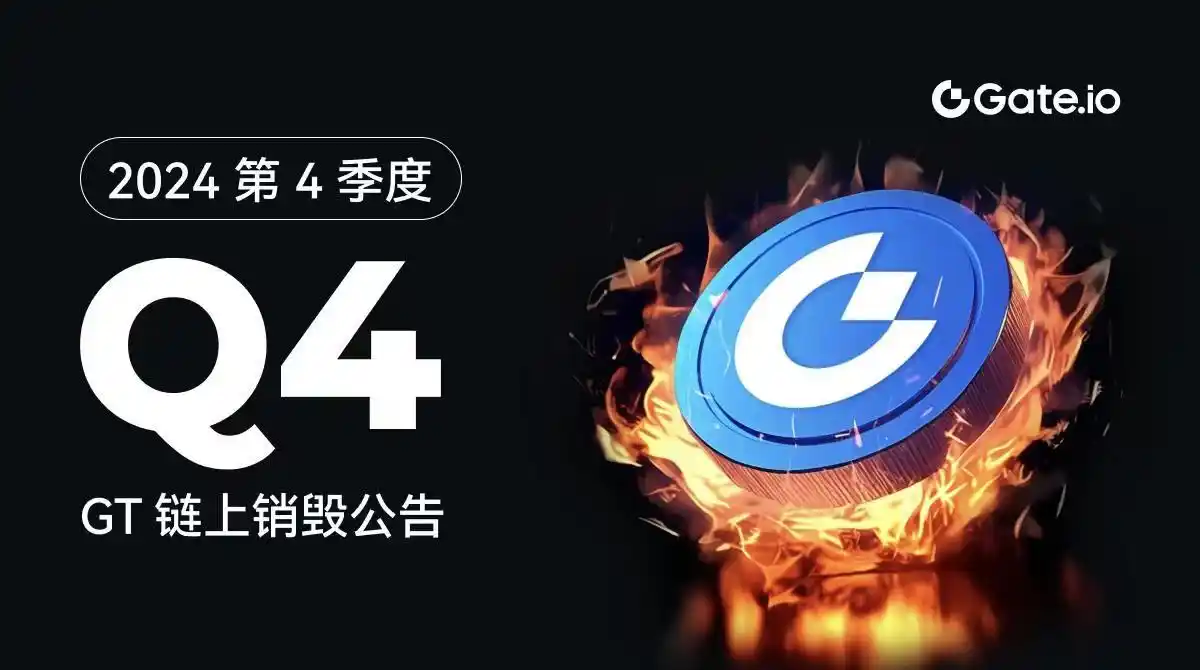
In the cryptocurrency market, the burn mechanism of platform tokens has always been a key factor influencing their value and market performance. GT, as the core token of the Gate.io platform, stands out in the market with its unique burn strategy and model. This article will delve into the GT burn mechanism, market performance, and its importance in the platform ecosystem, as well as look forward to its future development potential.
Q4 2024 GT Burn
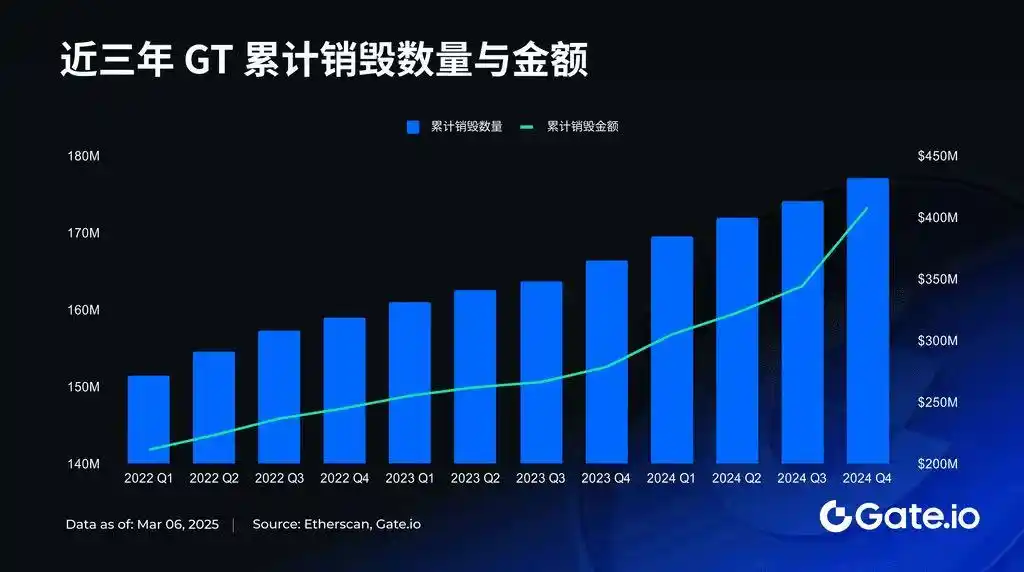
The official announcement indicates that the on-chain burn of GT for the fourth quarter of 2024 has been completed. The amount burned this time reached 2,904,885.4321514 tokens, worth over $63.9 million USD. Currently, a total of 177 million GT has been burned, accounting for approximately 60% of its initial total supply, placing this burn scale at a leading level in the industry.
GT Burn Mechanism and Effectiveness Analysis
Burn Mechanism Core Logic
The GT burn mechanism is not set in stone but is dynamically adjusted based on market conditions and platform development. Its core logic is to reduce circulation through a continuous burn strategy, thereby enhancing GT's scarcity and value. Specifically, the GT burn mechanism consists of the following stages:
Gate.io plans to use the holdings in the GT Insurance Fund for burning to ensure that these tokens do not flow into the market. At the same time, the Insurance Fund will increase allocations of equivalent value of mainstream assets like USDT, USDC, BTC, ETH, etc., to enhance the health and stability of the Insurance Fund. This strategy helps protect user assets and provides the platform with stronger risk resistance during extreme market conditions. The goal of this phase is to reduce the total GT supply from the current roughly 133 million tokens to below 100 million tokens.
After successfully reducing the total GT supply to below 100 million tokens, Gate.io will uphold the burn strategy philosophy, set new total supply reduction targets, and strictly follow the new targets. Gate.io's burn strategy is a long-term and continuous process that will not cease after achieving short-term goals.
To accommodate the needs of Layer 2/Layer 3 scaling protocols, Gate.io is undergoing underlying architecture transformation of GateChain. Upon completion of the transformation, an on-chain automatic burn mechanism will be introduced. This mechanism will make GT the support for underlying Gas fees, and with the frequent on-chain transfers, more GT will be burned.
In addition to the above plan, Gate.io will also closely follow industry technological developments and regulatory changes, continuously explore more and better burning solutions. At the same time, Gate.io also welcomes community members to actively participate, provide suggestions for GT's burning strategy, and work together to build a robust, sustainable, and mutually beneficial ecological future.
Burning Effect: Circulation Control and Value Support
The burning mechanism of GT has had a significant impact on its market performance. By the fourth quarter of 2024, GT's on-chain burning has been completed, with the amount of this burning reaching approximately 2.9 million tokens, and the burning value exceeding $63.9 million.
Since the launch of GateChain in 2019, GT has continued to burn, reducing the total supply by about 60% from the initial 300 million tokens. The cumulative amount of GT burned is 177,089,412.23 tokens, with a burning value of approximately $408,270,578. Even amidst changing market conditions, GT's burning policy has maintained a stable execution intensity. Through continuous burning, the circulation of GT has been effectively controlled, its scarcity has continued to increase, thus providing strong support for GT's value.
GT Price Trend and Market Cap Performance
Price Growth Trajectory
GT's price growth trajectory demonstrates its strong market performance. Over the past year, it has seen a full-year increase of over 300%, breaking $17.699 in December (24-hour increase of 20.1%) and reaching a peak of $25.96 in January 2025. In March 2025, GT's price is between $21.3 and $22.5, with a nearly 60-day increase of 11.44%.
Market Cap and Ranking Surge
GT's market cap and ranking have seen significant increases in 2024 and 2025. At the beginning of 2024, GT's market cap was less than $1 billion, but by March 2025, it had surpassed $26 billion, successfully entering the top 50 in the global cryptocurrency rankings. Currently, GT's market cap has reached $26.8 billion, ranking it 46th. This surge in market cap and ranking demonstrates GT's market acceptance and its important position in the cryptocurrency market.
Ecosystem Expansion and Platform Competitiveness in a Bull Market
Technical Upgrades and Ecosystem Development
Gate.io has been continuously strengthening its efforts in technical upgrades and ecosystem development. By the fourth quarter of 2024, Gate's Web3 ecosystem has significantly deepened its multi-chain support capabilities through continuous iterations, now extending to 199 blockchains with over 54 million added addresses.
Meanwhile, the MemeBox section has introduced an AI-driven intelligent coin recommendation feature. The coin recommendation strategy, with cutting-edge algorithms at its core, continuously optimizes Web3 asset allocation efficiency. These technological innovations further solidify Gate Web3's leading position in cross-chain interaction and intelligent investing, enhancing the ecosystem's overall competitiveness and providing global users with deeper on-chain financial services.
Additionally, the v1.1.6 mainnet upgrade completed in August 2024 has laid a solid foundation for GateChain's stable operation in the fourth quarter. The new Gas mechanism and burning strategy have propelled the ecosystem's smooth development. User transactions this quarter have remained efficient, with a transparent and reasonable fee structure, and on-chain activity has remained active.
Furthermore, the Gas burning mechanism has further reduced the total supply of GT tokens, enhancing GT's scarcity and value potential. GateChain's stable performance has not only provided users with an efficient and reliable trading environment but has also laid the groundwork for future technological innovation and ecosystem expansion.
In the future, GateChain will continue to upgrade core features, including DA, to ensure the network's efficiency and security and expand the Web3 ecosystem in wallets, trading, financial management, NFTs, Memes, and more to enhance user experience. With more applications and public links joining, GT will play a greater empowering role.
It is certain that Gate.io will steadfastly execute the GT burning plan and drive the crypto industry towards a more standardized, secure, and efficient direction, providing global users with richer blockchain services, and jointly building a prosperous Web3 ecosystem.
User and Asset Growth
In 2024, Gate.io's user and asset growth have demonstrated strong market competitiveness. Startup mining and staking rewards have attracted a large number of users to participate, with the platform's user base surpassing 21 million. At the same time, Gate.io's reserve exceeds $10 billion, with an excess reserve ratio of 23.91%, further enhancing its financial strength.
Comparison Analysis with Major Platform Coins
Comparison of Major Exchange Platform Coin Burning Models
In terms of the burning model, GT has a significant advantage compared to other major platform coins. GT's current circulating supply is 96 million, with a burn ratio of 58.06%, the highest burn rate, lowest circulation, and most notable scarcity. Its current market cap ranking is 46. Compared to BNB, ranked 5th by market cap, GT's burning mechanism is more efficient, and its market cap is only 1/10 of BNB, demonstrating its significant valuation potential. When compared to OKB, ranked 47th by market cap, GT's burning strategy is more aggressive, with lower circulation, showing a clear advantage in the burning model.
Use Cases and Empowerment
GT also has multidimensional advantages in terms of use cases and empowerment. GT can be used not only for transaction fee discounts (up to 50%) and VIP privileges, but also for staking, mining, and on-chain governance. Furthermore, GT covers various ecosystem aspects such as DeFi, NFTs, cross-chain, providing users with a rich set of use cases and empowerment. In comparison, although BNB and OKB have similar use cases, GT has a greater advantage in ecosystem diversification and user empowerment.
GT Future Outlook: Unlimited Potential, Awaits Growth
Through aggressive burning strategies, ecosystem diversification, and user growth, GT has emerged as a "dark horse" in the platform token race. Its burning mechanism is similar to the BNB model but more efficient. Combined with Gate.io's initiatives in the Web3 and compliance fields, GT is poised to continue breaking through the market cap ceiling.
In the future, Gate.io will further drive GT's burning strategy to reduce its circulating supply, enhancing its scarcity and potential value. At the same time, Gate.io will continuously expand its Web3 ecosystem, including areas such as wallets, trading, asset management, NFTs, Memes, etc., to provide users with a more comprehensive blockchain service.
With Gate.io's ongoing efforts in compliance, its market recognition will continue to rise. Obtaining licenses in multiple countries will provide strong support for Gate.io's global business expansion, attracting more users and investors. As the core token of Gate.io, GT will play a crucial role in this process, further enhancing its market position and value.
GT's burning mechanism and strategy have shown significant effectiveness in the cryptocurrency market. Through continuous burning and ecosystem expansion, GT's scarcity and value have rapidly increased. In future market competitions, GT has the opportunity to stand out in the platform token race with its aggressive burning strategy, diversified ecosystem layout, and compliance advantages, bringing more value and opportunities to investors.
Disclaimer
This content does not constitute any invitation, solicitation, or advice. You should always seek independent professional advice before making any investment decisions. Please note that Gate.io may restrict or prohibit all or part of its services from restricted regions. Please read the User Agreement for more information, link: https://www.gate.io/en/user-agreement .
This article is contributed content and does not represent the views of BlockBeats.
You may also like

Dialogue with OmenX Founder: Why does the prediction market need an evolution from "spot" to "derivatives"?

When the P2P illicit funds from ten years ago turned into 60,000 bitcoins

Morning News | CME Group launches Nasdaq Cryptocurrency Index futures; Asset management giant Janus Henderson strategically invests in Ethena

Why did Oracle deliver the strongest financial report in history, yet its stock price fell?

Bitcoin Layer 2 Network Botanix: Why Did We Choose to Dissolve?

Morning Report | OpenAI has submitted an S-1 registration statement draft to the U.S. SEC; Morpho completes $175 million financing

Galaxy Deep Research Report: How Hyperliquid's HIP-4 Upgrade Changes the Landscape of Prediction Markets?

Latest research from 13 top universities including Cornell University: The current state, challenges, and misconceptions of the fusion of Crypto and AI
Deconstructing Anthropic: The Best AI Company, Possibly Also a Type of Organizational Invention

Every exchange is a "Universal Exchange."

The counterattack of traditional finance: Alliance chains are quietly reviving
Pantera Capital Partner: How Tokenization is Restructuring the Private Equity and Early Investment Ecosystem?

Mastercard Launches Agent Pay for AI, Plans to Record AI Agent Payment Authorizations on Polygon
Mastercard launched Agent Pay for AI, a new payment protocol designed to help AI agents make small payments such as pay-per-use access to data and APIs. The system plans to record human-granted AI agent permissions on Polygon, focusing on verifiable authorization, identity, and payment controls.

Curve Deploys Llamalend v2 on Optimism With 250,000 OP Incentives
Curve launched Llamalend v2 on Optimism with 250,000 OP incentives from the Optimism Foundation. The upgrade expands Llamalend beyond its earlier crvUSD-focused model, adding broader collateral support, LlamaRisk market reviews, and the ability to use Curve LP tokens as collateral.

Raydium Old Liquidity Pool Reportedly Exploited, With $1.34 Million Moved to Ethereum and Tornado Cash
An old Raydium liquidity pool was reportedly exploited for around $1.34 million in USDC, RAY, and wSOL, with the stolen funds bridged to Ethereum and deposited into Tornado Cash. The incident highlights the tail risks of legacy DeFi pools, old contracts, and cross-chain fund laundering paths.
Kalshi Executive Challenges “SBF Backed AI Unicorns” Narrative, Says Leopold Aschenbrenner Was Key Figure
Kalshi executive John Wang questioned the “SBF backed AI unicorns” narrative, saying Leopold Aschenbrenner was the key figure behind major AI investment decisions.

New York Proposes Stricter Stablecoin Issuer Rules Aligned With Federal GENIUS Act
NYDFS proposed stricter stablecoin issuer rules aligned with the GENIUS Act, covering reserves, custody, redemption timelines, audits, and capital buffers.

CryptoQuant Says Bitcoin Profitable Supply Is Near 45% Pressure Zone as On-Chain Data Points to Market Repricing
CryptoQuant said Bitcoin’s profitable supply is nearing the 45% pressure zone, signaling rising market stress, unrealized losses, and a possible on-chain repricing phase.
Dialogue with OmenX Founder: Why does the prediction market need an evolution from "spot" to "derivatives"?
When the P2P illicit funds from ten years ago turned into 60,000 bitcoins
Morning News | CME Group launches Nasdaq Cryptocurrency Index futures; Asset management giant Janus Henderson strategically invests in Ethena
Why did Oracle deliver the strongest financial report in history, yet its stock price fell?
Bitcoin Layer 2 Network Botanix: Why Did We Choose to Dissolve?
Morning Report | OpenAI has submitted an S-1 registration statement draft to the U.S. SEC; Morpho completes $175 million financing


