
How Gate.io Stands Out in a Competitive Landscape: The Rise of the Futures Market

Source: Gate.io
Against the backdrop of the rapid development of the global cryptocurrency market, contract trading has become an increasingly preferred trading method for many investors. As one of the industry's leading platforms, Gate.io has particularly excelled in the futures market. With a wide range of available assets, innovative trading features, and a robust market strategy, its futures market has attracted a large number of users, demonstrating strong growth momentum.
This article will delve into key data regarding Gate.io's futures market, analyze the driving forces behind its rapid growth, and explore its innovative initiatives in product features and market strategy. Through multidimensional data analysis and interpretation of industry trends, we will comprehensively showcase how Gate.io has stood out in fierce competition and continually reinforced its leading position in the cryptocurrency futures market.
User Growth and Market Performance
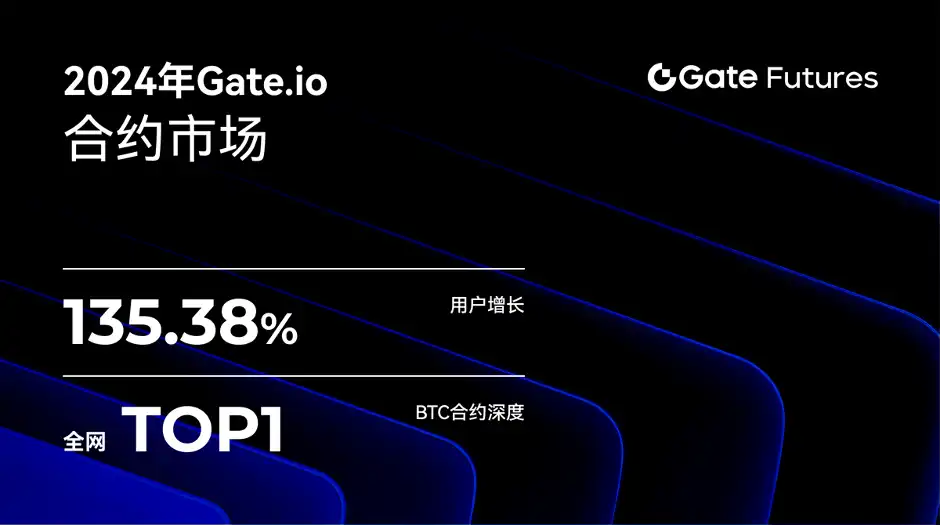
In 2024, Gate.io's futures trading user base experienced a significant growth spurt, with a growth rate of up to 135.38%. This data reflects the expansion of the platform's user base and also demonstrates user recognition and trust in Gate.io's futures products. With its diverse product offerings and deep market liquidity, Gate.io has become the preferred platform for many traders.
According to the latest data, Gate.io offers over 600 types of altcoin futures, making it one of the platforms with the most variety of coin futures. The extensive coin coverage provides users with diverse investment options while solidifying Gate.io's leading position in the altcoin futures market.
Furthermore, Gate.io has also shown outstanding performance in BTC futures depth, securing the top position across the network and leading the competition in mainstream cryptocurrency futures markets.
Industry Position and Market Influence
In terms of market depth, Gate.io's futures market has risen to the rank of TOP2 in the global cryptocurrency futures trading market, holding a significant position in the market. According to CoinGecko data, Gate.io has a global user base of over 20 million, with both the breadth and depth of its futures market at the industry's leading level. These data further demonstrate Gate.io's undeniable influence in the global cryptocurrency futures market.
New Strategies and Coverage on Gate Futures Market
Market Trends and Opportunities
Against the backdrop of a bull market and GT continually hitting new highs, Gate.io's contract market has adopted a flexible listing strategy aimed at providing more investment opportunities for both new and existing user bases. By quickly listing high-quality assets, Gate.io helps users seize market opportunities and capture more market dividends.
In 2024, Gate.io's contract market has listed over 200 contract products, accurately understanding user demand and swiftly responding to market trends. This strategy has not only improved user trading experience but also provided users with more early-stage investment opportunities. For example, VIRTUAL has seen up to a 10x increase since its listing on Gate.io's contract market, delivering significant investment returns to users.
AI and MEME Hot Sector Layout
Gate.io has made precise moves in popular sector layouts, focusing on sectors such as AI Agent and MEME. The platform continues to quickly list new contracts, including AIXBT, AI6Z, FARTCOIN, and PENGU.
Among them, AIXBT has seen an almost 6x increase since its listing, and it launched nearly 20 days ahead of competitors, allowing users to seize profit opportunities early. This rapid listing strategy has kept Gate.io ahead in market competition, creating more wealth opportunities for users.
Gate.io Contract Features Lead Industry Innovation
Take Profit and Stop Loss: Powerful Risk Management Tools
Take Profit and Stop Loss are crucial risk management tools in contract trading. By setting trigger conditions in advance, they help users lock in profits or control losses during market fluctuations. Gate.io offers various take profit and stop loss strategies, including trailing take profit and MMR stop loss, providing users with flexible trading options.
Trailing Take Profit
This strategy automatically adjusts the liquidation trigger price based on market price fluctuations, suitable for trending markets. When the price moves in a favorable direction, the trailing take profit order adjusts the trigger price to help users maximize their returns.
MMR Stop Loss
Based on trigger conditions related to the maintenance margin rate, MMR stop loss effectively helps users manage account risk, particularly suitable for users trading multiple assets simultaneously. In times of high market volatility, setting different MMR triggers allows users to prioritize liquidation timing for different positions based on changes in the maintenance margin rate, retaining crucial positions as much as possible and reducing the risk of liquidation.
Take Profit and Stop Loss are powerful risk management tools. By understanding the difference between the trigger price and the order price, as well as the various prices such as the last price, mark price, and index price, users can better utilize the Take Profit and Stop Loss feature to enhance trading efficiency and market responsiveness.
Based on different trading needs, choosing the appropriate type of Take Profit and Stop Loss can effectively lock in profits and limit losses, ensuring trade safety and stability. In addition to the above functions, Gate.io's Take Profit and Stop Loss also include Order Take Profit and Stop Loss, Close All Position Take Profit and Stop Loss, and Partial Position Take Profit and Stop Loss.
Support for Multiple Order Types, Most Comprehensive in the Industry
In a complex market environment, flexible order types are crucial for implementing diversified trading strategies. Gate.io supports various order types ranging from traditional limit orders to advanced limit orders, including Limit Order, Advanced Limit Order, Market Order, Smart Market Order, Conditional Order, Time-Weighted Average Price (TWAP) Order, Iceberg Order, and Trailing Limit Order.
Time-Weighted Average Price (TWAP) Order
This is an algorithmic trading strategy that splits large orders into multiple small orders and places them at set time intervals to reduce market impact. TWAP Order is applicable to all perpetual contract trading (including USDT-margined and BTC-margined contracts). TWAP Order will calculate the optimal order placement and execution time based on user-set parameters.
Slice Order
Slice Order functionality covers all perpetual contract trading, allowing users to split large orders within a specified price range and place orders flexibly using average, increment, or decrement modes. This can effectively reduce market impact and optimize execution prices.
While helping investors diversify trading risks, Slice Order can also conceal trading intentions, avoid herd-following and sniper risks, making the execution of strategies in a complex market more precise and efficient.
Smart Market Order
Smart Market Order is a more advanced type of market order that combines a market order with other conditions or algorithms to achieve higher execution efficiency and better execution prices. When executed, the Smart Market Order may take into account factors such as market depth, price fluctuations, and order book conditions to optimize the trading outcome.
Gate.io's contract order types have a broader coverage and meet the diverse needs of both ordinary users and professional traders with high flexibility and innovation. The variety of order types provides users with great flexibility, enhancing trading accuracy and efficiency. This comprehensive layout of order types keeps Gate.io at the forefront of the industry in terms of feature design.
At the same time, Gate.io regularly updates and upgrades its order types. Recently, they introduced the "Chase Limit Order" order type, which is a limit order placed at the best bid or ask price that dynamically adjusts the entry price based on the evolving market conditions until the order is filled, canceled, or reaches the maximum chase distance.
Industry Analysis and Competitive Advantage
Clear Competitive Advantage
The digital asset contract market is highly competitive, with major platforms striving to attract users and increase their market share. Leveraging its unique competitive advantage, Gate.io has gradually become a leader in the industry. These advantages include a wide selection of assets, deep market liquidity, and flexible product features, providing users with diversified investment options and an outstanding trading experience.
Gate.io has excelled in its deployment in the small-cap contract market. Compared to other platforms, Gate.io has listed over 600 small-cap contracts, allowing it to quickly respond to market trends and continuously provide users with trading opportunities for emerging assets. The extensive asset selection enables users to find more investment targets on the platform.
In terms of market depth, Gate.io has also demonstrated remarkable performance. The substantial market liquidity ensures that users are not severely impacted by price fluctuations during large trades, which is particularly important for users engaging in frequent large contract transactions.
Gate.io's provision of various trading tools and flexible order types, such as time-based orders, scaled orders, and smart market orders, further enhances the user's trading experience. These functionalities can meet the diverse trading strategy needs of users, helping them achieve more efficient trading operations in different market conditions.
Future Market Trends
The rapid development of the digital asset market and technological innovation will continue to drive the evolution of contract trading. Small-cap contracts and high-frequency trading are widely regarded as key trends in the next phase of market development. The high volatility of small-cap assets and the potential for high returns have attracted a large number of investors, while high-frequency trading provides users with more arbitrage opportunities by rapidly responding to market changes.
With its deep involvement in the small-cap contract market and rapid listing strategies, Gate.io possesses an inherent advantage in leading this trend. Furthermore, Gate.io's exploration and deep exploration of hot sectors allow it to quickly seize market opportunities and create additional investment returns for users.
Gate.io's forward-looking market strategy and technological innovation enable it to quickly adapt to market changes. Additionally, as high-frequency trading technology matures, Gate.io will continue to optimize its trading systems and functionalities, providing users with faster trade execution speeds and a more stable trading environment.
Gate.io Futures Market, Fully Embracing the Future
With a rich selection of cryptocurrencies, deep market liquidity, and diverse trading tools, Gate.io provides users with a comprehensive investment and trading solution.
From the perspective of the industry's development, the success of Gate.io's futures lies in its own strategy and strong technical support. With the continuous evolution of market demand and technological advancement, futures trading will become more complex and diverse, and user expectations of the platform will also continue to rise. In this context, Gate.io is continuously enhancing its competitiveness and market influence through ongoing innovation and market insights.
The digital asset futures market will face more challenges and opportunities in the future. By maintaining a keen insight into market trends and a deep understanding of user needs, Gate.io will continue to lead the industry's development, providing users with higher-quality trading services and more abundant investment opportunities. Based on continuous investment in technological innovation and market strategies, Gate.io is expected to continuously strengthen its core competitiveness, driving the healthy development and progress of the entire industry.
Disclaimer
This content does not constitute any invitation, solicitation, or advice. You should always seek independent professional advice before making any investment decisions. Please note that Gate.io may restrict or prohibit all or part of its services from restricted areas. Please read the user agreement for more information.
This article is contributed content and does not represent the views of BlockBeats.
You may also like

Morning Report | BitMine increased its holdings by 126,971 ETH last week; trader Eugene announced his exit from the crypto market

Wang Chuan: How can one not feel anxious after the neighbor Old Wang made thirty times profit by investing in storage stocks? (Seven) - A quarter-century cycle

Cryptocurrency CEXs are flocking to sell US stocks, and traditional brokerages are facing an "uninvited guest."

$75 billion in foreign capital has fled, and South Korean retail investors have absorbed it all using leverage

Japan’s Three Megabanks Plan Joint Stablecoin Issuance in Fiscal 2026
MUFG, SMBC, and Mizuho reportedly plan to jointly issue fiat-pegged stablecoins in fiscal 2026, signaling Japan’s growing push into bank-led digital payment infrastructure.

Humanity Discloses H Token Dual-Chain Attack Details, With Losses on Ethereum and BSC Exceeding $36 Million
Humanity said the H token attack across Ethereum and BSC caused more than $36 million in losses after leaked ProxyAdmin keys enabled malicious contract upgrades and token minting.
White House Discusses CLARITY Act With Law Enforcement Ahead of Senate Vote
The White House discussed the CLARITY Act with law enforcement ahead of a Senate vote, focusing on illicit finance risks and developer protections.

Bitcoin Trading Guide 2026: Strategies for Experienced Traders

What Is XAUT and PAXG? Why Tokenized Gold Is Booming in 2026

Will the SpaceX IPO Hurt Bitcoin? Here's What Traders Are Watching

Foreign selling in the South Korean stock market accelerates, with cumulative net sales reportedly reaching $75 billion this year
On June 9, The Kobeissi Letter, citing Goldman Sachs data, reported that global investors are selling South Korean stocks at an unusually rapid pace. In the latest trading session, foreign investors sold about $801 million worth of Kospi constituent stocks again; total foreign outflows last week reached about $10 billion, and the market has been in net foreign selling on nearly every trading day over the past month. According to the data cited in the report, foreign investors have sold about $75 billion worth of South Korean stocks so far this year. Meanwhile, South Korean retail and institutional investors together recorded roughly $69 billion in net buying over the same period, suggesting that the market’s main buying support has come from domestic capital rather than returning overseas funds. The information currently disclosed still mainly comes from The Kobeissi Letter’s retelling and Goldman Sachs data summaries, while public details on the statistical period and the specific definition of “selling” remain relatively limited.

Fortune Warns of Strategy’s Financing Structure Risks as Bitcoin Premium Narrows
Fortune warned that Strategy’s Bitcoin treasury model faces growing financing risks as MSTR’s net asset premium narrows and preferred stock dividend pressure increases.

Ferrari Challenge Le Mans: Carl Moon to Dominate in WEEX Livery

Sahara AI Responds to SAHARA’s Sharp Drop: No Contract or Product Security Issues Found, Internal Investigation Underway
Sahara AI responded to SAHARA’s 60% price drop, saying no token contract or product security issues have been found and an internal investigation is underway.

WEEX Deposit/Withdrawal Dynamic Island: Your Asset Status, Always in Sight
Scaling Crypto Derivatives: The Digital Asset Infrastructure Behind High-Volume Trading
In the fast-moving digital asset ecosystem, derivatives platforms face an extreme architectural test. High-leverage futures markets demand more than just standard security—they require absolute operational precision, zero-latency matching engines, and ironclad structural scalability, all while navigating intense market volatility.
As global platforms scale to meet these demands, the industry is shifting away from rigid, monolithic setups toward a more agile, "decoupled" infrastructure philosophy.
The Blueprint for High-Volume Copy TradingFor elite global exchanges like WEEX (founded in 2018), this architectural choice becomes critical when scaling high-volume retail features like social copy trading. When thousands of users automatically mirror the real-time strategies of elite traders simultaneously, it triggers sudden, monumental spikes in concurrent transactional volume.
To prevent execution latency or settlement bottlenecks during these peak volatility events, a platform's primary engine must remain entirely dedicated to risk management, copy-trade synchronization, and order matching.
The Architectural Rule: New-generation platforms must separate front-end user execution engines from heavy backend infrastructural overhead to eliminate operational friction.
By separating these layers, platforms can maintain complete sovereignty over their trading environments and user experiences while strategically aligning with institutional-grade infrastructure ecosystems. This strategic framework allows modern exchanges to leverage advanced Digital Asset Custody infrastructure such as Cobo’s behind the scenes, ensuring that backend wallet management scales elastically alongside trading spikes.
Capitalizing on Market Momentum and 400× LeverageIn a derivatives arena where platforms offer up to 400× leverage on perpetual contracts, capital efficiency and market agility are core business metrics. To capture market momentum, an exchange needs the ability to rapidly expand its asset offerings, supporting everything from legacy crypto assets to sudden, trending altcoins across a massive library of trading pairs.
Adopting a flexible, scalable Wallet-as-a-Service (WaaS) solution such as Cobo’s could completely rewrite the development timeline for high-growth exchanges. Instead of spending months of engineering capital building out custom backend wallet architectures for every new blockchain network, platforms can deploy localized infrastructure in days.
This agility allows platforms to instantly scale their listings to over a thousand trading pairs without compromising security or delaying time-to-market. It mirrors the exact operational advantages seen during high-velocity market events, similar to how advanced wallet infrastructure empowers platforms during sudden asset surges; allowing exchanges to pass that speed and liquidity directly to their global user base.
A Mature Foundation for GrowthThe synergy between trusted infrastructure ecosystems and global trading platforms represents the natural evolution of a maturing crypto market. As WEEX continues to scale its global spot and derivatives offerings for over 6 million users, adopting robust backend paradigms proves that platforms no longer have to compromise between cutting-edge trading velocity and uncompromised structural security.

Get Paid to Onboard? Try WEEX’s New Homepage with Rewards for Registration, Deposit & Trade
WEEX Custom Layout: Build Your Perfect Trading Workspace in Seconds
Morning Report | BitMine increased its holdings by 126,971 ETH last week; trader Eugene announced his exit from the crypto market
Wang Chuan: How can one not feel anxious after the neighbor Old Wang made thirty times profit by investing in storage stocks? (Seven) - A quarter-century cycle
Cryptocurrency CEXs are flocking to sell US stocks, and traditional brokerages are facing an "uninvited guest."
$75 billion in foreign capital has fled, and South Korean retail investors have absorbed it all using leverage
Japan’s Three Megabanks Plan Joint Stablecoin Issuance in Fiscal 2026
MUFG, SMBC, and Mizuho reportedly plan to jointly issue fiat-pegged stablecoins in fiscal 2026, signaling Japan’s growing push into bank-led digital payment infrastructure.
Humanity Discloses H Token Dual-Chain Attack Details, With Losses on Ethereum and BSC Exceeding $36 Million
Humanity said the H token attack across Ethereum and BSC caused more than $36 million in losses after leaked ProxyAdmin keys enabled malicious contract upgrades and token minting.


