
Meteora TGE Imminent: What Is the Fair Value of MET?

Original Article Title: Meteora's TGE: What is fair value for MET?
Original Article Authors: Luke Leasure & Carlos
Original Article Translators: AididiaoJP, Foresight News
This week, Meteora is about to launch its MET token: where could its fair value be?
Index
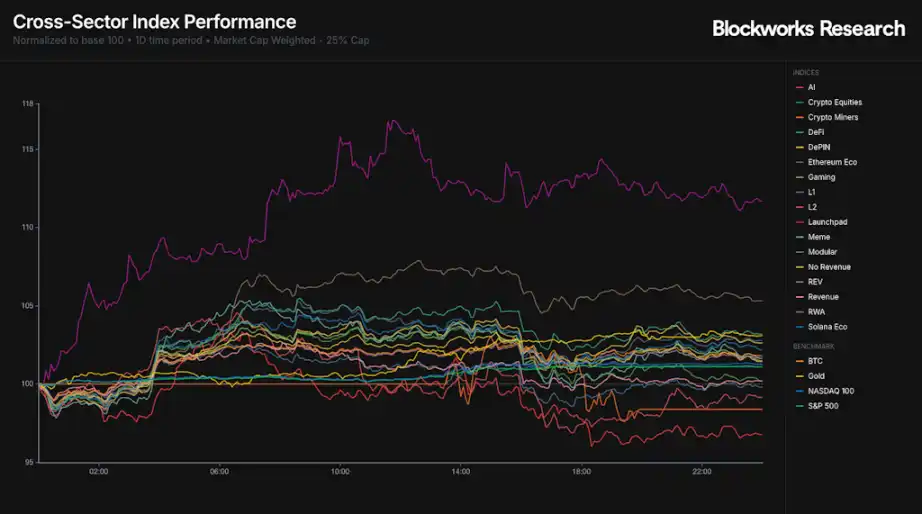
The week started strong, with BTC rising 7% from last Friday's low. During Monday's trading session, the Launchpad sector performed the best, while the AI sector saw the biggest decline, reversing their relative strength and weakness shown over the past week.
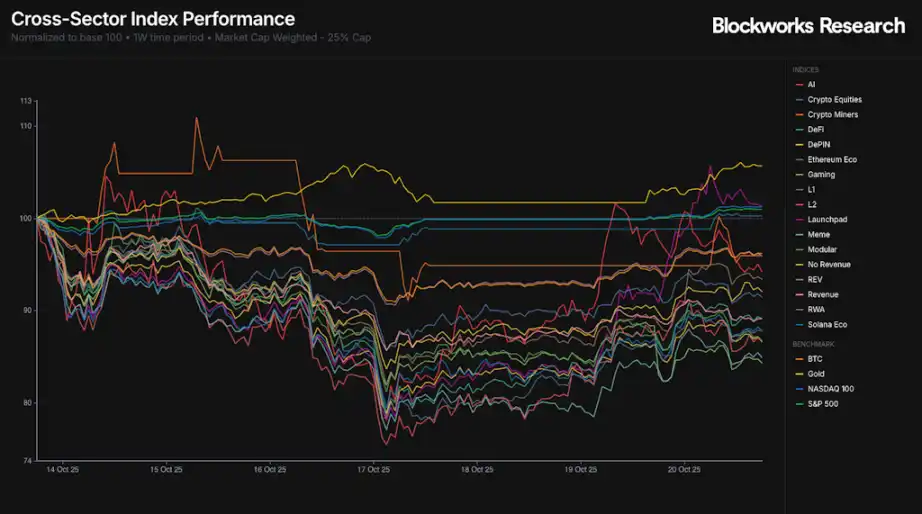
Looking at the weekly chart, the recent strength of the Launchpad sector has made it a relative winner, second only to gold, which once again approached its historical high by Monday's close. Overall, most indices remain negative on a weekly basis after the historic liquidation event. Within the Launchpad index, the BSC-based Launchpad project AUCTION was the only asset showing a positive return on the weekly chart, rising by 46%.
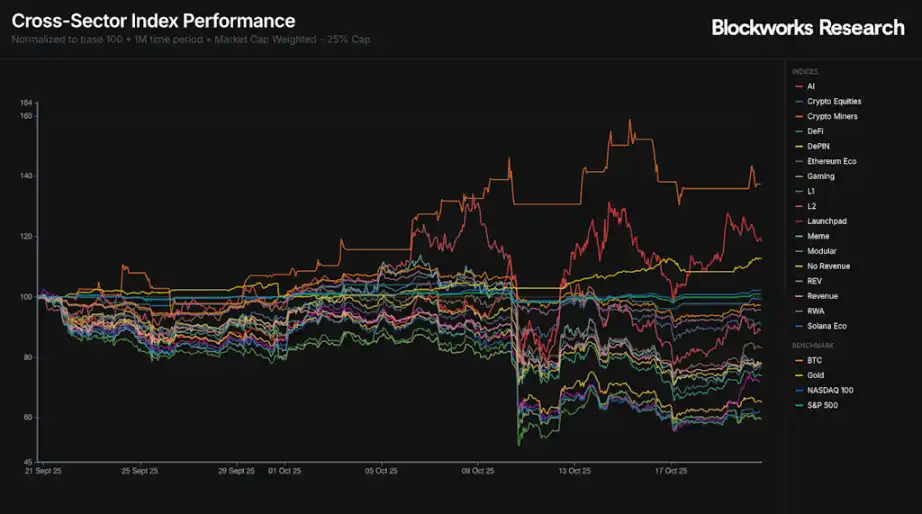
While there is some short-term upside, the monthly chart shows that almost all cryptocurrency indices have been falling over the past 30 days. The October 10 liquidation event resulted in widespread weakness, with only gold, cryptocurrency miners, AI, and stock indices performing strongly.
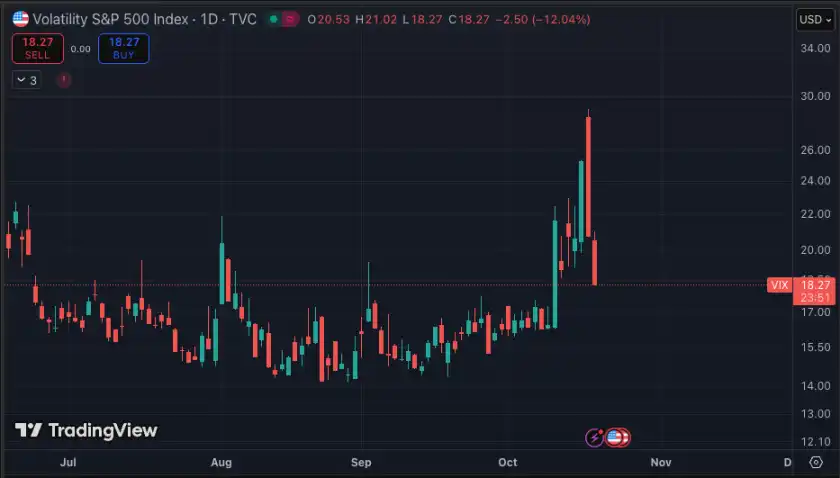
The VIX index has significantly retreated, rising to 29 on Friday morning and now falling to 18. The S&P 500 index and the Nasdaq index both rose during Monday's trading session, coming close to historical highs in the closing price.
Market Update
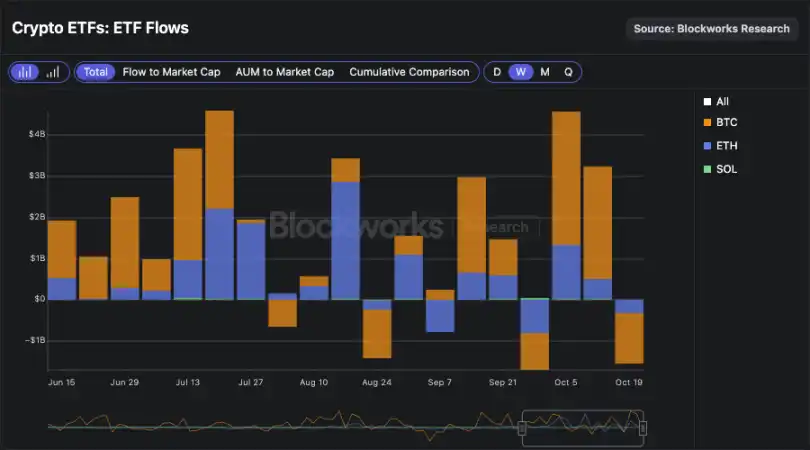
ETF fund flows remain subdued and negative. Monday's data shows BTC ETF outflows of $40 million, ETH ETF outflows of $145 million, and a $27 million inflow into SOL ETF. Looking at the weekly data, the total net outflows from ETFs last week amounted to $1.5 billion, reversing some of the funds accumulated at the strong start of October. SOL ETF is the only product showing net inflows, increasing by $14 million.
In DATCOs, BMNR is far ahead. The entity currently holds 3,236,014 ETH, surpassing the total held by all other ETH DATCOs, representing 2.67% of the total ETH supply. It is worth noting that since the end of August, BMNR has continuously increased its ETH holdings by nearly 70%, while the holdings of most other ETH DATCOs have remained stable. During this process, BMNR's market share of ETH held by DATCOs has grown from 50% to close to 65%.
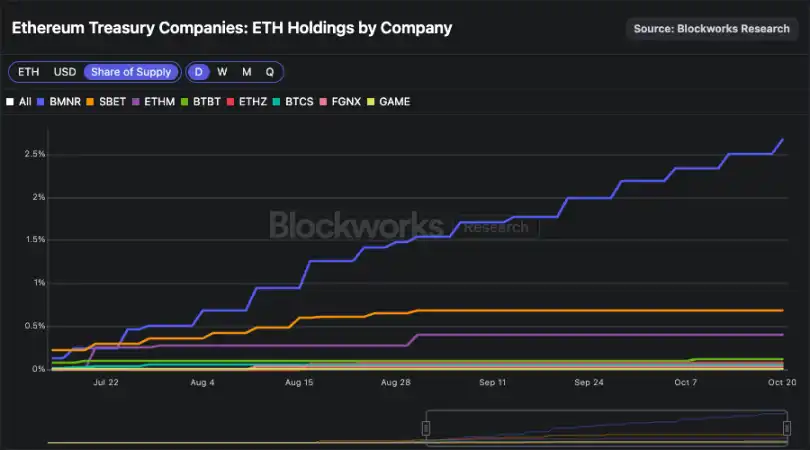
This situation is also reflected in the trading volume of ETH DATCOs. BMNR accounts for 60-85% of ETH DATCOs' trading volume, making its stock the most liquid. This liquidity feature has attracted significant allocators to the entity and reduced the marginal impact of ATM issuance on price. BMNR seems to be the clear winner in the ETH treasury company space.
In SOL DATCOs, the situation is less clear. FORD remains the largest holder, with almost all of its scale obtained through PIPE issuance earnings. Despite authorizing a $40 billion ATM issuance plan, the entity has not significantly increased its holdings through ATM issuance.
Growth in holdings remains soft, with HSDT recently rising to the second position.
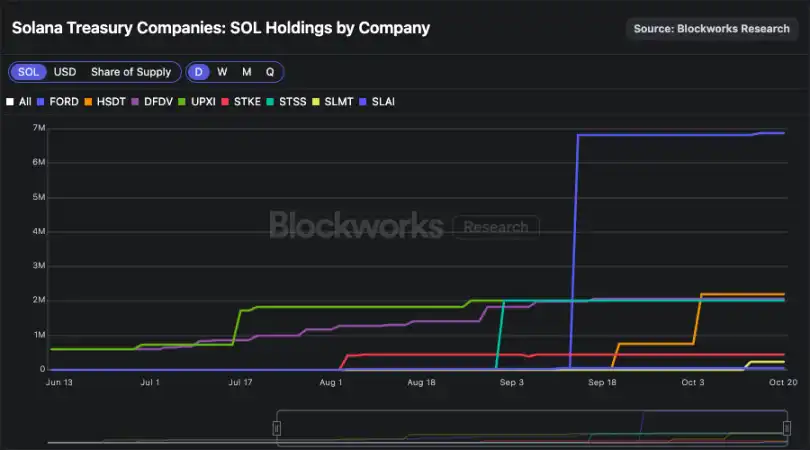
The trading volume of SOL DATCOs also tells a similar story. While DFDV once dominated much of the trading volume in this space, the situation has now shifted to a more even distribution among top names. Although FORD holds around 43% of the SOL held by DATCOs, it accounts for only about 10% of the trading volume in this space, indicating a relatively low turnover rate of its stock. These data may well explain why there is very little SOL accumulated through ATM issuance by FORD.
While BMNR is emerging as the clear winner in the ETH space, the leader in the SOL space may still be undecided. Over the next month, it is expected that trading volume will increasingly concentrate on top companies.
Meteora's TGE: What Is the Fair Value of MET?
The highly anticipated Meteora TGE will take place on Thursday, October 23. Unlike recent projects following the ICO trend, Meteora will not conduct any fundraising before the TGE. Instead, it will airdrop to eligible recipients, including Mercurial stakeholders, Meteora liquidity providers, JUP stakers, and Launchpad partners. Airdrop recipients will receive unlocked MET by default, or they can choose to provide liquidity at launch to earn trading fees.
Meteora was launched by the Solana ecosystem's largest DEX aggregator and perpetual contract trading platform Jupiter team in February 2023. Upon Meteora's launch, the protocol's previous iteration, Mercurial Finance, was sunsetted. The decision to close Mercurial and its governance token was made due to a significant amount of MER being involved with FTX/Alameda, leading the team to decide that the best course of action was to rebuild the platform using a new token.
Back in 2023, the team announced that 20% of the MET tokens would be distributed to Mercurial stakeholders at the TGE. As shown below, the team has honored the initial commitment, with 15% allocated to Mercurial stakeholders and 5% allocated to the Mercurial reserve. Additionally, the DEX has been running a rewards program since January 31, 2024, distributing a total of 15% of MET to the program. At launch, 48% of the MET supply will be in circulation, which is a high circulating supply ratio compared to other prominent tokens in the Solana ecosystem.
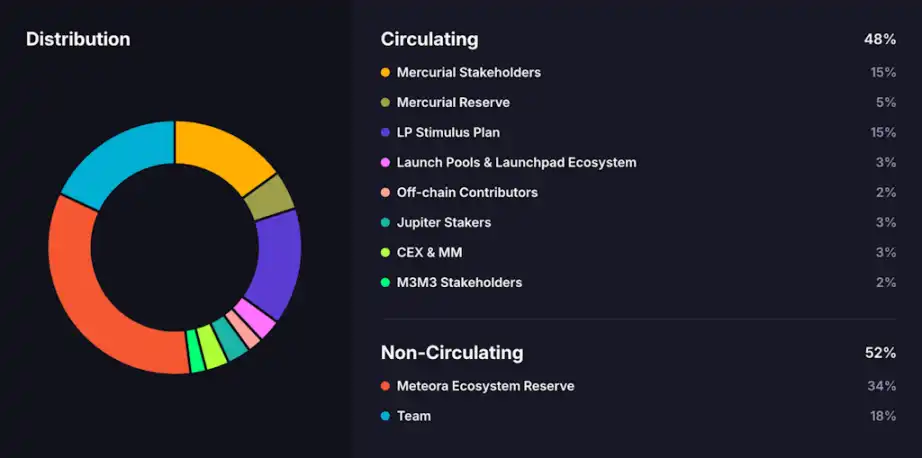
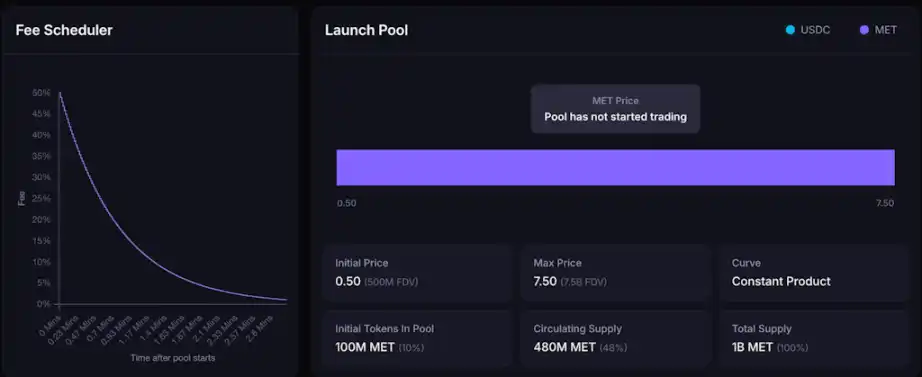
As mentioned earlier, 10% of the total supply will be used to seed initial liquidity through a dynamic AMM pool, with a starting price of $0.5 and liquidity distribution up to a $7.5 billion valuation. The early liquidity pool is one-sided, with early buyers exchanging their USDC for MET. It is important to note that the pool fees start high and sharply decrease over time through a fee schedule.
Valuation Calculation
DEXs, especially on Solana, lack significant moats as they do not have a front end. A prime example of this dynamic is when Raydium suffered significant trading volume and revenue losses after PumpSwap decided to route graduated tokens to its own AMM. Meteora aims to address this issue by vertical integration, expanding its distribution capabilities through Jupiter and selected Launchpad partners.
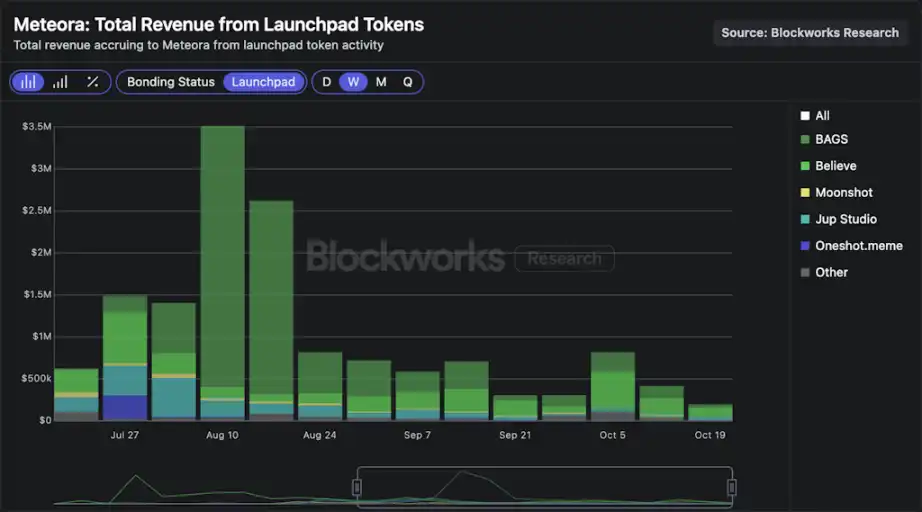
As mentioned earlier, this DEX collaborates closely with the Jupiter team, with Jupiter having become a popular gateway for retail users to conduct on-chain transactions. Additionally, in August 2024, Meteora partnered with Moonshot to launch a Launchpad and over time introduced new partners, including Believe, BAGS, and Jup Studio. The chart below shows that in recent weeks, Launchpad activities have contributed weekly revenues ranging from $200,000 to $800,000 to Meteora, with the majority of the traffic coming from Believe and BAGS.
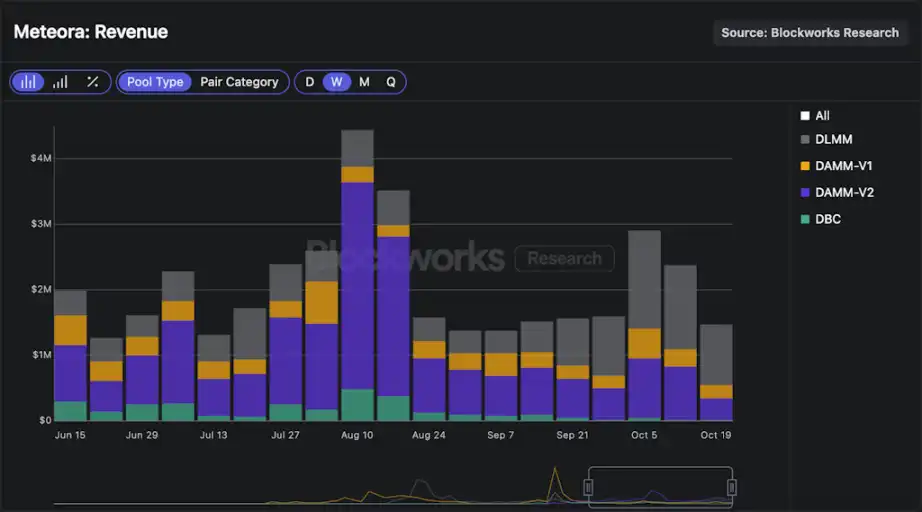
Looking at the overall financial data, Meteora generated $8.8 million in revenue over the past 30 days from all its liquidity pools, maintaining a weekly revenue close to $1.5 million even during periods of relatively low on-chain activity. It is noteworthy that over 90% of Meteora's revenue comes from Memecoin pools, which typically have higher fee levels compared to SOL-stablecoin, project token, LST, and stablecoin-stablecoin pools.
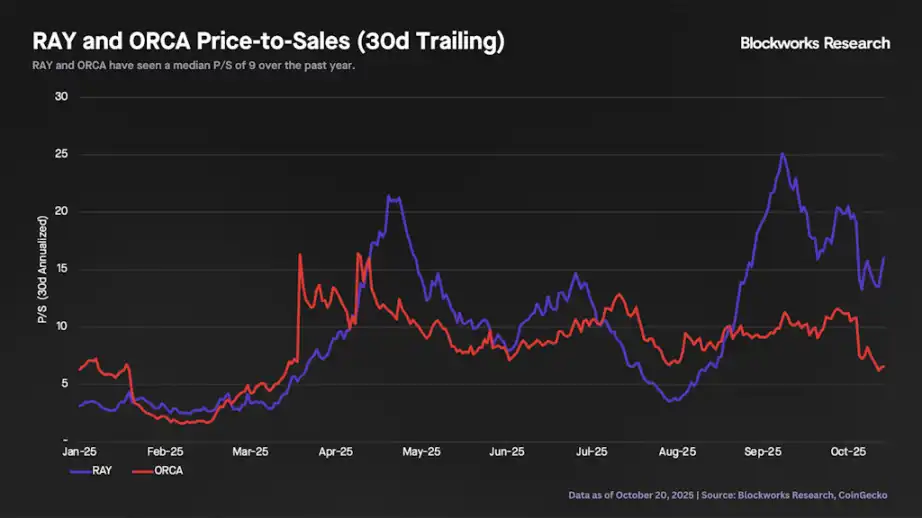
Regarding valuation, we can consider Raydium and Orca as comparable companies. The chart below shows the Price-to-Sales ratios of RAY and ORCA year-to-date based on 30-day annualized data. We observe that until September, the pricing ratios of these two assets were relatively similar, after which RAY began trading at a premium. Taking a broader view, the median Price-to-Sales ratio for these two assets in 2025 is 9x.
The table below compares the Price-to-Sales ratios of RAY and ORCA over various lookback periods. We notice that ORCA's trading behavior across all annualized time frames is very consistent, with a Price-to-Sales ratio of around 6x. On the other hand, as revenue declines, RAY has become more expensive over the past few months. For Meteora, we see its annualized revenue ranging from around $75 million to around $115 million based on the lookback period.
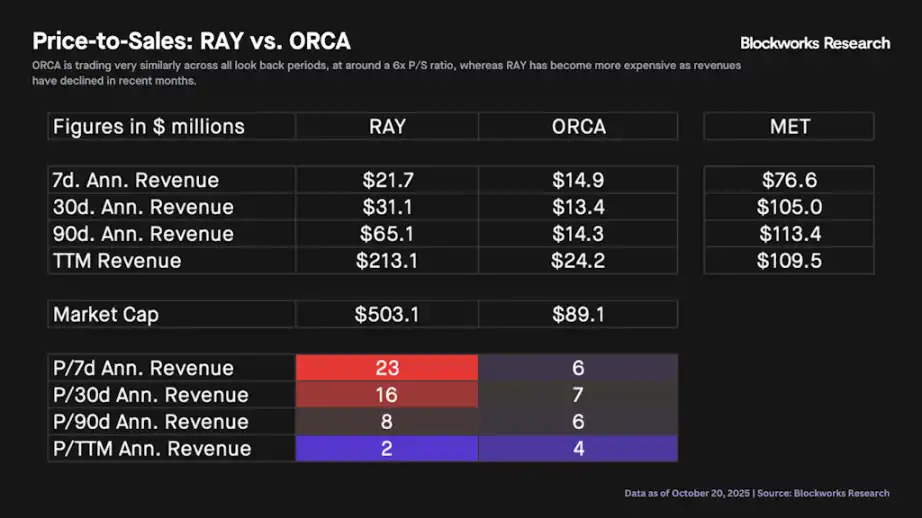
Finally, the chart below illustrates the potential valuation of MET across different revenue and Price-to-Sales ratio ranges. Based on the historical pricing behavior of RAY and ORCA, a Price-to-Sales ratio between 6x and 10x is the most likely. Therefore, it can be reasonably expected that post-launch, MET's trading valuation would fall between $4.5 billion and $11 billion. Please note that based on the numbers below, a valuation exceeding $10 billion starts to seem somewhat expensive relative to comparable companies, and a valuation surpassing $20 billion would almost certainly indicate MET is overvalued unless it can improve its revenue operating rate.
You may also like

Mastercard Launches Agent Pay for AI, Plans to Record AI Agent Payment Authorizations on Polygon
Mastercard launched Agent Pay for AI, a new payment protocol designed to help AI agents make small payments such as pay-per-use access to data and APIs. The system plans to record human-granted AI agent permissions on Polygon, focusing on verifiable authorization, identity, and payment controls.

Curve Deploys Llamalend v2 on Optimism With 250,000 OP Incentives
Curve launched Llamalend v2 on Optimism with 250,000 OP incentives from the Optimism Foundation. The upgrade expands Llamalend beyond its earlier crvUSD-focused model, adding broader collateral support, LlamaRisk market reviews, and the ability to use Curve LP tokens as collateral.

Raydium Old Liquidity Pool Reportedly Exploited, With $1.34 Million Moved to Ethereum and Tornado Cash
An old Raydium liquidity pool was reportedly exploited for around $1.34 million in USDC, RAY, and wSOL, with the stolen funds bridged to Ethereum and deposited into Tornado Cash. The incident highlights the tail risks of legacy DeFi pools, old contracts, and cross-chain fund laundering paths.

Kalshi Executive Challenges “SBF Backed AI Unicorns” Narrative, Says Leopold Aschenbrenner Was Key Figure
Kalshi executive John Wang questioned the “SBF backed AI unicorns” narrative, saying Leopold Aschenbrenner was the key figure behind major AI investment decisions.

Pantera Capital Partner: How Tokenization is Restructuring the Private Equity and Early Investment Ecosystem?

New York Proposes Stricter Stablecoin Issuer Rules Aligned With Federal GENIUS Act
NYDFS proposed stricter stablecoin issuer rules aligned with the GENIUS Act, covering reserves, custody, redemption timelines, audits, and capital buffers.
Every exchange is a "Universal Exchange."

The counterattack of traditional finance: Alliance chains are quietly reviving

CryptoQuant Says Bitcoin Profitable Supply Is Near 45% Pressure Zone as On-Chain Data Points to Market Repricing
CryptoQuant said Bitcoin’s profitable supply is nearing the 45% pressure zone, signaling rising market stress, unrealized losses, and a possible on-chain repricing phase.

Bitcoin Falls Below 200-Week Moving Average as On-Chain Data Shows Over Half of Supply in Loss
Bitcoin dropped below its 200-week moving average as on-chain data showed over 50% of circulating supply is now in loss, signaling rising market stress.

CFTC Reportedly Plans New Prediction Market Rules Focused on Manipulation Risk and Public Interest Review
The CFTC is reportedly preparing new prediction market rules focused on manipulation risk, public interest review, and retail trader protections.

Meet the new WEEX trial fund—your gateway to greater profits

WEEX Labs Lands at Dutch Blockchain Week: A Disruptive Crypto × AI Conversation Sets Sail in Amsterdam
SK Hynix Reportedly Plans U.S. ADR Listing as Early as August, With SEC Approval Possible in Late June
SK Hynix may pursue a U.S. ADR listing as early as August, with SEC approval reportedly possible in late June amid strong AI chip supply chain demand.

SpaceX vs Tesla vs xAI: Which Elon Musk Trade Has the Biggest Upside in 2026?
OpenAI Reveals It Has Confidentially Submitted an S-1 to the SEC, Keeping the Door Open for a Future IPO
On June 9, according to an OpenAI announcement, the company recently confidentially submitted a draft S-1 registration statement to the U.S. Securities and Exchange Commission (SEC), beginning the preliminary compliance process for a potential initial public offering. OpenAI said it chose to disclose this proactively because it expected the news might leak; however, the company has not yet set a specific listing timeline, and related arrangements may still take some time.
Latest research from 13 top universities including Cornell University: The current state, challenges, and misconceptions of the fusion of Crypto and AI
Deconstructing Anthropic: The Best AI Company, Possibly Also a Type of Organizational Invention
Mastercard Launches Agent Pay for AI, Plans to Record AI Agent Payment Authorizations on Polygon
Mastercard launched Agent Pay for AI, a new payment protocol designed to help AI agents make small payments such as pay-per-use access to data and APIs. The system plans to record human-granted AI agent permissions on Polygon, focusing on verifiable authorization, identity, and payment controls.
Curve Deploys Llamalend v2 on Optimism With 250,000 OP Incentives
Curve launched Llamalend v2 on Optimism with 250,000 OP incentives from the Optimism Foundation. The upgrade expands Llamalend beyond its earlier crvUSD-focused model, adding broader collateral support, LlamaRisk market reviews, and the ability to use Curve LP tokens as collateral.
Raydium Old Liquidity Pool Reportedly Exploited, With $1.34 Million Moved to Ethereum and Tornado Cash
An old Raydium liquidity pool was reportedly exploited for around $1.34 million in USDC, RAY, and wSOL, with the stolen funds bridged to Ethereum and deposited into Tornado Cash. The incident highlights the tail risks of legacy DeFi pools, old contracts, and cross-chain fund laundering paths.
Kalshi Executive Challenges “SBF Backed AI Unicorns” Narrative, Says Leopold Aschenbrenner Was Key Figure
Kalshi executive John Wang questioned the “SBF backed AI unicorns” narrative, saying Leopold Aschenbrenner was the key figure behind major AI investment decisions.
Pantera Capital Partner: How Tokenization is Restructuring the Private Equity and Early Investment Ecosystem?
New York Proposes Stricter Stablecoin Issuer Rules Aligned With Federal GENIUS Act
NYDFS proposed stricter stablecoin issuer rules aligned with the GENIUS Act, covering reserves, custody, redemption timelines, audits, and capital buffers.


