
Pectra Upgrade Takes First Step, What Upgrades are Coming to Ethereum?

Original Title: Pectra Upgrade Takes First Step, What Updates Will Ethereum See?
Original Author: Francesco
Original Translator: Luffy, Foresight News
The next Ethereum upgrade, Pectra, has taken its first step.
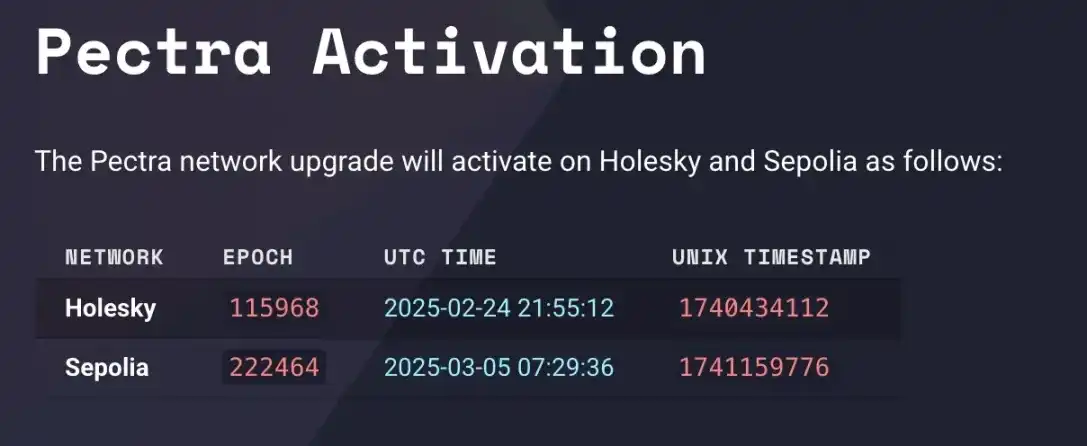
On February 24, the Pectra upgrade went live on the Holesky testnet; on March 5, Pectra will go live on the Sepolia testnet.
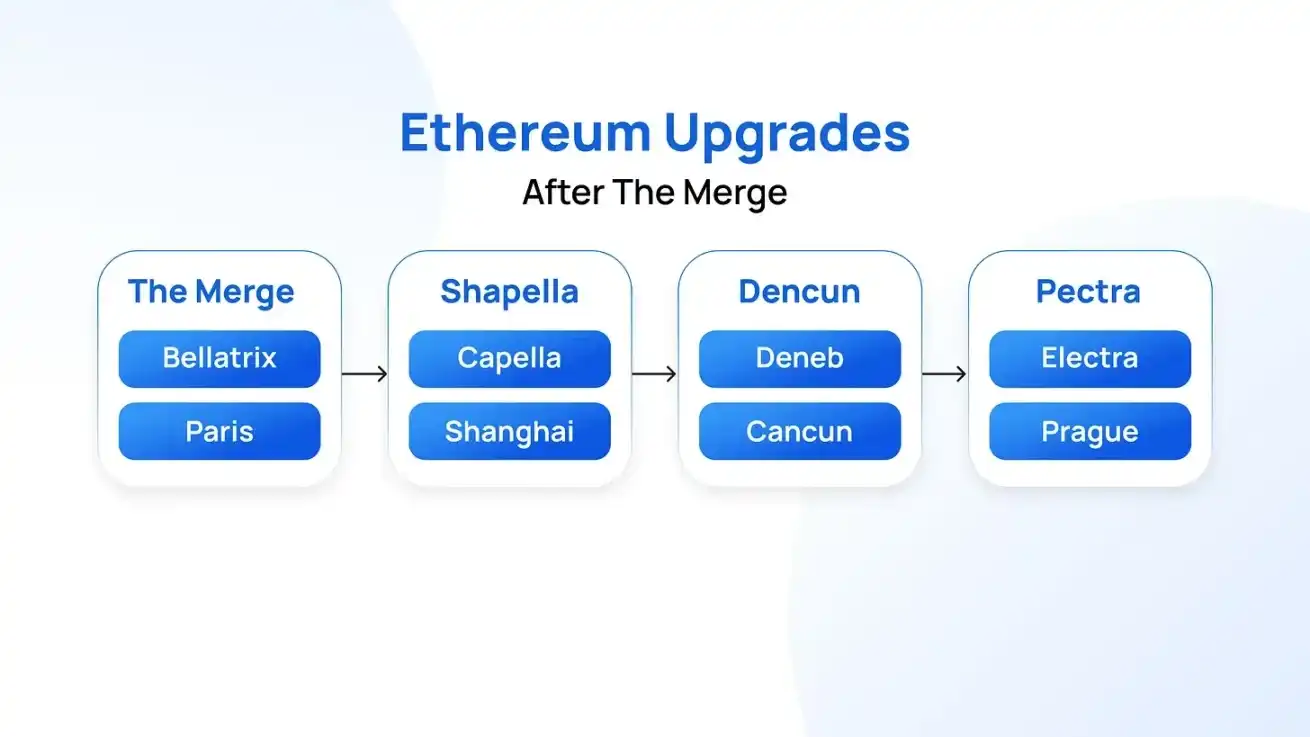
Once these upgrades are successfully implemented on the testnets, the mainnet upgrade date will be set, with the mainnet upgrade expected to take place within 3 to 9 months after the testnet implementation.
Pectra is a significant upgrade that introduces multiple Ethereum Improvement Proposals (EIPs) at once:
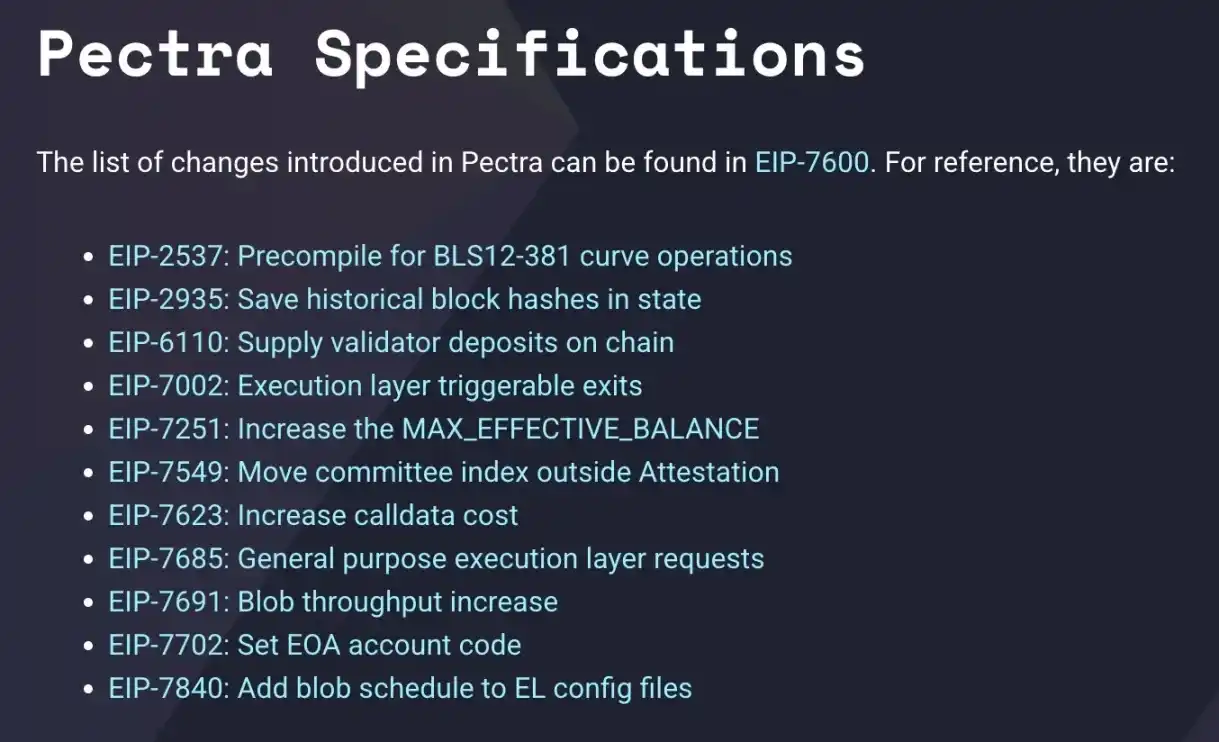
We can categorize these upgrades into three key areas:
· Enhancing Ethereum Accounts
· Improving the User Experience for Ethereum Validators
· Expanding the processing capability of "data blobs"
Let's delve into some of the upcoming Ethereum Improvement Proposals and how they will benefit the Ethereum protocol and users.
Enhancing Ethereum Accounts: EIP-7702
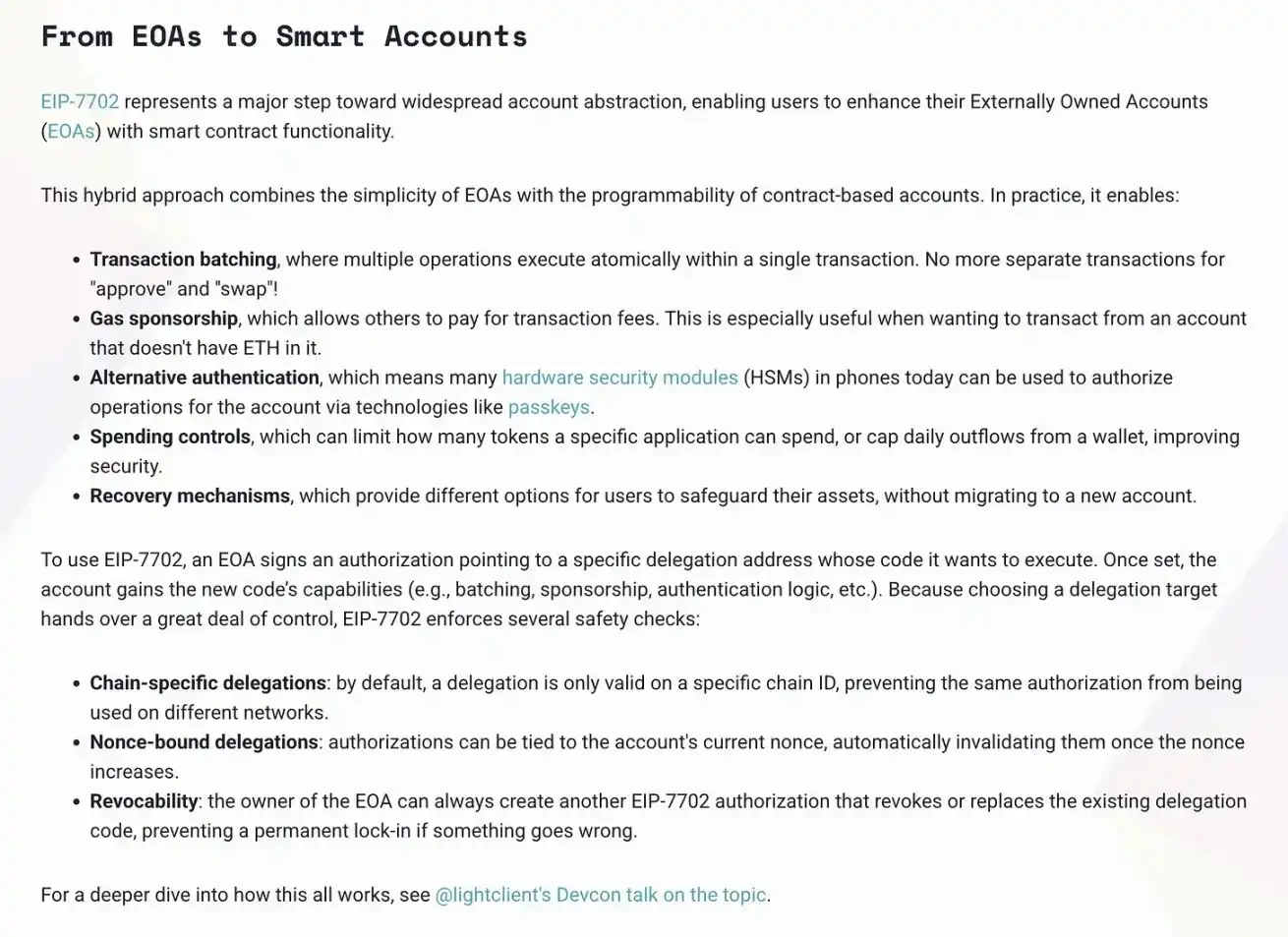 EIP-7702 brings Ethereum closer to an account abstraction experience at the protocol level. It achieves this by extending the functionality of Ethereum's externally owned accounts (EOAs) with features such as:
Transaction Batching: Executing multiple operations in a single transaction
Gas Fee Sponsorship: Allowing accounts with no ETH to have their gas fees sponsored by others
Additional authentication and recovery mechanisms
Enhancing the User Experience for Ethereum Validators: EIP-7251, EIP-7002, EIP-6110
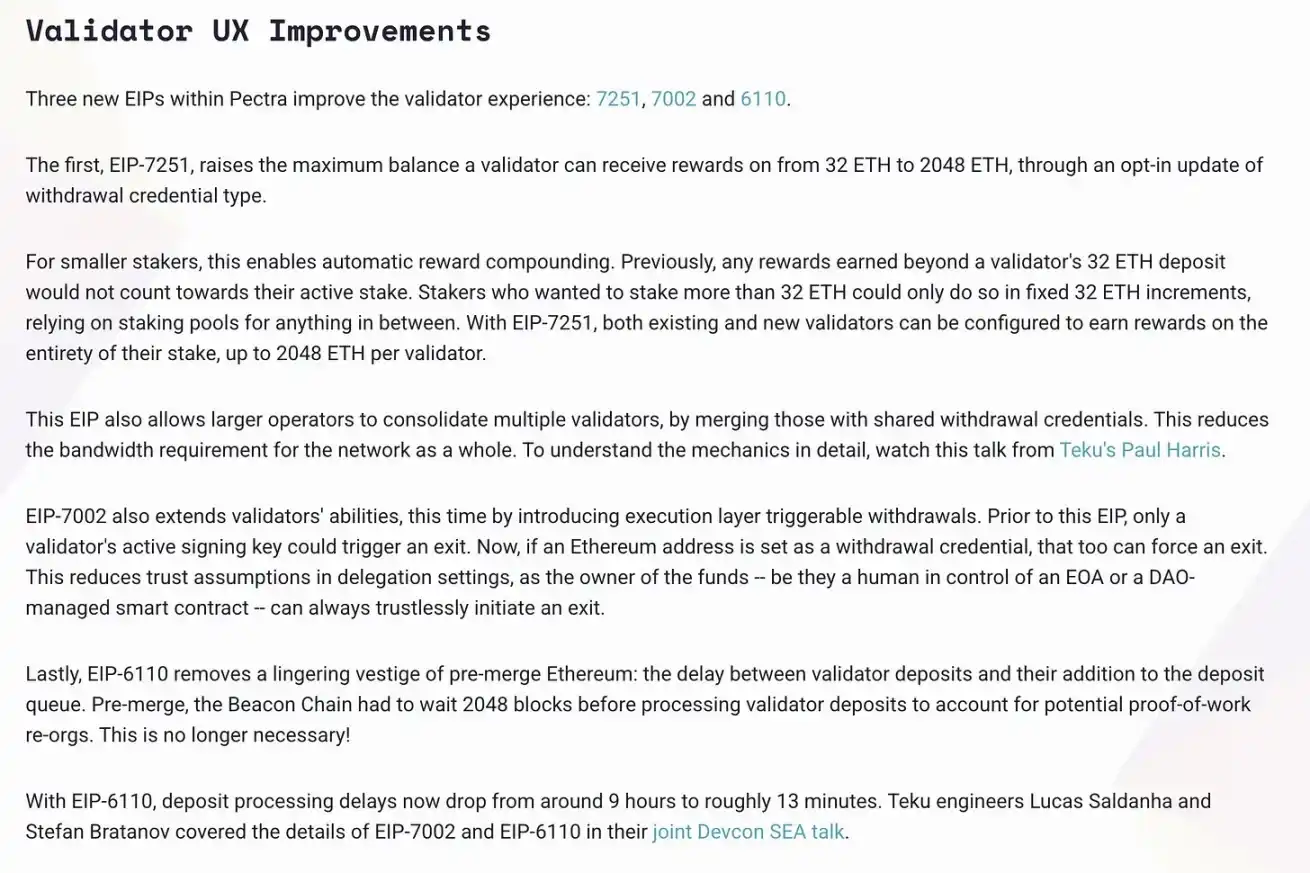
EIP-7251: Increases the validator's maximum balance to 2048 ETH and enables automatic compounding of rewards for larger valid staking balances. Previously, rewards were calculated based on a 32 ETH balance only. Additionally, validators with larger stakes can now consolidate multiple 32 ETH validators into one.
EIP-7002: By setting the execution layer address to a "withdrawable credential", it is allowed to trigger a withdrawal operation, reducing reliance on trust. Previously, only validators could trigger exit operations.
EIP-6110: Eliminates the delay of up to 2048 blocks after validator deposits before being added to the queue. The expected wait time will shrink from 9 hours to 13 minutes.
Enhancing Processing Capabilities of "Data Blobs": EIP-7691
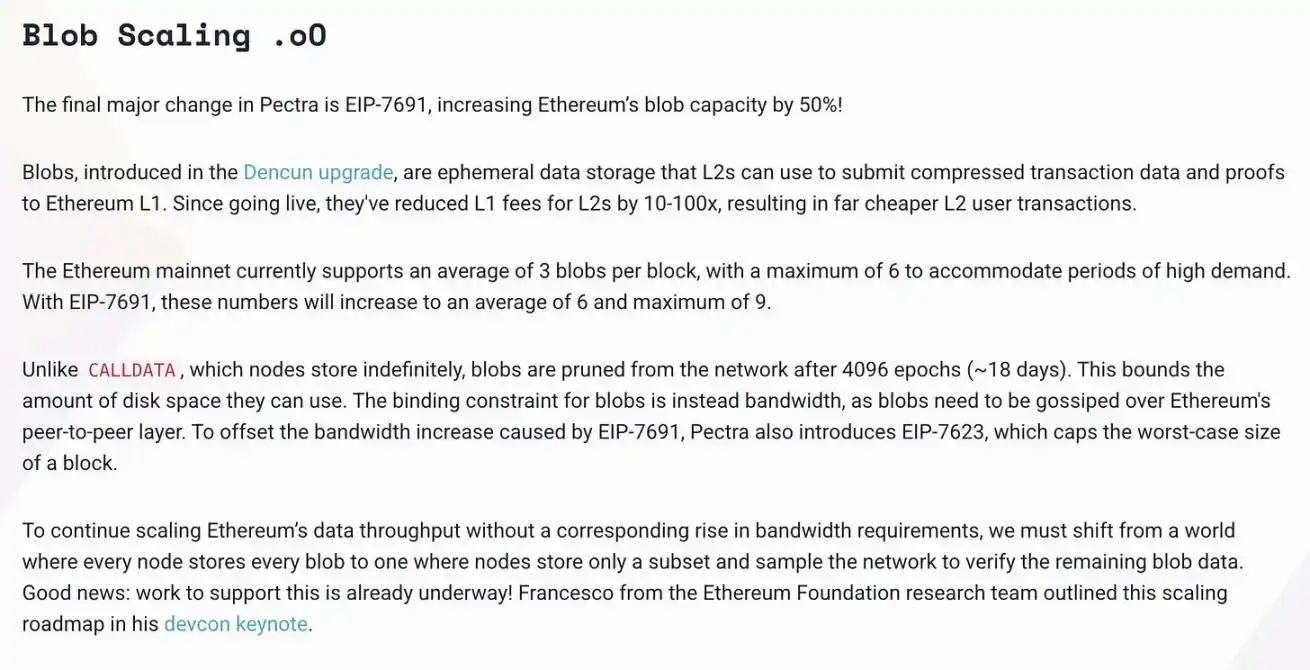
As the cost of "Blob" continues to rise, there is a need to enhance its processing capabilities. Through EIP-7691, the capacity of "Data Blobs" will increase by 50%: currently, each Ethereum block can hold approximately 3 "Data Blobs" on average (up to 6 during peak demand). With EIP-7691, the average number of "Data Blobs" a block can hold will increase to 6, reaching up to 9 during peak demand.
The next step in further expanding the processing capabilities of "Data Blobs" is to reduce the requirement to store all "Data Blobs" and move them to a subnet that can still be used to validate "Data Blob" data.
Other EIPs Included in the Pectra Upgrade
EIP-2537: Increases the security bits of operations from the current 80+ bits to over 120 bits.
EIP-2935: To accommodate the arrival of stateless clients, this proposal suggests storing historical block hash values as part of the block processing logic in the state. By achieving this through contract storage, EIP-2935 allows for a soft transition without impacting block hash logic. Layer 2 networks will be able to leverage longer historical data and query storage contracts directly.
EIP-7549: This proposal aims to improve the efficiency of the Casper client. It achieves this by reducing the number of pairings required for consensus validation. Specifically, it removes one of the three elements in the Casper client proof message: the committee index. By removing this element from the proof message, it is now possible to more efficiently aggregate consensus votes into a block, increasing the number of votes per block from 2 epochs to 8 epochs.
EIP-7623: The proposal to increase the cost of call data outlined in EIP-7623 is one of the most impactful upgrades (especially for Layer 2 networks). The proposal aims to adjust the cost of call data to address the discrepancy between average block size (100 kb) and maximum block size (7.15 MB). This will not affect regular users but will involve transactions primarily used for data publication. The cost increase will be achieved through a base fee that depends on the Gas fee proportion spent on call data operations: this can be accomplished by reducing block size to accommodate more "Data Blobs" or by increasing the Gas limit.
EIP-7685: Introduces a framework for storing requests triggered by smart contracts. This allows validator operations controlled by smart contracts to delegate management operations to the smart contract, reducing the need for intermediaries.
EIP-7840: Introduces a method to "dynamically adjust the target and maximum 'data Blob' per block for each block" through a "blobSchedule" object, instead of passing all values through an API.
This upgrade sends a clear signal for Ethereum. We know these upgrades have been scheduled long ago and are not a response to recent criticism. Nevertheless, this upgrade focuses on making the Ethereum network more secure, improving Ethereum accounts, and expanding the processing capabilities of 'data Blobs,' which aligns with some of the most critical development needs.
You may also like

Latest research from 13 top universities including Cornell University: The current state, challenges, and misconceptions of the fusion of Crypto and AI
Deconstructing Anthropic: The Best AI Company, Possibly Also a Type of Organizational Invention
Apollo and Blackstone Reportedly Back $35 Billion Anthropic Chip Financing as Deal Details Remain Unclear
On June 9, according to currently available news alerts, Apollo and Blackstone Group participated in a $35 billion financing for an Anthropic “chip project.” Based on the original wording of the report, the funding has already been raised, but public information remains limited. The financing structure, use of proceeds, project entity, and whether Apollo and Blackstone participated through equity, debt, or project financing have not yet been disclosed.

Humanity Protocol Security Incident Escalates: More Than $31 Million Stolen From Related Addresses as Attacker Continues Selling H for ETH
On June 9, according to monitoring by Onchain Lens, more than $31 million has been stolen from addresses linked to Humanity Protocol, and the attack is still ongoing, with the hacker continuously swapping H tokens for ETH. Project founder Terence Kwok later confirmed the security incident on X, saying the issue involved a private key leak.

Bloomberg: As Bitcoin Weakens, Stablecoins and RWA Continue to Drive Expansion in Crypto Businesses
In June, Bloomberg reported that despite Bitcoin falling below $60,000 last week, wiping out about $235 billion in market value within seven days, and dropping close to 50% from last year’s peak, some core businesses in the crypto industry are still expanding, mainly in stablecoins, real-world asset tokenization (RWA), payments, and infrastructure. The report also noted that overall altcoin activity has contracted significantly: altcoin market capitalization has fallen from a peak of about $431 billion in November 2021 to around $170 billion, and among the tens of millions of tokens issued in recent years, fewer than 1,700 still maintain meaningful trading activity.

Galaxy Deep Research Report: How Hyperliquid's HIP-4 Upgrade Changes the Landscape of Prediction Markets?
Binance Research: RWA Market Expected to Expand Nearly 6x from Early 2025, with Public Equities and Onchain Payments Heating Up Together
In June, Binance Research said in its monthly market report that the real-world asset (RWA) market is expected to grow by about 589% from the beginning of 2025. Bond- and money market fund-related RWA expanded by about $6.5 billion, up 83% year over year, while publicly traded equity RWAs grew by about 422%. The report also noted that monthly crypto debit card transaction volume exceeded $747 million in May, up 48.6% year to date.

Japan to Assess a Framework for Yen Stablecoins and Crypto ETFs as Asia’s Compliant Payments Narrative Heats Up
Recently, according to the original report, Japan is considering the launch of yen stablecoins and cryptocurrency ETFs. Public information remains limited at this stage, and there is still no complete policy text, regulatory draft, or clear implementation timeline, so this is better characterized as a “policy discussion” rather than formal implementation. The original wording also noted that advancing stablecoin regulation in Asia is driving XRP usage and supporting growth in the XRPL ecosystem. However, based on currently available public information, there is not enough evidence to directly establish a clear causal relationship between this round of discussion in Japan and XRP or XRPL.

ZachXBT: Humanity private key leak and abnormal surge in H token should be viewed separately
On June 9, according to related disclosures, on-chain investigator ZachXBT posted an update on Humanity’s roughly $31 million security incident, saying that after further analyzing fund flows, he currently tends to believe the project team was not involved in an “inside job” or a self-staged attack. According to him, the official explanation about the private key leak was broadly accurate, but before the token unlock, the price of H had been artificially pushed higher, and the hacker later took advantage of that market environment; therefore, the private key leak and the earlier abnormal price pumping should be regarded as two separate and independent events. This reframing has shifted the market’s understanding of the nature of the incident. Earlier discussion around Humanity had focused on whether the team directly participated in the attack or used the security incident to cover up internal operations. ZachXBT’s latest remarks shift the focus from “whether it was self-theft” to “whether there were pre-unlock market structure issues.” He also questioned whether the team may have.

Morning Report | OpenAI has submitted an S-1 registration statement draft to the U.S. SEC; Morpho completes $175 million financing

Morning Report | BitMine increased its holdings by 126,971 ETH last week; trader Eugene announced his exit from the crypto market

Wang Chuan: How can one not feel anxious after the neighbor Old Wang made thirty times profit by investing in storage stocks? (Seven) - A quarter-century cycle
Cryptocurrency CEXs are flocking to sell US stocks, and traditional brokerages are facing an "uninvited guest."
$75 billion in foreign capital has fled, and South Korean retail investors have absorbed it all using leverage

Japan’s Three Megabanks Plan Joint Stablecoin Issuance in Fiscal 2026
MUFG, SMBC, and Mizuho reportedly plan to jointly issue fiat-pegged stablecoins in fiscal 2026, signaling Japan’s growing push into bank-led digital payment infrastructure.

Humanity Discloses H Token Dual-Chain Attack Details, With Losses on Ethereum and BSC Exceeding $36 Million
Humanity said the H token attack across Ethereum and BSC caused more than $36 million in losses after leaked ProxyAdmin keys enabled malicious contract upgrades and token minting.
White House Discusses CLARITY Act With Law Enforcement Ahead of Senate Vote
The White House discussed the CLARITY Act with law enforcement ahead of a Senate vote, focusing on illicit finance risks and developer protections.

Bitcoin Trading Guide 2026: Strategies for Experienced Traders
Latest research from 13 top universities including Cornell University: The current state, challenges, and misconceptions of the fusion of Crypto and AI
Deconstructing Anthropic: The Best AI Company, Possibly Also a Type of Organizational Invention
Apollo and Blackstone Reportedly Back $35 Billion Anthropic Chip Financing as Deal Details Remain Unclear
On June 9, according to currently available news alerts, Apollo and Blackstone Group participated in a $35 billion financing for an Anthropic “chip project.” Based on the original wording of the report, the funding has already been raised, but public information remains limited. The financing structure, use of proceeds, project entity, and whether Apollo and Blackstone participated through equity, debt, or project financing have not yet been disclosed.
Humanity Protocol Security Incident Escalates: More Than $31 Million Stolen From Related Addresses as Attacker Continues Selling H for ETH
On June 9, according to monitoring by Onchain Lens, more than $31 million has been stolen from addresses linked to Humanity Protocol, and the attack is still ongoing, with the hacker continuously swapping H tokens for ETH. Project founder Terence Kwok later confirmed the security incident on X, saying the issue involved a private key leak.
Bloomberg: As Bitcoin Weakens, Stablecoins and RWA Continue to Drive Expansion in Crypto Businesses
In June, Bloomberg reported that despite Bitcoin falling below $60,000 last week, wiping out about $235 billion in market value within seven days, and dropping close to 50% from last year’s peak, some core businesses in the crypto industry are still expanding, mainly in stablecoins, real-world asset tokenization (RWA), payments, and infrastructure. The report also noted that overall altcoin activity has contracted significantly: altcoin market capitalization has fallen from a peak of about $431 billion in November 2021 to around $170 billion, and among the tens of millions of tokens issued in recent years, fewer than 1,700 still maintain meaningful trading activity.
Galaxy Deep Research Report: How Hyperliquid's HIP-4 Upgrade Changes the Landscape of Prediction Markets?


