
Rumors are swirling, can Trump's cancellation of the cryptocurrency capital gains tax become a reality?




Original Title: "Rumors Abound, Can Trump's Abolition of Crypto Capital Gains Tax Become a Reality?"
Original Source: Deep Tide TechFlow
The market is a huge Christmas tree.
Yesterday, the market was still immersed in the bullish sentiment brought about by Trump's support for cryptocurrency. However, before the day was over, Bitcoin plummeted all the way back to the starting point, erasing all the gains brought by Trump's comments, painting a grim picture that made the market uneasy.
But the market, after grasping at a lifeline, did not easily give up on the possibility of digging out more bullish news from Trump.
In the morning of March 4, Alpine Fox LP founder Mike Alfred tweeted that the Trump administration may announce at the crypto summit on Friday that it will award a tax-free capital gains policy on cryptocurrency sales.
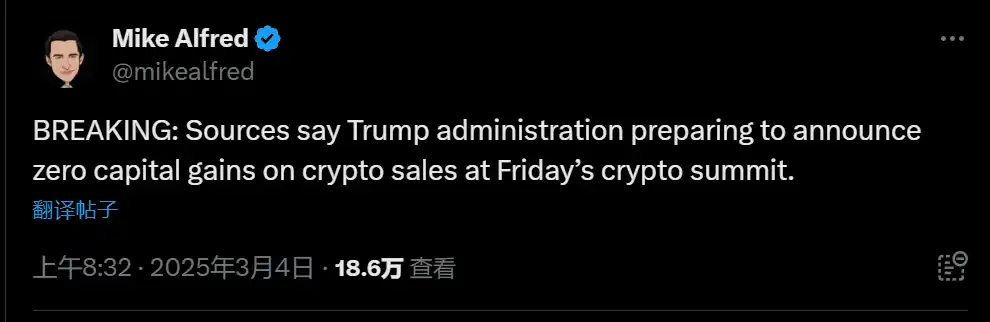
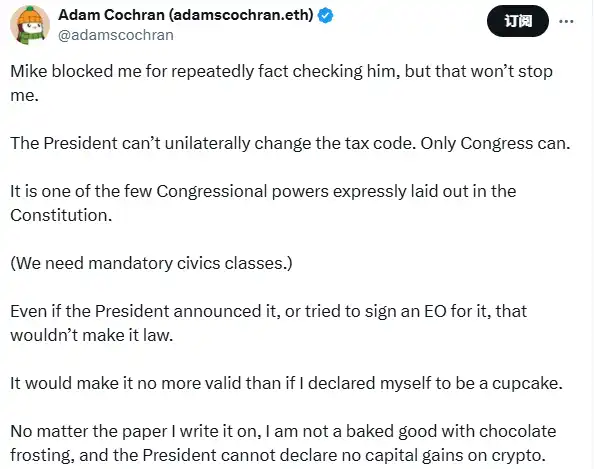
Regarding Mike Alfred's claim of "Trump is preparing to announce a cryptocurrency zero tax rate," Adam Cochran, partner at Cinneamhain Ventures, directly responded, "Mike blocked me because I fact-checked him repeatedly, but that won't stop me. The president cannot unilaterally change tax law. Only Congress can. It is one of the few powers explicitly given to Congress in the Constitution. Even if the president announces the decision, or attempts to sign an executive order for it, it will not make it a law. This is no more effective than me claiming I am a paper cupcake."
Eliminating crypto capital gains tax is a major event for the cryptocurrency market itself, market participants, and the U.S. government.
Regarding the authenticity of such a major event, social media is naturally in a debate.
Setting aside the market noise, let's first look at what impact it would have on the market if crypto becomes tax-free. If it doesn't happen, what factors are constraining it?
How Is Cryptocurrency Taxed Now?
First, let's talk about the current situation. According to Coinbase's tax guide, in the United States, cryptocurrency is not considered "currency," the IRS (Internal Revenue Service) defines cryptocurrency as "property." If you buy Bitcoin, and when its price increases, sell it, the money you earn is subject to capital gains tax. The tax rate also depends on how long you held the asset:

This means that if a U.S. resident buys $10,000 worth of Bitcoin, and after three months, it doubles to $20,000, and they sell, earning $10,000, that $10,000 net profit is subject to income tax rates (10%-37%), possibly losing a few thousand dollars. If they hold it for a year before selling, the tax rate is lower, perhaps paying one or two thousand in tax, or even being tax-exempt if their income is low. However, taxes are inevitable in any case.
Of course, not only transactions, but ordinary income tax on cryptocurrency applies to various activities such as mining, staking, wage payments, airdrops, and any other activities carried out using cryptocurrency as a medium of exchange. Individuals are required to report the fair market value at the time of receipt and pay tax at ordinary income tax rates (10%-37%).
What If Zero Capital Gains Tax Really Happens?
Assuming Trump really abolishes the capital gains tax on cryptocurrency assets, what would be the impact? Setting aside high-level analysis for a moment, let's discuss how the market and ordinary individuals might be affected.
For the market, eliminating tax restrictions would naturally make more U.S. hot money willing to enter the investment scene, while short-term trading behavior would increase due to the lack of tax constraints, amplifying short-term market volatility. Additionally, more cryptocurrency project teams would be attracted by the zero tax policy, leading to major projects relocating to the U.S., making the U.S. the promised "Capital of Cryptocurrency Assets" by Trump.
However, benefiting the market essentially means hurting the government as it would lose billions of dollars in tax revenue annually from cryptocurrency. The government's public budget would need to be recalculated, and expenditures on infrastructure, healthcare, and other areas may need to be adjusted. If ordinary U.S. taxpayers who do not engage in cryptocurrency activities learn that cryptocurrency millionaires are exempt from taxes while they still have to honestly pay income tax, it may lead to a sense of unfairness.
In conclusion, if the current U.S. cryptocurrency capital gains tax has no effect on you, the impact of the (potential) tax-free policy on your personal cryptocurrency gains would require a specific analysis of the situation. Describing it simply as positive or negative may not be appropriate.
Rumors Abound, but Can It Really Happen?
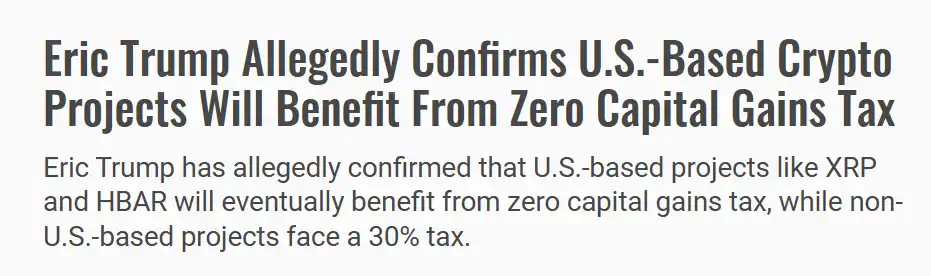
There has been ongoing news about changes to cryptocurrency taxation. In January, The Street reported that Eric Trump, who is enthusiastic about participating in cryptocurrency activities, confirmed that top U.S. cryptocurrency projects such as XRP and HBAR would enjoy zero capital gains tax benefits, while non-U.S. projects would face over 30% capital gains tax.
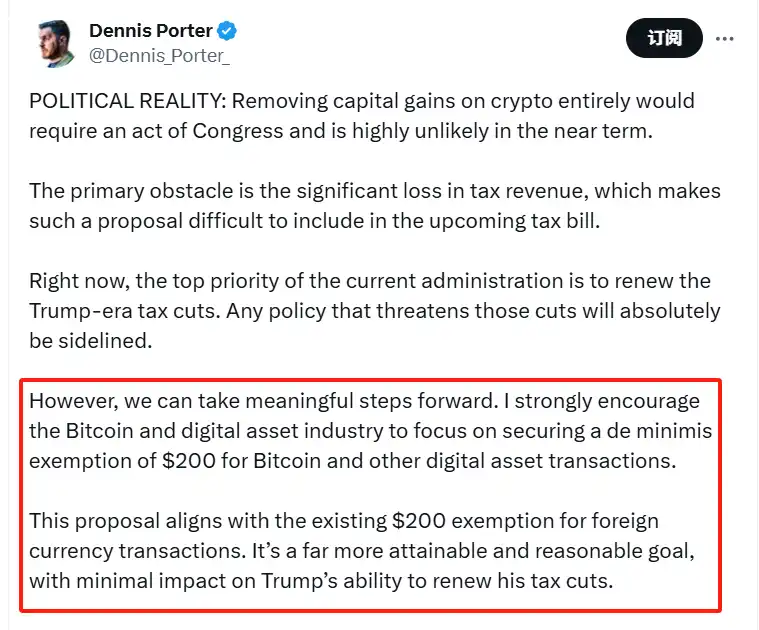
Meanwhile, Dennis Porter, co-founder of the Satoshi Action Fund, stated that completely abolishing cryptocurrency taxes is impractical in the short term, but changes such as "minimum exemption amounts" could be pursued.
So, even though the slogans are loud, tax laws are not solely at the discretion of Trump.
The U.S. Constitution stipulates that changes in tax policies must be approved by Congress, so even if the Republican Party supports it, the Democratic Party may not.
As the U.S. local tax law system itself is complex, each state has its own specific policies, making it a lengthy issue to unify opinions.
Conclusion: Dreams Are Good, But Perhaps Need to Wait
Moving away from just the idea of eliminating capital gains tax on crypto assets, it is an incredibly beautiful wish for the vast market participants. If it comes true, it would certainly lift the currently struggling market for another round of battle. However, returning to reality, the market changes after a zero tax rate and a series of social issues are hurdles that policymakers cannot avoid. Therefore, this wish may only hold expectations in the short term.
In the author's view, this seems more like one of the many fantasies painted for the crypto market. It looks appealing, but whether you can actually enjoy it in the end depends on Congress's mood. For retail investors like us, we can dream, but we also need to hold onto our wallets tightly. Don't go all-in on your future at the first hint of good news.

You may also like

Raydium Old Liquidity Pool Reportedly Exploited, With $1.34 Million Moved to Ethereum and Tornado Cash
An old Raydium liquidity pool was reportedly exploited for around $1.34 million in USDC, RAY, and wSOL, with the stolen funds bridged to Ethereum and deposited into Tornado Cash. The incident highlights the tail risks of legacy DeFi pools, old contracts, and cross-chain fund laundering paths.

Kalshi Executive Challenges “SBF Backed AI Unicorns” Narrative, Says Leopold Aschenbrenner Was Key Figure
Kalshi executive John Wang questioned the “SBF backed AI unicorns” narrative, saying Leopold Aschenbrenner was the key figure behind major AI investment decisions.

Pantera Capital Partner: How Tokenization is Restructuring the Private Equity and Early Investment Ecosystem?

New York Proposes Stricter Stablecoin Issuer Rules Aligned With Federal GENIUS Act
NYDFS proposed stricter stablecoin issuer rules aligned with the GENIUS Act, covering reserves, custody, redemption timelines, audits, and capital buffers.
Every exchange is a "Universal Exchange."

The counterattack of traditional finance: Alliance chains are quietly reviving

CryptoQuant Says Bitcoin Profitable Supply Is Near 45% Pressure Zone as On-Chain Data Points to Market Repricing
CryptoQuant said Bitcoin’s profitable supply is nearing the 45% pressure zone, signaling rising market stress, unrealized losses, and a possible on-chain repricing phase.

Bitcoin Falls Below 200-Week Moving Average as On-Chain Data Shows Over Half of Supply in Loss
Bitcoin dropped below its 200-week moving average as on-chain data showed over 50% of circulating supply is now in loss, signaling rising market stress.

CFTC Reportedly Plans New Prediction Market Rules Focused on Manipulation Risk and Public Interest Review
The CFTC is reportedly preparing new prediction market rules focused on manipulation risk, public interest review, and retail trader protections.

Meet the new WEEX trial fund—your gateway to greater profits

WEEX Labs Lands at Dutch Blockchain Week: A Disruptive Crypto × AI Conversation Sets Sail in Amsterdam

SK Hynix Reportedly Plans U.S. ADR Listing as Early as August, With SEC Approval Possible in Late June
SK Hynix may pursue a U.S. ADR listing as early as August, with SEC approval reportedly possible in late June amid strong AI chip supply chain demand.

SpaceX vs Tesla vs xAI: Which Elon Musk Trade Has the Biggest Upside in 2026?
OpenAI Reveals It Has Confidentially Submitted an S-1 to the SEC, Keeping the Door Open for a Future IPO
On June 9, according to an OpenAI announcement, the company recently confidentially submitted a draft S-1 registration statement to the U.S. Securities and Exchange Commission (SEC), beginning the preliminary compliance process for a potential initial public offering. OpenAI said it chose to disclose this proactively because it expected the news might leak; however, the company has not yet set a specific listing timeline, and related arrangements may still take some time.
Latest research from 13 top universities including Cornell University: The current state, challenges, and misconceptions of the fusion of Crypto and AI
Deconstructing Anthropic: The Best AI Company, Possibly Also a Type of Organizational Invention
Apollo and Blackstone Reportedly Back $35 Billion Anthropic Chip Financing as Deal Details Remain Unclear
On June 9, according to currently available news alerts, Apollo and Blackstone Group participated in a $35 billion financing for an Anthropic “chip project.” Based on the original wording of the report, the funding has already been raised, but public information remains limited. The financing structure, use of proceeds, project entity, and whether Apollo and Blackstone participated through equity, debt, or project financing have not yet been disclosed.

Humanity Protocol Security Incident Escalates: More Than $31 Million Stolen From Related Addresses as Attacker Continues Selling H for ETH
On June 9, according to monitoring by Onchain Lens, more than $31 million has been stolen from addresses linked to Humanity Protocol, and the attack is still ongoing, with the hacker continuously swapping H tokens for ETH. Project founder Terence Kwok later confirmed the security incident on X, saying the issue involved a private key leak.
Raydium Old Liquidity Pool Reportedly Exploited, With $1.34 Million Moved to Ethereum and Tornado Cash
An old Raydium liquidity pool was reportedly exploited for around $1.34 million in USDC, RAY, and wSOL, with the stolen funds bridged to Ethereum and deposited into Tornado Cash. The incident highlights the tail risks of legacy DeFi pools, old contracts, and cross-chain fund laundering paths.
Kalshi Executive Challenges “SBF Backed AI Unicorns” Narrative, Says Leopold Aschenbrenner Was Key Figure
Kalshi executive John Wang questioned the “SBF backed AI unicorns” narrative, saying Leopold Aschenbrenner was the key figure behind major AI investment decisions.
Pantera Capital Partner: How Tokenization is Restructuring the Private Equity and Early Investment Ecosystem?
New York Proposes Stricter Stablecoin Issuer Rules Aligned With Federal GENIUS Act
NYDFS proposed stricter stablecoin issuer rules aligned with the GENIUS Act, covering reserves, custody, redemption timelines, audits, and capital buffers.
Every exchange is a "Universal Exchange."
The counterattack of traditional finance: Alliance chains are quietly reviving


