
Soon to come "Santa Rally," which is more promising, Bitcoin or Gold?

Original Title: "Santa Claus Rally": Bitcoin vs. Gold
Original Author: Ashrith Rao, Blockhead
Original Translation: Chopper, Foresight News
The so-called "Santa Claus Rally" refers to the phenomenon where the cryptocurrency market typically experiences a price surge in the last few weeks of December to early January. This trend is driven by multiple factors, including annual portfolio rebalancing by institutions and traders, as well as a seasonal boost in investor confidence.
During the holiday period, market liquidity decreases, which can amplify price fluctuations, further fueling the upward momentum. There is a noticeable difference in the market behavior of crypto assets between the full year and the Christmas period. While this trend originated in the traditional stock market, it has begun to manifest in the gold market and more recently in the Bitcoin market.
Whenever global markets slow down due to holidays, market participants reassess the possibility of a Santa Claus Rally. During periods of low liquidity or shifts in market sentiment, the reactions of gold and Bitcoin may vary significantly.
Now investors are discussing: in the anticipated seasonal uptrend in December, which asset, gold or Bitcoin, will benefit more?
To protect wealth from the impact of inflation, people have been buying gold for generations. Central banks around the world also hold significant amounts of gold in reserve as a crucial part of their foreign exchange reserve management and monetary policy.
At the end of each year, the seasonal demand for gold tends to rise, driven by various factors:
· During festivals and wedding seasons in India and China, jewelry purchases typically increase;
· Central banks continue to adjust their reserve structures, leaning towards increasing their gold holdings;
· Institutions engage in year-end risk management and portfolio adjustments.
Gold's Holiday Performance
December is not typically a month of surging gold prices but rather a gradual uptrend. During economic downturns or geopolitical unrest, gold often exhibits more safe-haven characteristics than other assets.
Although the price of gold may fluctuate with overall economic conditions, it rarely delivers the staggering returns seen in cryptocurrencies.
Nevertheless, this year, the price of gold has been soaring, reaching historic highs multiple times, with a peak of $4380 per ounce, followed by an unprecedented pullback.
Over the past few weeks, gold has rebounded from a steep decline, with the current trading price surpassing $4,100 per ounce, showing a strong performance. In this highly active trading market, long positions have seen significant profits.
With the end of the U.S. government shutdown and the national debt expected to reach a historical high of $40 trillion, this precious metal has bounced back from a deep decline.
Currently, the price of gold is only 7% away from its all-time high, and investors are well aware that after the government shutdown, deficit spending will only increase further.
Bitcoin: A New Choice for Value Storage
Since Bitcoin's price touched around $16,000 in November 2022, the view that "Bitcoin is digital gold" has been widely recognized, and its price has continued to rise.
On December 5, 2024, Bitcoin first broke through the $100,000 mark, and has since repeatedly reached that level. During the peak period in October of this year, Bitcoin's price surpassed $125,000, but like gold, it then experienced a sharp pullback.
Nevertheless, Bitcoin has generally held above the key psychological level of $100,000, only briefly dipping below this level on a few occasions.
Bitcoin's decentralized structure and fixed supply of 21 million coins make it a potential choice to hedge against currency inflation.
However, overall, Bitcoin is considered a riskier investment compared to gold: when investor confidence is high, its price may skyrocket; when confidence is low, it could also see a sharp drop.
From historical data, Bitcoin's performance in the fourth quarter of each year has often been noteworthy.
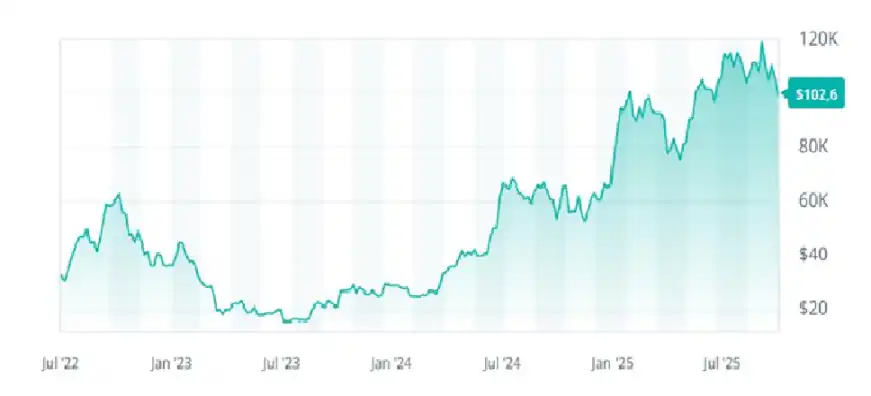
Data Source: TradingView
Macroeconomic Factors Drive This Year's Core Momentum
This year, the economic situation has become the most critical factor determining whether the Christmas rebound will occur as expected.
Market liquidity, inflation metrics, and central bank policies around the world (especially the Fed's policy) are all key driving factors.
At the October 2025 Fed interest rate meeting, the central bank cut the federal funds rate by 25 basis points, setting the new target range at 3.75%-4.00%. This rate cut was in line with market expectations and was another move after the September cut, bringing borrowing costs to the lowest level since the end of 2022.
A decrease in interest rates usually leads to a depreciation of the U.S. dollar, which may in turn increase investors' interest in alternative assets such as Bitcoin.
A report shows that in September 2025, the official inflation rate in the United States was 3.0%, higher than August's 2.9%; however, the core inflation rate saw a slight decrease from 3.1% to 3.0%. During times of high inflation, the market's focus on alternative assets like Bitcoin and the safe-haven asset gold tends to significantly increase.
Unlike traditional assets, Bitcoin's liquidity exhibits higher volatility.
Institutional buying behavior of Bitcoin Exchange-Traded Funds (ETFs) and small fund inflows can both have a significant impact on short-term price fluctuations.
The core difference between the two assets lies in their buyer base: gold's main buyers are jewelry manufacturers, sovereign wealth funds, and central banks, while Bitcoin's core supporters are young digital currency enthusiasts, tech pioneers, and retail investors.
Comparison of Gold and Bitcoin Performance
Over the past few years, both assets have experienced synchronous rallies, especially notable in 2025. However, there have also been instances of "one asset rallying first, followed by the other asset entering an uptrend."
In 2020, in response to the economic downturn caused by the pandemic, various governments implemented large-scale stimulus plans. With fiat currency depreciation, investors seeking asset preservation flocked to assets with stability guarantees.
At the beginning of the year, gold prices surged; in the latter half of the year, Bitcoin gained momentum. In December 2020, gold closed at $1900, a slight increase, while Bitcoin approached its interim high and closed at around $29,000.
This case illustrates that during periods of ample market liquidity and low interest rates, Bitcoin's performance tends to outshine traditional assets like gold. In
From 2021 to 2022, as inflation soared, central banks worldwide hiked interest rates significantly.
During this market crash period, speculative assets like Bitcoin suffered heavy losses. Market participants turned to gold, a traditional safe-haven asset, and its price experienced multiple rallies, demonstrating exceptional resilience.
This indicates that during times of monetary tightening and market pressure, gold's ability to preserve value usually surpasses that of Bitcoin.
With the government shutdown causing data freeze, now that the Washington fiscal standoff has ended, the release of inflation data will to a large extent determine which of the two asset classes will win the Christmas rally.
You may also like

Why does OKX want to start a new company with the parent company of the New York Stock Exchange?

The interim executive director of the Ethereum Foundation speaks out: What is our mission?

Standard Chartered Bank sings a 50x rhapsody again, aiming for AAVE to reach 3500 USD
Tidal Investment: We still have a positive outlook on the AI industry chain, but the reasons have changed

Former SpaceX engineer reconstructs the financial execution system using first principles

Why Is PAXG Price Different From Gold? 5 Reasons Crypto Traders Should Know

The cryptocurrency industry has entered the "Show Me" era: merely relying on vision is no longer enough

WEEX OpenAPI 101: 5 Powerful Modules, AI Trading Tools, and Grab Up to 70% Revenue Opportunities
Learn how WEEX OpenAPI connects traders, developers, AI agents, and trading platforms. Discover WEEX API features, Binance-compatible integration, automated trading workflows, revenue opportunities, and ecosystem possibilities.

Morning News | The draft amendment to the People's Bank of China Law aims to clarify the legal status of digital renminbi; South Korea will transfer about 40 unregistered virtual asset service providers to law enforcement agencies

Interpreting the Ethereum Foundation's new structure: Reaffirming self-sovereignty amid institutional trends

Interview with NDV Founder Jason Huang: Popping the AI Bubble and the Myth of Microstrategy, Seeking the Ultimate Ace in the Crypto Market
Morning Report | Former Ethereum Foundation researcher establishes Ethlabs; EU Parliament Economic Committee passes digital euro regulatory proposal

Dragonfly partner Haseeb: The fastest-growing companies in the future may all be stuck at 149 people

How xBubble Breaks the Deadlock in VC's Heavy Investment in the OPC Economy

The encrypted unicorn Blockstream is deeply embroiled in a serious fraud case

Morning Report | The South Korean Financial Services Commission plans to expand the regulatory sandbox to include virtual assets; the parent company of the New York Stock Exchange, ICE, has reached a partnership with OKX to jointly establish a cryptocu...

Exclusive Interview with Strategy CEO: Putting Aside the Sale of 32 BTC, the 60 Trillion AI Intelligence is the Ultimate Fate of Bitcoin

TRON revitalizes the image of the bull, creating a more approachable brand character
Why does OKX want to start a new company with the parent company of the New York Stock Exchange?
The interim executive director of the Ethereum Foundation speaks out: What is our mission?
Standard Chartered Bank sings a 50x rhapsody again, aiming for AAVE to reach 3500 USD
Tidal Investment: We still have a positive outlook on the AI industry chain, but the reasons have changed
Former SpaceX engineer reconstructs the financial execution system using first principles
Why Is PAXG Price Different From Gold? 5 Reasons Crypto Traders Should Know


