
US Stock Market Loses $1.5 Trillion, Cryptocurrency Market Loses $300 Billion, Trump Holds Ultra-Expensive Press Conference




Last night, the Dow Jones Index opened up 300 points, but then quickly spiraled downward, dropping 1,100 points in a matter of hours. Between 10:00 a.m. and 3:30 p.m. Eastern Time, the market capitalization of the S&P 500 Index evaporated by $1.5 trillion. At the same time, the cryptocurrency market saw a nearly $300 billion evaporation in market value.
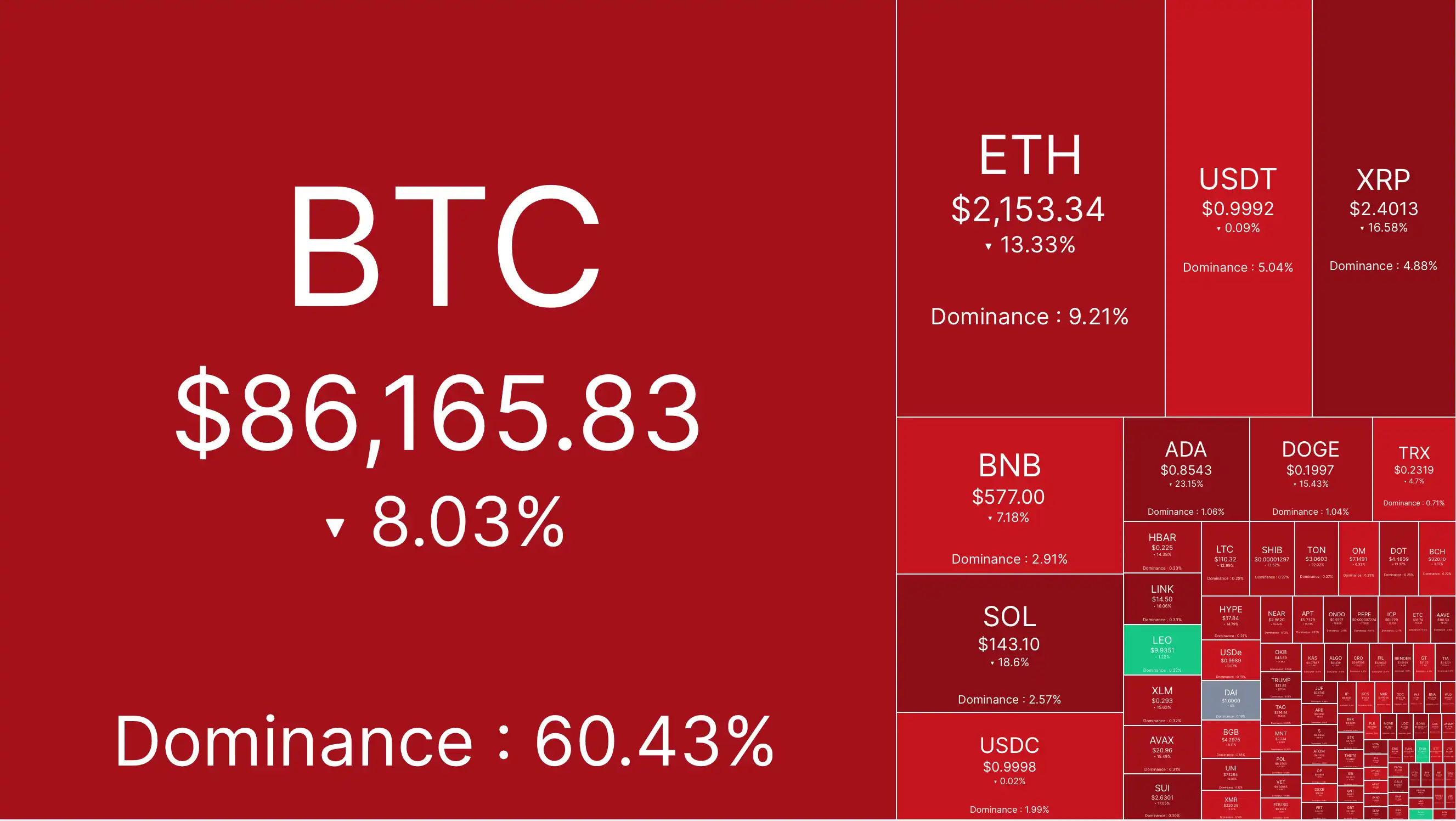
On Sunday, following a surge in the crypto market after President Trump announced plans to establish a strategic reserve for cryptocurrencies like SOL, XRP, and ADA, Trump swiftly executed a "reverse washout" in the stock market, leading to a steep decline in the crypto market as well. The entire capital market once again experienced a "violent" move by the President. What exactly happened? It all seemed to stem from a press conference held by President Trump...
Investing in TSMC, Easing Russia
Last night, the S&P 500 Index opened with an increase of about 30 points, following the trend from the previous Friday. However, shortly after, the Trump administration issued an "investment declaration," triggering selling pressure in the market.
Trump announced a $100 billion investment in TSMC in the United States, which includes:
1. Establishing 5 factories in Arizona;
2. Creating thousands of jobs;
3. Bringing TSM's total investment in the U.S. to $165 billion;
4. Generating "hundreds of billions of dollars in economic activity"
In the announcement, Trump stated that this investment plan would advance America's long-standing goal of revitalizing the U.S. semiconductor industry. For the capital market, this undoubtedly exacerbates the ongoing concerns over the Taiwan Strait issue.
Simultaneously, as President Trump made the announcement last night, The Wall Street Journal strategically published a report on Ukraine, stating that the Trump administration has officially ceased funding for the sale of new weapons to Ukraine. Subsequently, a report by Reuters indicated that the U.S. is working on a plan to ease sanctions on Russia.
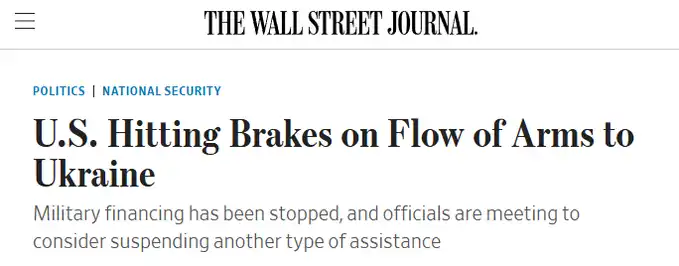
Prior to this, the Ukraine crisis had reached a stalemate due to a "live broadcast quarrel" between two presidents. The move to ease tensions with Russia is seen as favoring Russia and is considered unfavorable for further peace talks.
Tariff Turmoil
Following the investment announcement, Trump immediately moved to a question-and-answer session, further fueling market panic selling.

First, Trump confirmed that starting on March 4, a 25% tariff will be imposed on Canada and Mexico. Later, a reporter asked, "Regarding the tariffs, is there still room for Canada and Mexico to reach an agreement before midnight?" To this, Trump stated that there is no room for further negotiations on tariffs with Mexico and Canada.
Trump then announced that starting on April 2, tariffs will be imposed on imported agricultural products. Even worse, he stated that tariffs will be imposed on countries that engage in "currency devaluation tactics" as a sanction. Shortly after, the White House issued a statement announcing that Trump had signed an executive order to increase tariffs on China to 20%.
This means that tariffs on China have increased by 20 percentage points in 2 months. In comparison, it took Trump two years in his first term to raise tariffs on China to such a high level. Under the heavy blow of tariffs, the US stock market instantly evaporated $1.5 trillion...
Strategic Reserve Implementation Unlikely
During this press conference, Trump did not mention a single word about the previously mentioned cryptocurrency strategic reserve. This has also raised doubts in the market about his sincerity and the real ability of this administration.
BitMEX co-founder Arthur Hayes mentioned in a tweet some time ago that the fundamental problem with governments stockpiling any asset is that their trading of assets is primarily for political gain rather than financial gain. And those building truly decentralized technologies and applications do not have enough funds to play politics at this critical time in the cycle.
Yesterday, Arthur further commented that he believes the government simply does not have the money to purchase the needed cryptocurrency assets for a strategic reserve, "There is nothing new here, just talk. Let's talk when the crypto working group gets congressional approval to borrow money or revalues gold." Arthur believes that unless Trump moves towards a "Bitcoin" national reserve, the market will take a turn for the worse.
You may also like

Pantera Capital Partner: How Tokenization is Restructuring the Private Equity and Early Investment Ecosystem?

New York Proposes Stricter Stablecoin Issuer Rules Aligned With Federal GENIUS Act
NYDFS proposed stricter stablecoin issuer rules aligned with the GENIUS Act, covering reserves, custody, redemption timelines, audits, and capital buffers.
Every exchange is a "Universal Exchange."

The counterattack of traditional finance: Alliance chains are quietly reviving

CryptoQuant Says Bitcoin Profitable Supply Is Near 45% Pressure Zone as On-Chain Data Points to Market Repricing
CryptoQuant said Bitcoin’s profitable supply is nearing the 45% pressure zone, signaling rising market stress, unrealized losses, and a possible on-chain repricing phase.

Bitcoin Falls Below 200-Week Moving Average as On-Chain Data Shows Over Half of Supply in Loss
Bitcoin dropped below its 200-week moving average as on-chain data showed over 50% of circulating supply is now in loss, signaling rising market stress.

CFTC Reportedly Plans New Prediction Market Rules Focused on Manipulation Risk and Public Interest Review
The CFTC is reportedly preparing new prediction market rules focused on manipulation risk, public interest review, and retail trader protections.

Meet the new WEEX trial fund—your gateway to greater profits

WEEX Labs Lands at Dutch Blockchain Week: A Disruptive Crypto × AI Conversation Sets Sail in Amsterdam

SK Hynix Reportedly Plans U.S. ADR Listing as Early as August, With SEC Approval Possible in Late June
SK Hynix may pursue a U.S. ADR listing as early as August, with SEC approval reportedly possible in late June amid strong AI chip supply chain demand.

SpaceX vs Tesla vs xAI: Which Elon Musk Trade Has the Biggest Upside in 2026?
OpenAI Reveals It Has Confidentially Submitted an S-1 to the SEC, Keeping the Door Open for a Future IPO
On June 9, according to an OpenAI announcement, the company recently confidentially submitted a draft S-1 registration statement to the U.S. Securities and Exchange Commission (SEC), beginning the preliminary compliance process for a potential initial public offering. OpenAI said it chose to disclose this proactively because it expected the news might leak; however, the company has not yet set a specific listing timeline, and related arrangements may still take some time.

Latest research from 13 top universities including Cornell University: The current state, challenges, and misconceptions of the fusion of Crypto and AI
Deconstructing Anthropic: The Best AI Company, Possibly Also a Type of Organizational Invention
Apollo and Blackstone Reportedly Back $35 Billion Anthropic Chip Financing as Deal Details Remain Unclear
On June 9, according to currently available news alerts, Apollo and Blackstone Group participated in a $35 billion financing for an Anthropic “chip project.” Based on the original wording of the report, the funding has already been raised, but public information remains limited. The financing structure, use of proceeds, project entity, and whether Apollo and Blackstone participated through equity, debt, or project financing have not yet been disclosed.

Humanity Protocol Security Incident Escalates: More Than $31 Million Stolen From Related Addresses as Attacker Continues Selling H for ETH
On June 9, according to monitoring by Onchain Lens, more than $31 million has been stolen from addresses linked to Humanity Protocol, and the attack is still ongoing, with the hacker continuously swapping H tokens for ETH. Project founder Terence Kwok later confirmed the security incident on X, saying the issue involved a private key leak.

Bloomberg: As Bitcoin Weakens, Stablecoins and RWA Continue to Drive Expansion in Crypto Businesses
In June, Bloomberg reported that despite Bitcoin falling below $60,000 last week, wiping out about $235 billion in market value within seven days, and dropping close to 50% from last year’s peak, some core businesses in the crypto industry are still expanding, mainly in stablecoins, real-world asset tokenization (RWA), payments, and infrastructure. The report also noted that overall altcoin activity has contracted significantly: altcoin market capitalization has fallen from a peak of about $431 billion in November 2021 to around $170 billion, and among the tens of millions of tokens issued in recent years, fewer than 1,700 still maintain meaningful trading activity.

Galaxy Deep Research Report: How Hyperliquid's HIP-4 Upgrade Changes the Landscape of Prediction Markets?
Pantera Capital Partner: How Tokenization is Restructuring the Private Equity and Early Investment Ecosystem?
New York Proposes Stricter Stablecoin Issuer Rules Aligned With Federal GENIUS Act
NYDFS proposed stricter stablecoin issuer rules aligned with the GENIUS Act, covering reserves, custody, redemption timelines, audits, and capital buffers.
Every exchange is a "Universal Exchange."
The counterattack of traditional finance: Alliance chains are quietly reviving
CryptoQuant Says Bitcoin Profitable Supply Is Near 45% Pressure Zone as On-Chain Data Points to Market Repricing
CryptoQuant said Bitcoin’s profitable supply is nearing the 45% pressure zone, signaling rising market stress, unrealized losses, and a possible on-chain repricing phase.
Bitcoin Falls Below 200-Week Moving Average as On-Chain Data Shows Over Half of Supply in Loss
Bitcoin dropped below its 200-week moving average as on-chain data showed over 50% of circulating supply is now in loss, signaling rising market stress.


