
What's Next for the Top Zcash Fork in This Round of Mimicry?

Over the past 2 months, ZEC, which has surged nearly 10x and followed its own independent trend, has always been the focus of the market. The logical discussions surrounding ZEC have gradually evolved from early endorsements of privacy concepts by figures such as Naval, Arthur Hayes, and Ansem, to a stage where the debate is between the bullish view based on real privacy use cases and the bearish view based on coin hashrate and mining rewards.
So, apart from endorsements by well-known figures, what are the detailed arguments for the bullish and bearish views on ZEC?
Bullish View
Regulation-Induced "Safe Haven Premium"
At first glance, regulatory tightening may seem to suppress privacy coins, but in reality, it is the opposite; it is precisely due to regulatory pressure that the demand for privacy is being stimulated.
Regulatory tightening at the policy level is accelerating. The draft of the EU's Anti-Money Laundering Directive clearly states that by 2027, privacy coins will be completely restricted from transactions within the EU; the U.S. Financial Crimes Enforcement Network (FinCEN) is also planning to enhance scrutiny of "high-risk self-hosted wallets." With Bitcoin and Ethereum spot ETFs coming into the regulatory spotlight, all on-chain transactions are facing stricter tracking.
As compliant assets become more transparent, privacy assets become scarce. Therefore, Western media has even named this round of the market movement "Crypto Anti-Surveillance Wave." ZEC and XMR have been redefined as the "last line of on-chain anonymity defense." The consensus on social media is more direct: "Privacy is not a feature but a fundamental right."
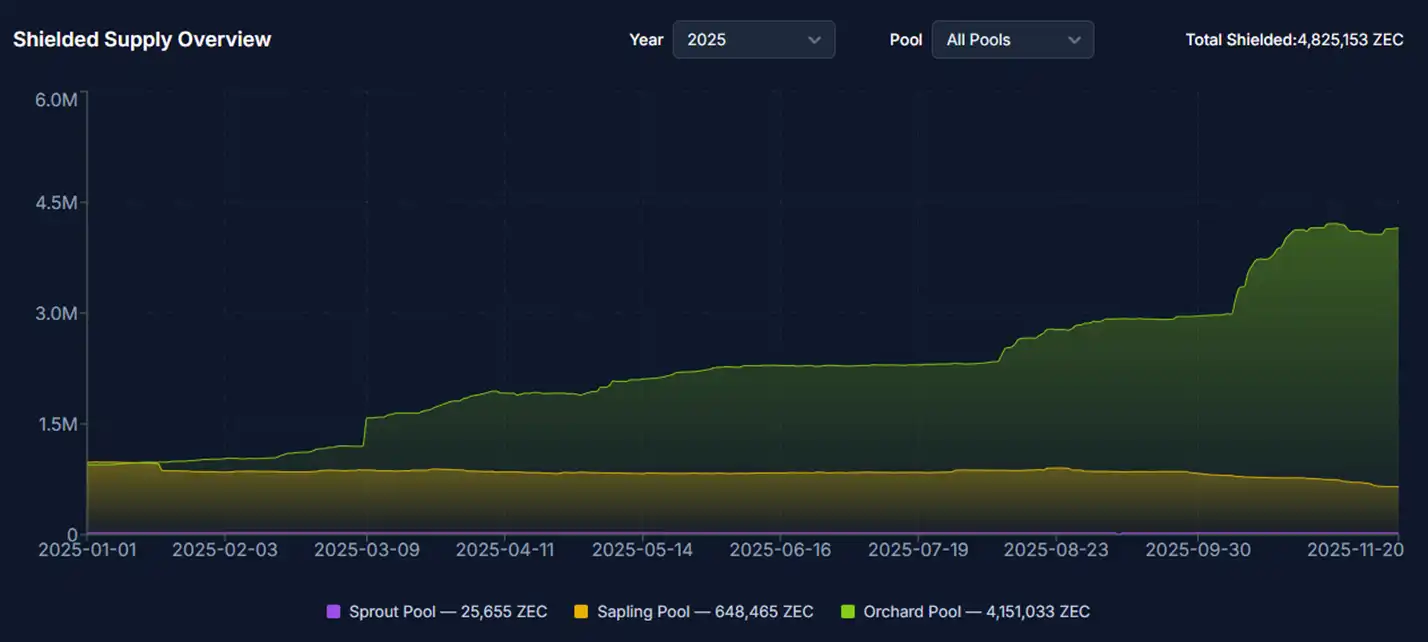
On-chain data confirms the growth of real demand. ZEC shielded pool balances have grown from just under 2 million coins at the beginning of this year to approximately 4.8 million coins today, an increase of 140%; shielded transaction counts have also increased with the overall network activity, reaching approximately 10% weekly.
In the recent two major "BTC Whale Asset Cases," the cases of Chen Zhi and Qian Zhimin, a total of over 180,000 BTC involved has prompted the market to reevaluate Bitcoin's real boundaries in narratives such as "anti-surveillance" and "anonymity." With the launch of BTC ETFs, deep institutional involvement, and further regulatory demands for transparency in the crypto asset sector, Bitcoin's early narrative centered on anonymity and anti-surveillance is gradually fading from the mainstream stage.
If BTC also struggles to maintain its role as an "anti-surveillance currency," then who will be the next symbol of privacy and on-chain asset storage? The market's answer may have already emerged—ZEC, which is currently moving against the trend at this point in time, is becoming the suitable "answer version."
Institutional Money Returning
Grayscale's Grayscale ZEC Trust relaunch was the most significant event in October. On October 1st, Grayscale announced the reopening of new subscriptions for the ZCSH Trust, offering two major upgrades: first, a waiver of management fees, and second, the addition of staking functionality, providing a 4-5% annualized yield. This one-two punch significantly improved the risk-return ratio.
Over the past decade, Grayscale has been almost the sole compliant bridge and price oracle for traditional institutional exposure to crypto assets. Its trusts issued in the U.S. have long provided crypto exposure to pensions, family offices, and hedge funds, making it a leading indicator of institutional entry scale and preference shifts.
Since launching its first Bitcoin trust in 2013, Grayscale has subsequently expanded to ETH, SOL, LTC, BCH, ETC, FIL, XLM, and over a dozen single-asset trusts. Several assets have experienced the typical "Grayscale Effect" — capital inflows driving price appreciation, premium expansion, and consensus narrative formation. The ZEC Trust (ZCSH) was established in 2017 and also experienced a surge in premium during the 2020-2021 bull market, becoming a key target for institutional allocation in the privacy sector.
However, due to increased regulatory scrutiny and privacy coins facing compliance pressures, ZCSH paused subscriptions in 2022 and went into dormancy in 2023. This relaunch signifies Grayscale's renewed endorsement of privacy assets, with its signaling significance often outweighing the actual funds.
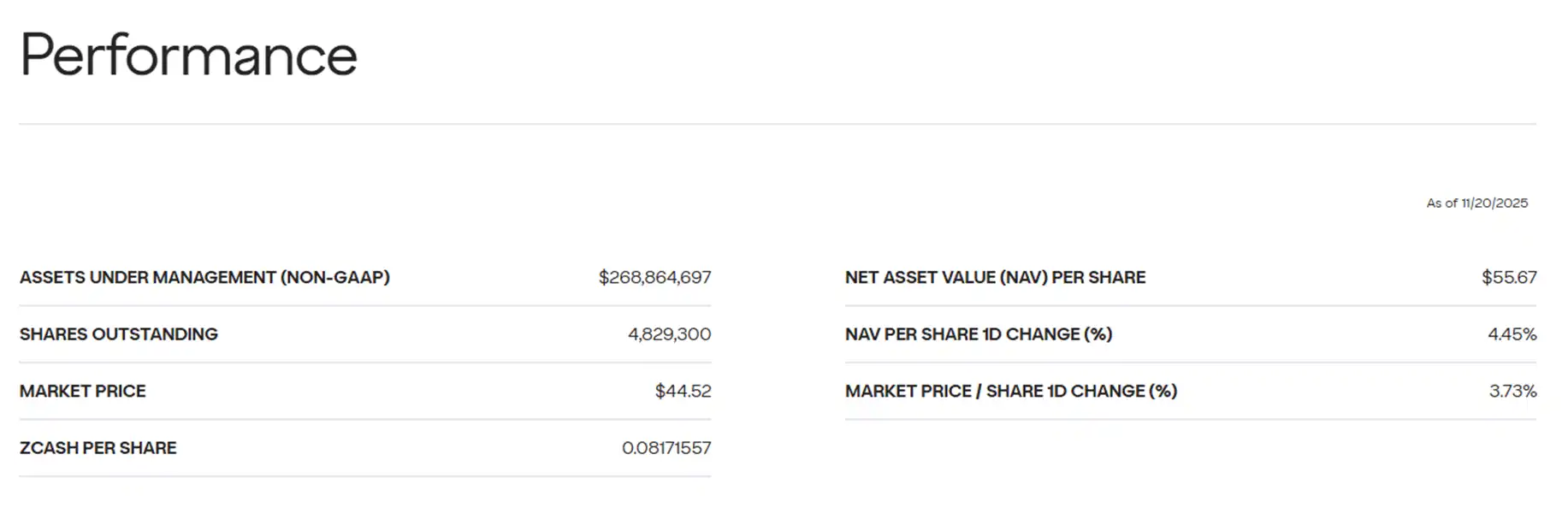
Data shows that ZCSH's Assets Under Management (AUM) have increased from around $42 million just over a month ago to $269 million, representing approximately 2.4% of ZEC's circulating supply. For an asset with daily trading volumes in the billions of dollars, nearly 2.5% of the chips are long-term locked in the trust, leading to significant supply-side constraints.
A deeper logic is the ETF's circuitous effect. The approval of Bitcoin and Ethereum spot ETFs has brought these assets into a stringent regulatory framework with every transaction being traceable. Some institutions and high net worth individuals, to avoid this transparency, are starting to divert funds to anonymous assets. Grayscale's ZEC Trust conveniently offers a compliant channel — providing exposure to a privacy coin while operating through traditional financial channels.
Bear Case
Is ZEC's miner economic model, network security, and on-chain activity truly robust enough to support a market capitalization of over $100 billion? Lacie (@Laaaaacieee) raised this question and conducted a thorough analysis.
The Extremely Short Payback Period (Ultra-High ROI) Is Often a Precursor to Mining Difficulty and Price Collapse
Based on the calculation of the payback period for ZEC mining using the most mainstream ZEC miner, the Bitmain Antminer Z15 Pro, each Z15 Pro unit's daily net income exceeds $50. The Z15 Pro's static payback period is only about 105 days, resulting in an annualized return rate of nearly 350%. Furthermore, historical data shows that such high returns have been sustained for at least a week.
Lacie points out that this figure is extremely rare throughout the entire PoW history—it can even be considered abnormal:
- The payback period during the BTC miner's uptrend usually takes 12–24 months
- The ROI for ETH's PoW-era miners ranged from 300 to 600 days
- PoW projects with payback periods of less than 120 days in history (such as FIL, XCH, RVN, etc.) almost all collapsed after several months
Lacie also reviews the recurring Hardware–Price Scissors scenario, as seen in Chia and KAS. The Hardware-Price Scissors is a recurring "harvesting" script in mining history in which miners, at the peak of the coin price and heavy FOMO sentiment, order miners at a multiple premium price (where ROI appears extremely low, with only a 4-month payback period). However, when the miners are actually delivered and put into operation, with a sharp rise in hash rate (often delayed by over 3 months), whales often sell at a high point, causing miners to face a double blow of "halving of coin price + halving of output," turning their miners into expensive scrap metal in an instant.
Network Security Issues Caused by Hashrate Scale
Lacie points out that according to the latest network data, ZEC's total network hashrate is approximately 12.48 GSol/s. Calculated based on a Z15 Pro's hashrate of 0.00084 GSol/s, it would only require about 14,857 Z15 Pro miners, with an energy consumption of approximately 40 MW, which is equivalent to the scale of a medium-sized Bitcoin mining farm. Generally, a 51% attack requires controlling over 50% of the network's hashrate at the same time. If nearly 1.6w Z15 Pro miners form the core of the ZEC network, an attacker would only need to rent or purchase thousands of devices to potentially control over 50% of the hashrate. On a public chain with a near-billion-dollar FDV, only a million-level hashrate investment is needed to launch a potential chain reorganization or double spend, which in itself is a structural risk that cannot be ignored.
The current hashrate of ZEC is not only significantly lower than that of mainstream PoW chains such as BTC/LTC/KAS, but even lower than chains like ETC, BTG, VTC, BSV that have been successfully 51% attacked in the past. During attacks, the hashrates of these chains were generally higher than that of ZEC currently, indicating that ZEC's network security has actually fallen into a vulnerable range.
The Growth of Real Privacy Usage Demand Is Not as Optimistic
Regarding the real privacy usage demand for ZEC, Lacie has also raised doubts. The average daily transactions in the past month were only 15,000 – 18,000 transactions per day, which is only 1% – 2% of large public chains. As a privacy chain, the vast majority of transactions are still transparent transactions, with shielded transactions (privacy-protected transactions) accounting for less than 10%.
In this regard, BuyUCoin CEO Shivam Thakral has also warned that the rise of ZEC is more driven by speculation rather than fundamental growth. The key reason is that the growth in the number of Zcash's shielded transactions is limited.
You may also like

CFTC Reportedly Plans New Prediction Market Rules Focused on Manipulation Risk and Public Interest Review
The CFTC is reportedly preparing new prediction market rules focused on manipulation risk, public interest review, and retail trader protections.

Meet the new WEEX trial fund—your gateway to greater profits

WEEX Labs Lands at Dutch Blockchain Week: A Disruptive Crypto × AI Conversation Sets Sail in Amsterdam

SK Hynix Reportedly Plans U.S. ADR Listing as Early as August, With SEC Approval Possible in Late June
SK Hynix may pursue a U.S. ADR listing as early as August, with SEC approval reportedly possible in late June amid strong AI chip supply chain demand.

SpaceX vs Tesla vs xAI: Which Elon Musk Trade Has the Biggest Upside in 2026?
OpenAI Reveals It Has Confidentially Submitted an S-1 to the SEC, Keeping the Door Open for a Future IPO
On June 9, according to an OpenAI announcement, the company recently confidentially submitted a draft S-1 registration statement to the U.S. Securities and Exchange Commission (SEC), beginning the preliminary compliance process for a potential initial public offering. OpenAI said it chose to disclose this proactively because it expected the news might leak; however, the company has not yet set a specific listing timeline, and related arrangements may still take some time.

Latest research from 13 top universities including Cornell University: The current state, challenges, and misconceptions of the fusion of Crypto and AI
Deconstructing Anthropic: The Best AI Company, Possibly Also a Type of Organizational Invention
Apollo and Blackstone Reportedly Back $35 Billion Anthropic Chip Financing as Deal Details Remain Unclear
On June 9, according to currently available news alerts, Apollo and Blackstone Group participated in a $35 billion financing for an Anthropic “chip project.” Based on the original wording of the report, the funding has already been raised, but public information remains limited. The financing structure, use of proceeds, project entity, and whether Apollo and Blackstone participated through equity, debt, or project financing have not yet been disclosed.

Humanity Protocol Security Incident Escalates: More Than $31 Million Stolen From Related Addresses as Attacker Continues Selling H for ETH
On June 9, according to monitoring by Onchain Lens, more than $31 million has been stolen from addresses linked to Humanity Protocol, and the attack is still ongoing, with the hacker continuously swapping H tokens for ETH. Project founder Terence Kwok later confirmed the security incident on X, saying the issue involved a private key leak.

Bloomberg: As Bitcoin Weakens, Stablecoins and RWA Continue to Drive Expansion in Crypto Businesses
In June, Bloomberg reported that despite Bitcoin falling below $60,000 last week, wiping out about $235 billion in market value within seven days, and dropping close to 50% from last year’s peak, some core businesses in the crypto industry are still expanding, mainly in stablecoins, real-world asset tokenization (RWA), payments, and infrastructure. The report also noted that overall altcoin activity has contracted significantly: altcoin market capitalization has fallen from a peak of about $431 billion in November 2021 to around $170 billion, and among the tens of millions of tokens issued in recent years, fewer than 1,700 still maintain meaningful trading activity.

Galaxy Deep Research Report: How Hyperliquid's HIP-4 Upgrade Changes the Landscape of Prediction Markets?
Binance Research: RWA Market Expected to Expand Nearly 6x from Early 2025, with Public Equities and Onchain Payments Heating Up Together
In June, Binance Research said in its monthly market report that the real-world asset (RWA) market is expected to grow by about 589% from the beginning of 2025. Bond- and money market fund-related RWA expanded by about $6.5 billion, up 83% year over year, while publicly traded equity RWAs grew by about 422%. The report also noted that monthly crypto debit card transaction volume exceeded $747 million in May, up 48.6% year to date.

Japan to Assess a Framework for Yen Stablecoins and Crypto ETFs as Asia’s Compliant Payments Narrative Heats Up
Recently, according to the original report, Japan is considering the launch of yen stablecoins and cryptocurrency ETFs. Public information remains limited at this stage, and there is still no complete policy text, regulatory draft, or clear implementation timeline, so this is better characterized as a “policy discussion” rather than formal implementation. The original wording also noted that advancing stablecoin regulation in Asia is driving XRP usage and supporting growth in the XRPL ecosystem. However, based on currently available public information, there is not enough evidence to directly establish a clear causal relationship between this round of discussion in Japan and XRP or XRPL.

ZachXBT: Humanity private key leak and abnormal surge in H token should be viewed separately
On June 9, according to related disclosures, on-chain investigator ZachXBT posted an update on Humanity’s roughly $31 million security incident, saying that after further analyzing fund flows, he currently tends to believe the project team was not involved in an “inside job” or a self-staged attack. According to him, the official explanation about the private key leak was broadly accurate, but before the token unlock, the price of H had been artificially pushed higher, and the hacker later took advantage of that market environment; therefore, the private key leak and the earlier abnormal price pumping should be regarded as two separate and independent events. This reframing has shifted the market’s understanding of the nature of the incident. Earlier discussion around Humanity had focused on whether the team directly participated in the attack or used the security incident to cover up internal operations. ZachXBT’s latest remarks shift the focus from “whether it was self-theft” to “whether there were pre-unlock market structure issues.” He also questioned whether the team may have.

Morning Report | OpenAI has submitted an S-1 registration statement draft to the U.S. SEC; Morpho completes $175 million financing

Morning Report | BitMine increased its holdings by 126,971 ETH last week; trader Eugene announced his exit from the crypto market

Wang Chuan: How can one not feel anxious after the neighbor Old Wang made thirty times profit by investing in storage stocks? (Seven) - A quarter-century cycle
CFTC Reportedly Plans New Prediction Market Rules Focused on Manipulation Risk and Public Interest Review
The CFTC is reportedly preparing new prediction market rules focused on manipulation risk, public interest review, and retail trader protections.
Meet the new WEEX trial fund—your gateway to greater profits
WEEX Labs Lands at Dutch Blockchain Week: A Disruptive Crypto × AI Conversation Sets Sail in Amsterdam
SK Hynix Reportedly Plans U.S. ADR Listing as Early as August, With SEC Approval Possible in Late June
SK Hynix may pursue a U.S. ADR listing as early as August, with SEC approval reportedly possible in late June amid strong AI chip supply chain demand.
SpaceX vs Tesla vs xAI: Which Elon Musk Trade Has the Biggest Upside in 2026?
OpenAI Reveals It Has Confidentially Submitted an S-1 to the SEC, Keeping the Door Open for a Future IPO
On June 9, according to an OpenAI announcement, the company recently confidentially submitted a draft S-1 registration statement to the U.S. Securities and Exchange Commission (SEC), beginning the preliminary compliance process for a potential initial public offering. OpenAI said it chose to disclose this proactively because it expected the news might leak; however, the company has not yet set a specific listing timeline, and related arrangements may still take some time.


