
Why Did the Crypto Market Lose $900 Billion While Stablecoin Market Cap Hit an All-Time High?


Since Trump took office, the total market value of cryptocurrency has evaporated by nearly $900 billion, but the total market value of stablecoins has increased by 1.03% in the past week, surpassing $227 billion to hit a historical high. The community can't help but wonder what factors are driving the market value of stablecoins to rise against the trend?
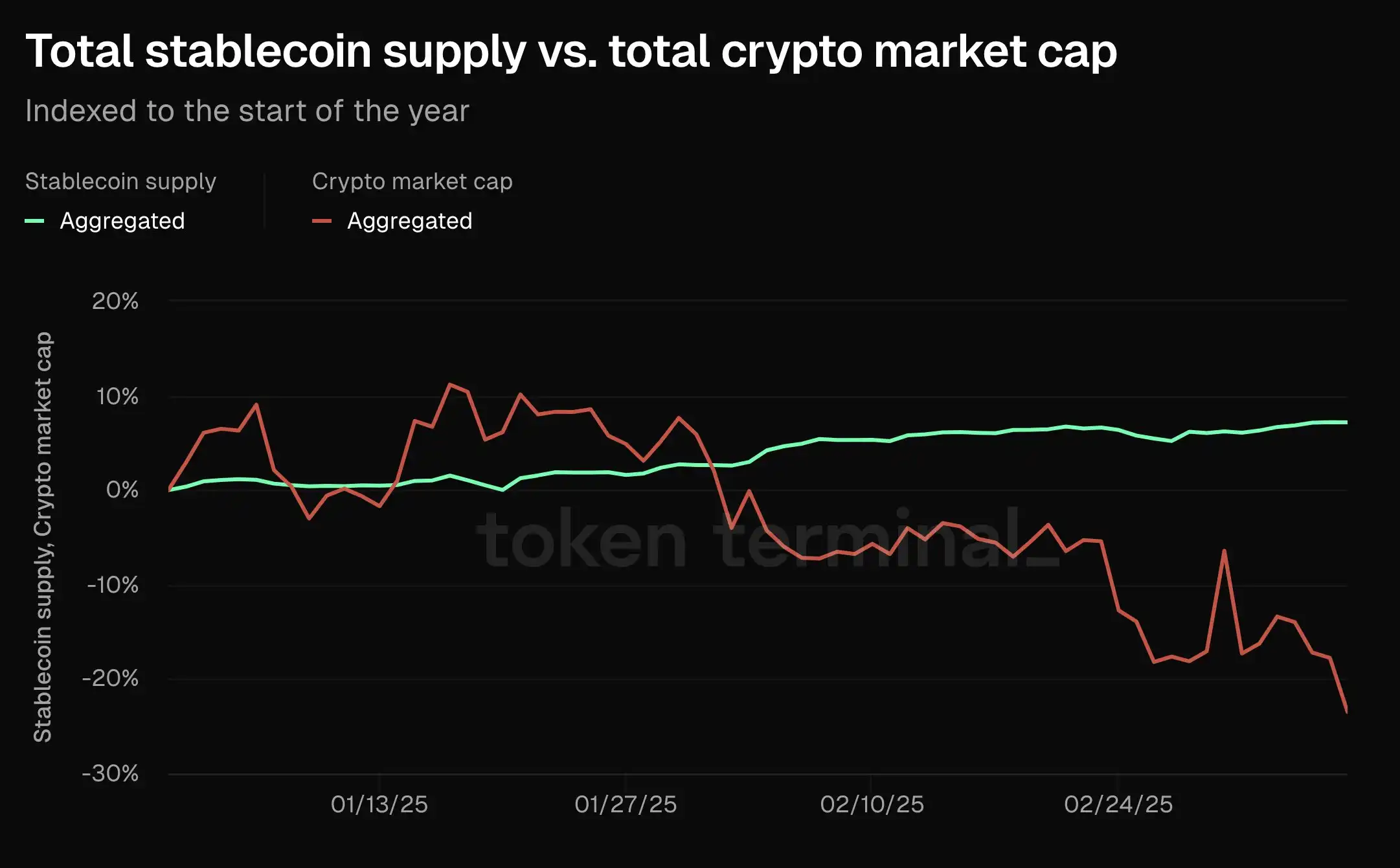
As the market value of stablecoins hits a historical high, Frax Finance co-founder Sam tweeted that a bear market is a bull market for stablecoins. He said, "Another way to describe a price drop is a rise in the value of the U.S. dollar. In these environments, on-chain dollar issuers will receive the most benefits, especially as favorable regulation is imminent."
Recently, CryptoQuant CEO Ki Young Ju also wrote an analysis stating that the capital flow cycle of past altcoin seasons is outdated. "The rotation of crypto assets dominated by Bitcoin has essentially ended under the drive of regulation and institutional adoption. New capital will flow through stablecoins or widely adopted altcoins — a scenario completely different from traditional altcoin seasons."
Against the backdrop of cryptocurrency assets and U.S. stocks trending downward and under pressure, stablecoins rising against the trend to consolidate the dominance of the U.S. dollar may have become the biggest winner in the recent market turmoil.
Regulatory Easing
On February 27, U.S. crypto-friendly Senator Cynthia Lummis stated at the first hearing of the Senate Banking Subcommittee on Digital Assets that "we are about to develop a bipartisan legislative framework for stablecoins and market structure."
At a White House inaugural crypto summit last Friday with little news coverage, Trump expressed his hope to receive a stablecoin legislative bill before the August congressional recess to advance federal government regulatory reform of cryptocurrency and reiterated his wish for the dollar to "remain dominant in the long run."

U.S. Treasury Secretary Scott Bessent pledged to strengthen the global reserve currency status of the dollar using digital assets, stating, "We will deeply consider the stablecoin system. As President Trump has directed, we will maintain the U.S. as the world's leading reserve currency and will use stablecoins to achieve that."
This statement highlights the U.S. government's concerns about macroeconomic and geopolitical uncertainties, which may lead to decreased demand from foreign investors for U.S. bonds, thereby pushing up bond yields. In the past year, the top two holders of U.S. debt, Japan and China, have continued to reduce their holdings. To maintain the global reserve currency status of the dollar, it is necessary to ensure a sustained demand for U.S. bonds in the international market.
By holding US Treasury bonds as reserve assets, stablecoins can help lower bond yields and simultaneously expand the global circulation of the US dollar. Stablecoins need to hold sufficient reserves in US dollars to meet investor redemption demands, with Tether currently being one of the largest holders of three-month US Treasury bonds.
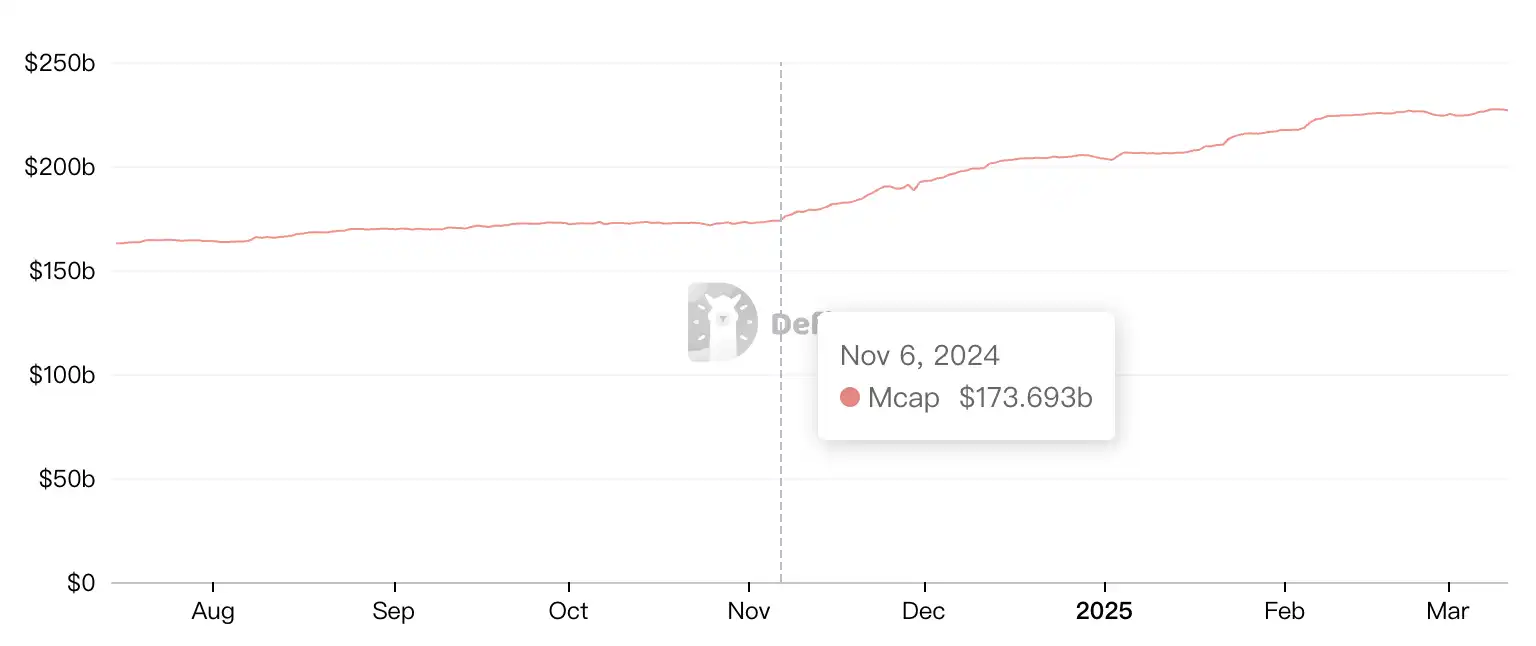
The total market value of stablecoins has surged by $500 billion since Trump's election; Source: DeFiLlama
On a policy level, the US has proposed two stablecoin bills—the House's \"Stablecoin Tethering and Bank Licensing Enforcement (STABLE) Act\" and the Senate's \"Guaranteeing Easy Access to Nurturing Investment in Stablecoins (GENIUS) Act\"—aimed at regulating stablecoin issuers through licensing requirements, risk management rules, and 1:1 reserve backing.
These two bills present different frameworks but converge on stringent compliance measures. Both support private, USD-backed stablecoins and prohibit central bank digital currencies (CBDCs).
Key differences include:
· Regulatory oversight (GENIUS allows states to regulate issuers until the market value reaches $10 billion; STABLE allows opting out of federal oversight if state-level rules meet the criteria)
· Reserve requirements (STABLE allows the use of Treasury bonds, bank deposits, and central bank reserves, while GENIUS also includes money market funds and reverse repurchase agreements)
· Consumer protection (GENIUS focuses on transparency and enforcement, while STABLE requires a one-to-one reserve and prohibits algorithmic stablecoins)
Stricter regulations could challenge Tether's dominant position, as both bills mandate monthly audits, asset segregation, and strict reporting, potentially forcing exchanges to delist non-compliant stablecoins, similar to the impact of the EU's MiCA. These laws would also pave the way for the legalization of stablecoins, attracting institutional adoption while creating barriers for less transparent issuers. If passed, they would provide clear guidelines for stablecoin issuers, ensuring market stability and compliance.
This morning, FOX Business reporter Eleanor Terrett posted on social media, saying, \"As far as I know, an updated version of US Republican Senator Bill Hagerty's stablecoin bill—the GENIUS Act—is set to be released tonight (local time). As of this morning, the US Senate Banking Committee still plans to mark up the bill on Thursday.\"
The new version of the document extends the mutual clause for overseas payment stablecoins, adding reserve requirements, regulation, anti-money laundering and counter-terrorism measures, sanctions compliance, liquidity requirements, and risk management standards, aiming to promote international transactions and achieve interoperability with overseas USD-priced payment stablecoins.
Stablecoin FOMO Wave is Coming, What Are the Future Opportunities?
Against the backdrop of Trump's explicit statement hoping to clarify stablecoin-related legislation by August, efforts have been made by countries including Japan, Thailand, and U.S. government departments for stablecoin adoption.
On March 10, the Thai Securities and Exchange Commission has designated stablecoins USDT and USDC as compliant cryptocurrencies. This approval means that USDT and USDC can be legally traded in Thailand, paving the way for the listing of stablecoins on regulated trading platforms in Thailand, and also laying the foundation for the widespread application of USDT and USDC in the Thai payment field.
On the same day, the Japanese Cabinet announced approval of a proposal to reform laws related to cryptocurrency brokers and stablecoins. According to the announcement by the Financial Services Agency (FSA) of Japan, the government has approved a cabinet resolution to amend the Payment Services Act. This legislation will allow crypto companies to operate as "intermediary businesses." This means brokers will no longer need to apply for the same type of license as cryptocurrency exchanges and wallet operators. The bill also provides more flexibility for stablecoin issuers in terms of the asset types supporting their tokens.
According to the Financial Times, some of the world's largest banks and fintech companies are eager to launch their stablecoins, aiming to capture the cross-border payment market share they expect to be reshaped by cryptocurrencies.
Last month, Bank of America stated its intention to issue its own stablecoin, joining established payment providers such as Standard Chartered, PayPal, Revolut, and Stripe in the race to compete with cryptocurrency groups led by Tether and Circle.
This shift comes six years after regulatory agencies strongly opposed Meta's Libra stablecoin, and it has received further support from U.S. President Trump endorsing cryptocurrency. "It's like selling shovels in a gold rush of stablecoins," said Simon Taylor, co-founder of the fintech consultancy 11:FS, likening it to FOMO.
In addition to Bank of America, other major Traditional Finance (TradFi) players are also gearing up for the development of stablecoins.
- Standard Chartered Bank: Advancing the Hong Kong Dollar stablecoin project
· PayPal: Plans to Expand the Issuance of PYUSD by 2025
· Stripe: Acquires Bridge Stablecoin Platform for $1.1 Billion
· Revolut: Exploring the Possibility of Issuing a Stablecoin
· Visa: Using Stablecoins for Payments and Global Business
Prior to this, the increase in stablecoin supply has often driven up cryptocurrency prices, as these tokens are primarily used as short-term holding instruments for transactional purposes. Now, the application of stablecoins is breaking through the realm of speculation—SpaceX uses stablecoins for refunds in Argentina and Nigeria through its Starlink service; ScaleAI uses them to pay overseas contractor wages.
The most direct trading opportunity lies in betting on which mainstream institutions will choose which public blockchains to issue new stablecoins on. Currently, Ethereum, Base, Tron, and Solana are the main alternative public blockchains. On February 26, Jesse Pollak, the head of the Base protocol, stated that this year they plan to launch a stablecoin for all global currencies on Base.
It is clear that both the on-chain world and traditional finance are strategizing around U.S. and USD-backed stablecoins. As for the altseason, it may be as CryptoQuant's CEO said—the capital flow cycle of past altseasons is outdated.
You may also like

Dialogue with OmenX Founder: Why does the prediction market need an evolution from "spot" to "derivatives"?

When the P2P illicit funds from ten years ago turned into 60,000 bitcoins

Morning News | CME Group launches Nasdaq Cryptocurrency Index futures; Asset management giant Janus Henderson strategically invests in Ethena

Why did Oracle deliver the strongest financial report in history, yet its stock price fell?

Bitcoin Layer 2 Network Botanix: Why Did We Choose to Dissolve?

Morning Report | OpenAI has submitted an S-1 registration statement draft to the U.S. SEC; Morpho completes $175 million financing

Galaxy Deep Research Report: How Hyperliquid's HIP-4 Upgrade Changes the Landscape of Prediction Markets?

Latest research from 13 top universities including Cornell University: The current state, challenges, and misconceptions of the fusion of Crypto and AI
Deconstructing Anthropic: The Best AI Company, Possibly Also a Type of Organizational Invention

Every exchange is a "Universal Exchange."

The counterattack of traditional finance: Alliance chains are quietly reviving
Pantera Capital Partner: How Tokenization is Restructuring the Private Equity and Early Investment Ecosystem?

Mastercard Launches Agent Pay for AI, Plans to Record AI Agent Payment Authorizations on Polygon
Mastercard launched Agent Pay for AI, a new payment protocol designed to help AI agents make small payments such as pay-per-use access to data and APIs. The system plans to record human-granted AI agent permissions on Polygon, focusing on verifiable authorization, identity, and payment controls.

Curve Deploys Llamalend v2 on Optimism With 250,000 OP Incentives
Curve launched Llamalend v2 on Optimism with 250,000 OP incentives from the Optimism Foundation. The upgrade expands Llamalend beyond its earlier crvUSD-focused model, adding broader collateral support, LlamaRisk market reviews, and the ability to use Curve LP tokens as collateral.

Raydium Old Liquidity Pool Reportedly Exploited, With $1.34 Million Moved to Ethereum and Tornado Cash
An old Raydium liquidity pool was reportedly exploited for around $1.34 million in USDC, RAY, and wSOL, with the stolen funds bridged to Ethereum and deposited into Tornado Cash. The incident highlights the tail risks of legacy DeFi pools, old contracts, and cross-chain fund laundering paths.
Kalshi Executive Challenges “SBF Backed AI Unicorns” Narrative, Says Leopold Aschenbrenner Was Key Figure
Kalshi executive John Wang questioned the “SBF backed AI unicorns” narrative, saying Leopold Aschenbrenner was the key figure behind major AI investment decisions.

New York Proposes Stricter Stablecoin Issuer Rules Aligned With Federal GENIUS Act
NYDFS proposed stricter stablecoin issuer rules aligned with the GENIUS Act, covering reserves, custody, redemption timelines, audits, and capital buffers.

CryptoQuant Says Bitcoin Profitable Supply Is Near 45% Pressure Zone as On-Chain Data Points to Market Repricing
CryptoQuant said Bitcoin’s profitable supply is nearing the 45% pressure zone, signaling rising market stress, unrealized losses, and a possible on-chain repricing phase.
Dialogue with OmenX Founder: Why does the prediction market need an evolution from "spot" to "derivatives"?
When the P2P illicit funds from ten years ago turned into 60,000 bitcoins
Morning News | CME Group launches Nasdaq Cryptocurrency Index futures; Asset management giant Janus Henderson strategically invests in Ethena
Why did Oracle deliver the strongest financial report in history, yet its stock price fell?
Bitcoin Layer 2 Network Botanix: Why Did We Choose to Dissolve?
Morning Report | OpenAI has submitted an S-1 registration statement draft to the U.S. SEC; Morpho completes $175 million financing


