
Yen Weakness Nears Inflation Red Line: Bank of Japan May Be Forced to Hike Early


Original Title: "Yen's Sharp Drop Forces Central Bank to Consider Early Rate Hike? Report: Officials More Concerned About Weak Exchange Rate's Impact on Inflation"
Original Author: Yeh Huiwen, Wall Street News
Bank of Japan officials are increasingly focused on the potential impact of the weak yen on inflation, a trend that could substantially disrupt the future rate hike path. According to sources familiar with the matter speaking to Bloomberg, while the Bank of Japan may keep rates unchanged at the upcoming policy meeting, exchange rate considerations may prompt a reevaluation of the timing of the rate hike, potentially even forcing an earlier action.
According to Bloomberg, Bank of Japan officials believe that the influence of the weak yen on prices is strengthening, especially as companies are increasingly inclined to pass on rising input costs to consumers, leading to further inflationary pressures. Despite the Bank of Japan having just raised its benchmark rate last month and not set a predetermined rate path, if the yen continues to weaken, policymakers may consider bringing forward the previously anticipated rate hike.
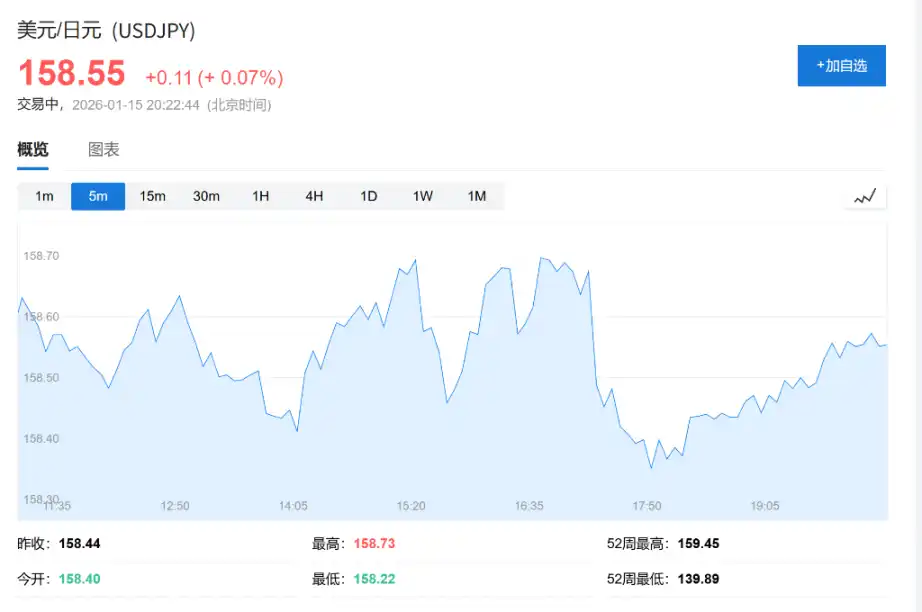
Currently, the general expectation among private economists is that the Bank of Japan will raise rates at a pace of approximately once every six months, implying that the next action could take place in the summer of this year. However, sources speaking to Bloomberg indicated that officials are inclined to act promptly on policy adjustments rather than being overly cautious, indicating variability in the market's previously expected rate hike pace. In response to this news, the yen to dollar exchange rate briefly dropped to around 158.68 before rebounding to 158.33. As of the time of writing, the yen against the dollar had fallen to 158.55.
January Meeting Expectation: Maintain Rates
The Bank of Japan is set to announce its latest policy decision on January 23. Sources familiar with the matter told the media that officials' current view is that keeping the rate at 0.75% is appropriate, a level that has reached a three-decade high. While the overall inclination is to hold steady, the committee will continue to monitor economic data and changes in the financial markets until the last moment to make the final decision.
The focus of this meeting will be on how the central bank assesses the yen's impact on potential inflation. Sources told Bloomberg that given the inflation trend is nearing the central bank's 2% target, officials will closely watch how exchange rate fluctuations alter household and business price expectations.
Exchange Rate Transmission Mechanism in Focus
A yen devaluation typically increases inflationary pressure by raising import costs and also boosts exporters' profits. However, some officials pointed out that as the yen continues to weaken, its negative impact on the economy may be growing. Officials believe that the Bank of Japan still has room to continue raising rates, with the key being to seize the timing of policy adjustments.
The voice of the Japanese business community on the exchange rate issue is also becoming increasingly frequent. Yoshinobu Tsutsui, President of Keidanren, Japan's largest business lobbying group, made rare comments this week, calling on the government to conduct currency intervention to prevent excessive depreciation of the yen, describing the recent yen trend as "a bit overdone."
Market Background and Political Factors
Despite the Bank of Japan raising interest rates on December 19, the yen continues to maintain a weak position against the US dollar. Influenced by the news that Prime Minister Takaichi Sanae will hold a snap election next month, the yen slid further this week to a new 18-month low.
Bloomberg data shows that the 10-year average exchange rate of the yen against the US dollar is 123.20, while over the past two years, the yen's exchange rate has fluctuated between approximately 140 and 161.95. Although it touched an 18-month low earlier this week and saw a slight rebound with intensified warnings from monetary authorities, the overall depreciation trend continues to exert sustained pressure on the central bank's decisions.
You may also like

'Bottom building in progress': Analysts say bitcoin holder capitulation signals late-stage bear market
A Comprehensive Analysis: Starting from 1996, Who is Laying the Foundation for the Next Generation of Capital Markets
Luke Dashjr, the Biggest Anti-Spammer of Bitcoin, Inscribed Phrases on the Network in 2011
Whales bought 270,000 BTC while ETFs bled $7 billion. One side is wrong
The crypto IPO class of 2025-26 is down as much as 89%. Autopsy of a listing boom
Robinhood Chain Mining Guide: A Comprehensive Tutorial from Cross-Chain to Memecoin
BitGo CEO says single-digit percentages of bitcoin's supply are 'probably right' for large holders amid Strategy's sale
Beyond Private Keys: How to Safeguard the Security Boundaries of Web3 from Wallets, L2 to Supply Chains?
Vanguard Enters the Market, Opening a New Crypto Gateway for 50 Million Traditional Investors
Why the OUSD Alliance of 150 Companies Still Cannot Shake USDT and USDC?
Citigroup Analysis: Is There Still 47% Upside for Nvidia? Can Rubin and CPO Deliver?
WEEX API Fast Connect: Turn Every Sign-In Into a Live Trader in Under 10 Seconds
WEEX API Fast Connect is a one-click OAuth authorization system that lets your users link their WEEX account without ever touching an API key. Frictionless onboarding, faster conversions, higher retention — built for WEEX Broker partners.
Bitcoin's dwindling exchange reserves don't pack the same bullish punch anymore
From Le Mans to the Rollercoaster: Carl Moon Takes On Portimão
Crypto world renowned KOL and racing driver Carl Moon, backed by WEEX, heads to the Ferrari Challenge Portugal round at the Algarve International Circuit, July 16–19, fresh off a podium finish at Le Mans. Here's why this race is one to watch.
Fast execution. Split-second accuracy. Security that never blinks. That's WEEX — and that's exactly how Carl races.
The Downfall of a Public Company: A $1.46 Billion Bet on WLFI, $540 Million Went to the Trump Family
Dragonfly Partner: BTC is Intergenerational Wealth, Optimistic About ETH and SOL
Goldman Sachs Calls to Go Long on Chinese AI: $4 Trillion Market Value Behind, Global Funds Only Allocated 1.2%
The New Landscape of Cryptocurrency in Europe: Why Germany Takes Center Stage?
'Bottom building in progress': Analysts say bitcoin holder capitulation signals late-stage bear market
A Comprehensive Analysis: Starting from 1996, Who is Laying the Foundation for the Next Generation of Capital Markets
Luke Dashjr, the Biggest Anti-Spammer of Bitcoin, Inscribed Phrases on the Network in 2011
Whales bought 270,000 BTC while ETFs bled $7 billion. One side is wrong
The crypto IPO class of 2025-26 is down as much as 89%. Autopsy of a listing boom
Robinhood Chain Mining Guide: A Comprehensive Tutorial from Cross-Chain to Memecoin